
Commercial Solar NZ: Real Costs, Payback & Tax (2026)
Investment Boost, GST, depreciation, the five bank green loans, and the maths on a 30 kW system.
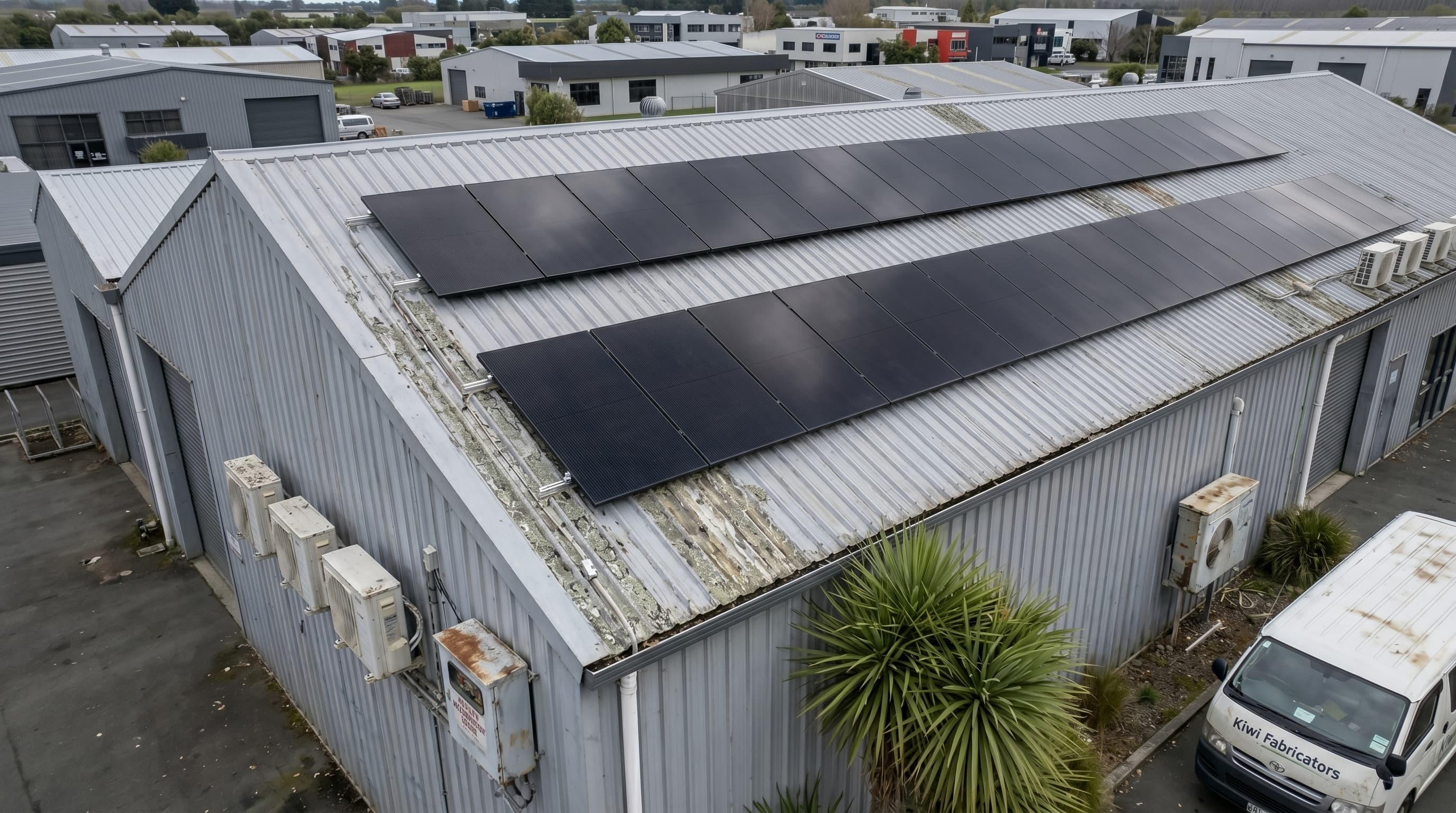

The maths on commercial solar in New Zealand changed in 2025. Investment Boost landed on 22 May with a 20% upfront tax deduction. The building-consent exemption extended to non-residential roofs on 23 October. The EWRB Mains Parallel Generation endorsement deadline got pushed out to 1 September 2026. And NZGIF wound down, leaving the operative finance stack as the five major bank green loans plus the tax code. Four moving parts, four levers, all on the same year.
Most NZ commercial roofs were already a better solar bet than the houses underneath them. Business sites use 60-90% of what they generate during the day instead of 30-50%. They reclaim GST. They depreciate the asset against taxable income. Now they get a 20% deduction up front too. The lifetime maths on a 30 kW system at a high daytime-load site has moved from “pays back eventually” to “pays back in four to seven years.”
This is the honest commercial guide. Real installed costs from EECA and named NZ installers, the four 2025 tax changes laid out side by side, the five bank green loans most NZ businesses can access, two case studies you can independently verify, and the parts the industry doesn’t put on the front page.
PS Solar Scout connects you with up to 3 vetted commercial-capable installers so you can compare quotes. Every one is EWRB registered and a member of SEANZ or Master Electricians. A vetted shortlist, not every company in town. Compare up to 3 quotes. Takes 2 minutes.
Key takeaways
- Commercial solar pays back faster than residential because business sites self-consume 60-90% of generation versus 30-50% for homes. Self-consumption is the hero number.
- The four 2025 changes: Investment Boost (20% upfront deduction from 22 May 2025), non-residential building-consent exemption under 40 m² (from 23 October 2025), EWRB Mains Parallel Generation endorsement now mandatory 1 September 2026, and NZGIF in wind-down.
- Typical 2026 installed price band: $1,400 to $2,000 per kW. A 30 kW system is $45k to $60k. A 100 kW system is $140k to $200k.
- GST is fully reclaimable for GST-registered businesses where the system powers a taxable activity. Depreciation runs at 16% diminishing value under IR265.
- Realistic 2026 paybackat a high-self-consumption site is 4 to 7 years. EECA’s pre-Investment-Boost 2021 IRR range of 0.4-8.6% is the conservative baseline.
The four 2025 changes that reset the maths
No NZ competitor page integrates all four. Each one is dated, each one is sourced.
1. Investment Boost (22 May 2025)
Announced in Budget 2025. Lets businesses immediately deduct 20% of the cost of an eligible new asset in the year of purchase, then depreciate the remaining 80% under normal rules. No cap. A $100,000 commercial solar install gives a $20,000 upfront deduction worth ~$5,600 in tax saved at the 28% company rate, then the remaining $80,000 depreciates at 16% diminishing value. Source: IRD Investment Boost.
2. Building-consent exemption extended to non-residential (23 October 2025)
The Building (Exempt Roof-mounted Solar Panel Arrays and Building Work) Order 2025 removed the building-consent requirement for rooftop solar arrays under 40 m² on non-residential buildings. Most NZ commercial roofs sit under 40 m² of panel area. Arrays above 40 m² still don’t need consent, but the structural fixings need to be reviewed by a Chartered Professional Engineer. Source: Building Performance.
3. EWRB Mains Parallel Generation endorsement (deadline 1 September 2026)
From 1 September 2026, electricians installing or certifying grid-connected solar or battery systems must hold the Endorsed Mains Parallel Generation Systems registration. The 2025 Registration Notice extended the transition window from the original 1 September 2025 date. Source: EWRB 2025 Registration Notice.
4. NZGIF in wind-down (announced 8 April 2025)
NZ Green Investment Finance is in a phased wind-down. Existing facilities (e.g. the Sunergise $10m commercial-solar lending facility) continue under transition; new public-sector green capital is closed. The operative commercial finance stack is now the five bank green loans plus the tax code. Source: RNZ.
Investment Boost plus the GST reclaim plus the existing depreciation already moves a $100,000 system’s effective first-year cost down by about $24,500 before a single kWh gets used.
The maths on a 30 kW commercial system
Generic Auckland or Christchurch SME with high daytime load. Warehouse plus light office, GST-registered, 28% company tax rate. 30 kW rooftop array, 70 panels at ~430W, single-storey metal roof, north-facing, no shading.
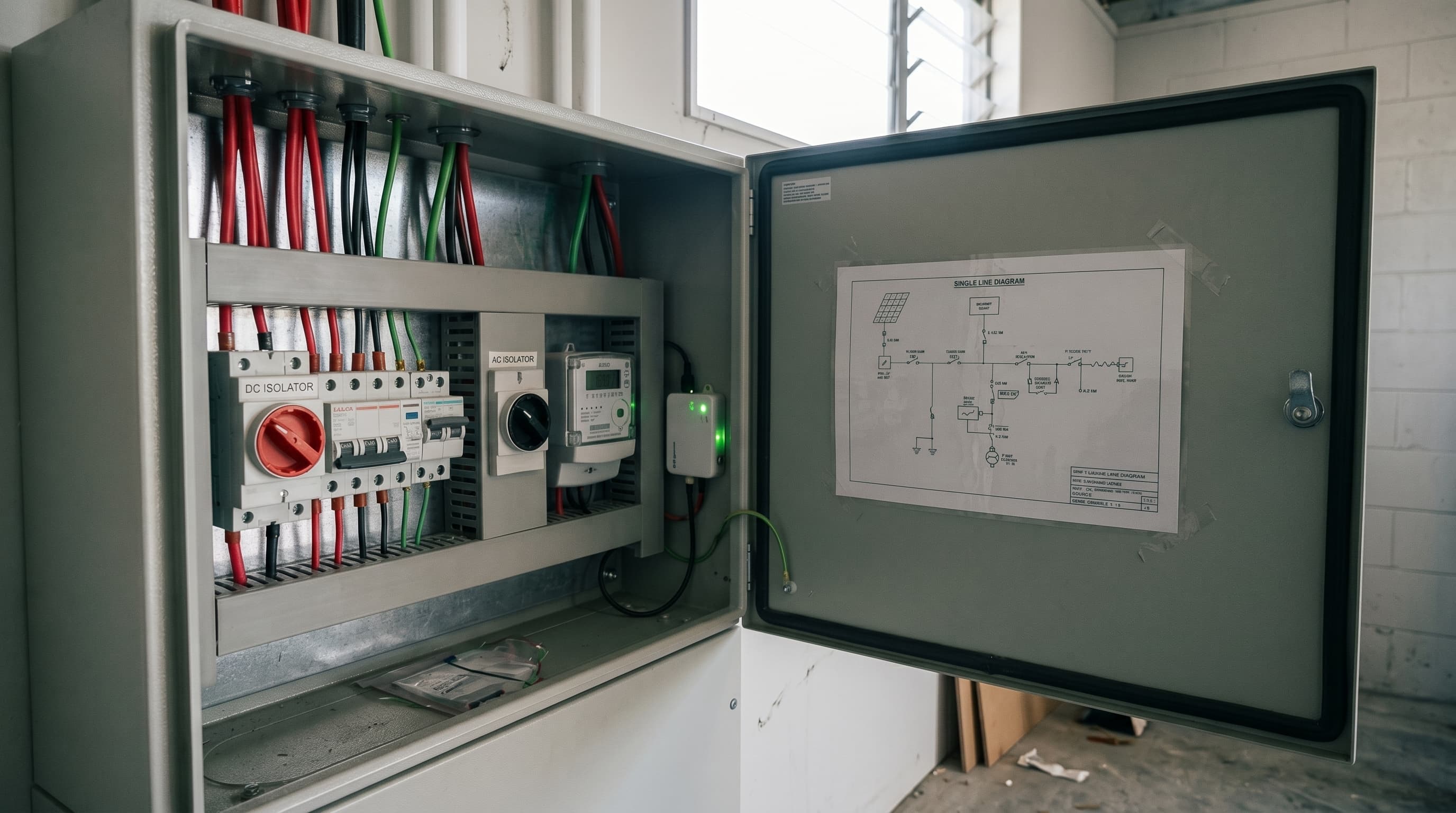
This is a worked example, not a quote. Six variables move it materially: roof aspect, shading, exact import tariff, the retailer’s commercial export rate, the lines-company DG limit, and how much load actually falls inside 9 am to 4 pm. The maths is shown so any business can run their own version.
A residential install at the same price point pays back in 6 to 10 years because half the generation gets exported at 10–13 c/kWh. A commercial install at a high daytime load site keeps the 30c per unit instead.
The four tax levers explained
Four levers, all sitting in the IRD’s own published guidance. Confirm the specifics of your situation with your accountant before you commit to an installer.
Lever 1. GST input credit (reclaim the GST on the install)
A GST-registered business claims the full GST input credit on the cost of a commercial solar install to the extent the asset is used in the business’s taxable activity. On a $52,500 inclusive quote, that’s $6,848 reclaimed in the next GST return. Source: IRD GST guide IR375.
Lever 2. Depreciation at 16% diminishing value (IR265)
The general depreciation rate for solar PV under IR265 (March 2026 edition) is 16% diminishing value, sitting under the “Power generation and electrical reticulation systems” industry category. Implied useful life of ~12.5 years for IR purposes, separate from the manufacturer’s 25-30 year performance warranty. Source: IR265 March 2026.
Lever 3. Investment Boost 20% upfront deduction (from 22 May 2025)
Deduct 20% of the cost of the new asset in the year of purchase. No cap on dollar value. The remaining 80% depreciates under the normal 16% DV rate. Solar PV is an eligible new depreciable business asset. Source: IRD Investment Boost.
Lever 4. Battery storage under PROV28 (13% DV)
For modular battery energy storage systems, IRD’s Determination PROV28 (4 February 2026) sets a separate 13% diminishing value, 8.5% straight line, 15.5-year useful life. PROV28’s scope formally covers “modular battery energy storage systems used by the power generation industry and national grid distribution networks.” A behind-the-meter commercial battery needs an accountant to confirm whether PROV28 applies or whether the battery sits under the general solar-PV class. Source: IRD PROV28.
Tax rules bed in over years, not weeks. Confirm Investment Boost eligibility, PROV28 application, and depreciation treatment with your accountant before you commit to an installer. Most of the major NZ chartered accounting firms have already published 2025 Investment Boost briefings for their commercial clients.
What commercial solar actually costs in NZ
EECA’s published reference range is $1,500 to $2,000 per kW installed. Worked examples cite ~$20,000 for a 10 kW system and ~$150,000 for a 100 kW system. Industry pricing in 2026 clusters slightly lower at $1,400 to $1,800 per kW for typical commercial rooftop installs from named NZ installers (Apollo, Sunergise, MySolarQuotes commercial data, VoltFlow, SolarPath).
Commercial wins on per-watt cost. NZ residential systems cluster around $1,700 to $2,300 per kW. The fixed setup costs (scaffolding, mobilisation, electrical mobilisation, DG application) spread across more panels.
Why daytime load makes or breaks the maths
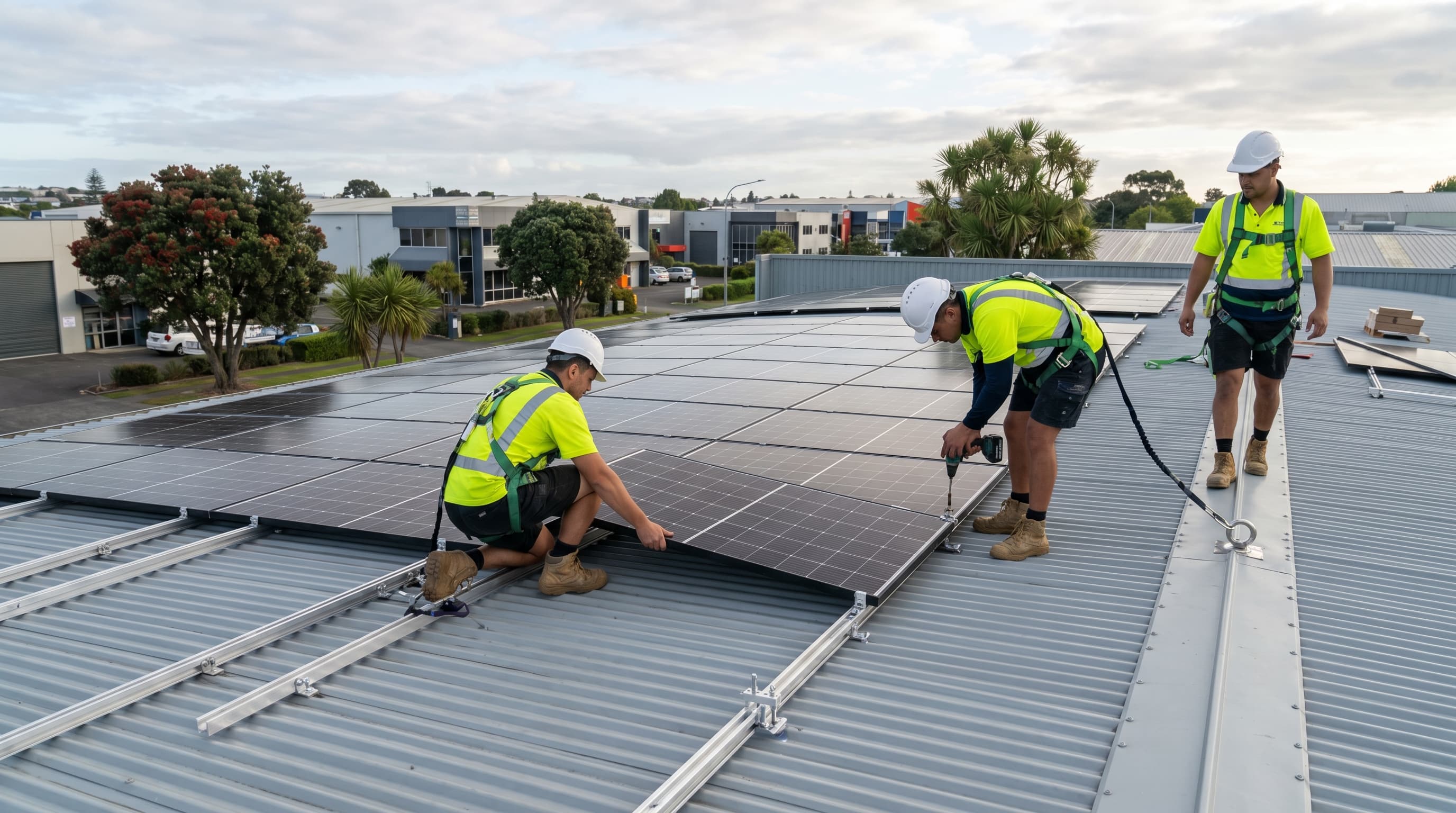
The single biggest reason commercial solar maths beats residential maths: business sites use what they generate while it’s generating. EECA and multiple industry sources put commercial self-consumption at 60-90%, often above 85% for standard 8 am to 5 pm operations.
The 30-40 percentage-point gap versus residential is everything. Self-consumed power saves the import price (~30 c/kWh). Exported power earns 8-17 c/kWh if there’s a published rate, less if the site is classified Commercial & Industrial or Time-of-Use and credited at wholesale spot.

Sites where the maths usually works
- Manufacturers and packhouses with daytime production runs
- Retail and supermarkets with peak daytime trading
- Warehousing and 3PL with daytime pick-and-pack activity
- Vineyards, dairies (parlour load), light industrial
- Schools and kindergartens (caveat: summer break is a weak point)
- Refrigeration-heavy operations
Sites where it's marginal
- 24-hour motels with overnight occupancy load
- Pure office sites with most consumption in overnight heating/cooling
- Seasonal operations where peak load is months when sun is weakest
- Sites where the daytime load profile doesn’t match peak solar
Solar pays a business back fastest at the sites you’d least expect to think about solar. The boring warehouse on the industrial estate beats the architectural office in town nine times out of ten.
power bill?$3,000
The five business green loans NZ banks offer
Five NZ banks have a green-loan product covering commercial solar PV. One publishes a basis-point discount. Four are negotiated per credit application. Commercial green-loan transparency is materially worse than residential.
- Margin discount off Westpac's standard loan margin
- Only NZ bank publishing a basis-point figure for a commercial green loan
- Loan size
- Standard sizing
- Term
- Standard

- Special Purpose Base Rate (discounted variable)
- Specific discount not on the public rate card
- Loan size
- $25k – $2m
- Term
- Standard term loan

- Special floating rate. ANZ does not publish the figure, so ask
- No approval fee on first $3m
- Loan size
- $5k – $3m
- Term
- Up to 5 yrs

- Discounted margin negotiated per credit application
- Eligibility checked per application against BNZ's green criteria
- Loan size
- Typically $1m+
- Term
- Standard

- Preferential rate set per credit application
- B-Corp certified businesses get further preferential pricing
- Loan size
- Subject to security
- Term
- 6 mo – 5 yrs fixed
Terms checked September 2026. Banks change these often, so confirm the current rate and conditions with the bank before you apply.
All five products require evidence the project delivers environmental benefit. Ask each bank what it needs from your installer. On the home-loan side, only ANZ and Kiwibank insist on a SEANZ member.
If a business pays cash, the only cost of capital is opportunity cost. If a business pays with a 0.20% discounted floating loan from Westpac, the cost of capital today is close to zero net of the tax shield. Either way, the maths still works.
Why bank and buy-back rates aren't published for commercial
Two transparency gaps a commercial buyer runs into.
Bank green-loan rates
Only Westpac publishes a basis-point discount (0.20% off margin). ANZ, ASB, BNZ, and Kiwibank price commercial green loans per credit application. There’s no public rate card. A small business shopping rates has to enquire individually with each bank’s business banking team.
Retailer commercial export rates
Most NZ retailers publish residential buy-back rates only. Commercial sites get caught by three patterns:
- System-size caps. Contact caps published export at 10 kW. Frank caps at 50 kW. Genesis publishes a 50 kWh residential cap.
- C&I or TOU classification.Sites large enough to be classified Commercial & Industrial or Time-of-Use are typically credited at wholesale spot price rather than a fixed export rate. Meridian explicitly splits NHH (12 c/kWh excl. GST) from C&I and TOU (wholesale spot).
- Enquire-only. Mercury, Electric Kiwi, Powershop, Octopus Energy NZ, Nova Energy all require commercial customers to negotiate directly. No published commercial rate card.
The honest budgeting rule: don’t budget a 30 kW commercial system on a published 17 c/kWh export rate. Assume the export rate sits in the 8 to 13 c/kWh band on a negotiated commercial contract, or wholesale spot if classified C&I or TOU. The hero number for commercial economics is self-consumption (60-90%), not export.
PPA vs ownership
Two ways a NZ business funds a commercial solar install.
Ownership (capex, with the bank's help)
Business buys the system. Pays cash or borrows via one of the five bank green loans. Owns the panels and inverter from day one. Reclaims the GST. Depreciates the asset. Claims Investment Boost. Keeps 100% of generated value (self-consumed plus exported).
Power Purchase Agreement (PPA)
Vendor designs, finances, installs, and maintains the system on the customer’s roof. Business pays for solar power consumed at a fixed $/kWh, usually over 15-20 years. The vendor owns the hardware until the agreement ends.
NZ example: Sudima Hotels Auckland Airport ran a 125 kW PPA with Sunergise from 2022. Solar electricity at ~30% below grid import price. 20-year fixed solar rate. ~115,000 kWh/yr.
A cautionary note on long contracts.SolarZero Limited entered liquidation on 26 November 2024. SolarZero ran a residential subscription model (not commercial), but the lesson generalises: long-duration solar contracts can be assigned to a new servicer with changed conditions on the original company’s failure. Have a lawyer review the assignment, performance-guarantee, and buy-out clauses of any commercial PPA before signing. Full context at solar scams in NZ.
Consent, connection, and standards
1. Building consent
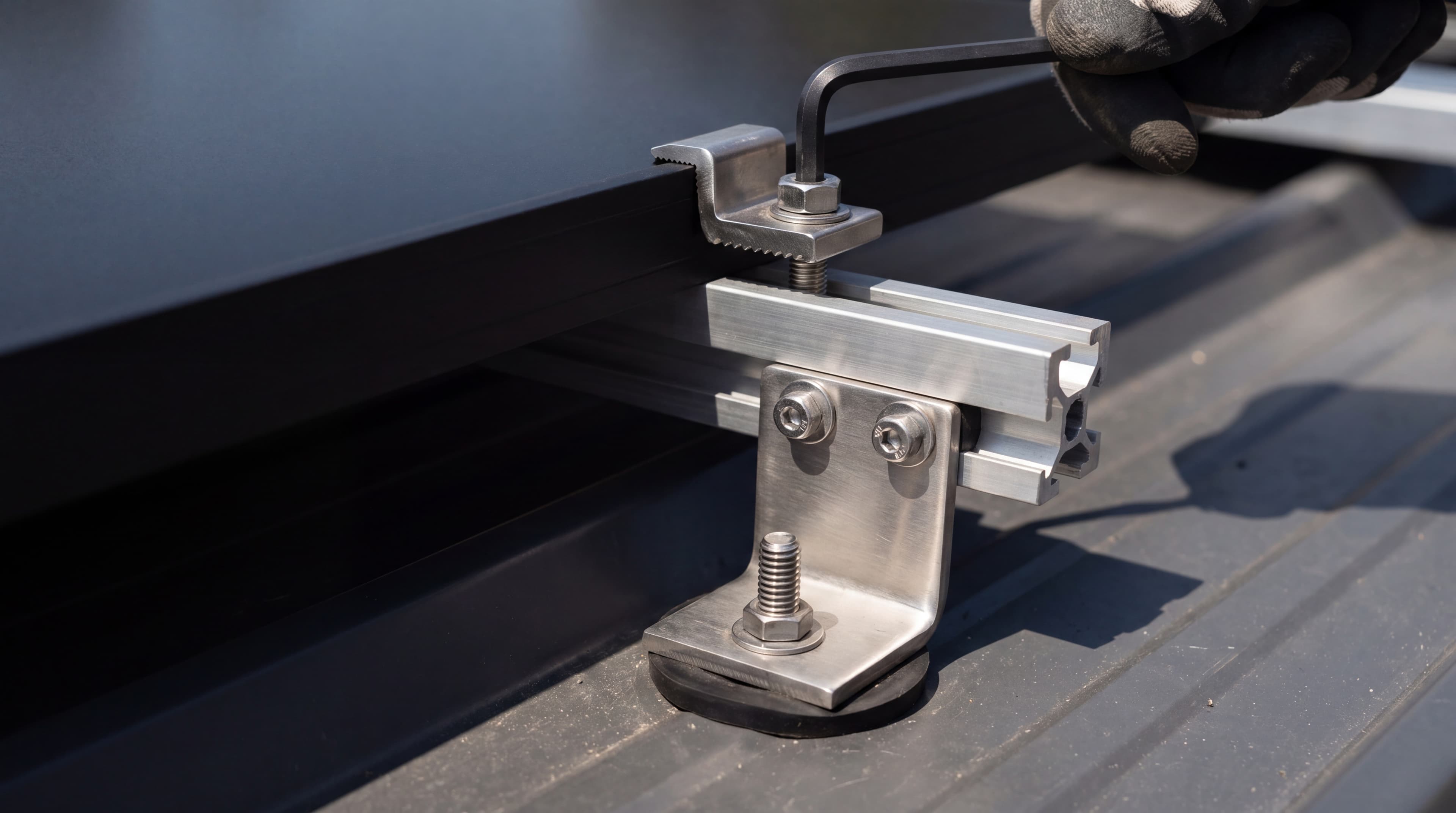
From 23 October 2025, rooftop solar arrays under 40 m² on non-residential buildings are exempt from building consent. Arrays over 40 m² still don’t need consent but the structural fixings need to be reviewed by a Chartered Professional Engineer (CPEng). Building Code and District Plan obligations still apply.
2. Distributed Generation application
The 10 kW threshold is the dividing line across NZ lines companies between standard residential-style applications and formal commercial DG processes. Vector, Powerco, Aurora Energy, and the Electricity Authority all use 10 kW. Above 10 kW, the lines company runs an individual export-limit assessment. Export-limited inverters cap exported power below installed capacity for sites that would otherwise be rejected.
3. Standards in force
AS/NZS 5033:2021 (PV installation and safety, mandatory since 19 May 2022), AS/NZS 4777.1 and AS/NZS 4777.2:2020 (grid connection and inverter requirements, must be read with the local lines company’s technical connection rules), AS/NZS 3000 (Wiring Rules, applies in full).
4. EWRB Mains Parallel Generation endorsement
From 1 September 2026, electricians installing or certifying grid-connected solar or battery systems must hold the endorsed registration. Confirm any prospective installer has the endorsement or is on a clear path to it.
“No consent required” does not mean “no engineering required.” A 60 kW rooftop array sits on the same fixings as a 6 kW one, only there are ten times as many of them.
What EECA's published research shows
EECA has published commercial-solar economics from real NZ installations going back to 2021. We’re not going to claim anyone else’s install as our case study. The numbers below are the ones EECA puts in the public domain, and they tell the same story as the worked example above.
- Typical commercial payback:EECA’s 2021 research showed IRRs ranging from 0.4% (a retail site in Dunedin) to 8.6% (a manufacturing site in Auckland), with simple paybacks around 7 years for a well-designed mid-sized office array. These are pre-Investment-Boost figures; the same installs run faster paybacks in 2026.
- Self-consumption coverage:EECA’s published case material shows mid-sized rooftop arrays typically covering 30 to 50%of a commercial building’s common-area electricity (HVAC, lifts, lighting), with the share rising sharply for tenant occupants with daytime load.
- PPA economics:EECA’s published material on commercial PPAs (no upfront capital, vendor owns hardware) shows solar electricity delivered at ~30% below grid import price on a 20-year fixed rate, on a 125 kW rooftop install in the hotel sector. The contract structure is sound when the contract drafting is tight.
Source: EECA Commercial-scale solar in New Zealand and EECA: Rooftop solar with no upfront investment.
What we'd do if it were our money

- Get three itemised quotes. Panels, inverter, racking, cabling, install labour, monitoring, DG application, GST shown separately. Cap deposit at 10 to 20%.
- Specific model numbers in writing. “JKM430N-54HL4R-V,” not “premium 430W.” Inverter brand and model. Optimisers if used. Battery if specified.
- Choose an installer your bank will accept. Some green loans ask for a SEANZ member, so check your bank’s current conditions first. SEANZ commercial-capable installers self-identify on the directory.
- Confirm the EWRB Mains Parallel Generation endorsement. Mandatory from 1 September 2026 for installer and inspector.
- Time the install after 22 May 2025. Investment Boost only applies to assets first available for use on or after that date.
- Talk to your accountant before you sign. Investment Boost plus GST plus 16% DV plus PROV28 if you’re adding a battery. The bigger the system, the more it matters.
Want vetted commercial-capable solar installers in your region? We pre-vet electrical certification, workmanship guarantees, deposit policy, and commercial install experience, then line up a vetted shortlist of up to 3 so you can compare quotes. Compare up to 3 quotes (free, takes 2 minutes).
For NZ businesses
Let’s talk strategy.
Tell us about your business. We’ll come back with up to 3 vetted installer quotes to compare, plus financing options
Common questions
$1,400 to $2,000 per installed kilowatt in 2026. A 30 kW system costs $42,000 to $60,000 GST-inclusive. A 100 kW system costs $140,000 to $200,000. EECA's published reference range is $1,500 to $2,000 per kW; named NZ installers in 2026 cluster slightly lower at $1,400 to $1,800 reflecting hardware price decline.
Usually yes if the site has high daytime electricity load. Commercial sites self-consume 60-90% of generated power versus 30-50% for residential, which is the difference between saving the import price (~30 c/kWh) and earning the export rate (~10 c/kWh). Realistic 2026 payback at a high-self-consumption site is 4 to 7 years. Sites with overnight or seasonal load (24-hour motels, ski resorts, mostly-overnight cold storage) are marginal.
Yes. A GST-registered NZ business claims the full GST input credit on the cost of a commercial solar install to the extent the asset is used in the business's taxable activity. On a $52,500 GST-inclusive quote, that's $6,848 reclaimed in the next GST return. The principal-purpose test applies; mixed-use sites claim only the business-use percentage.
Yes, in two ways. First, the asset depreciates at 16% diminishing value under IR265, a tax deduction each year over the asset's useful life. Second, from 22 May 2025, Investment Boost allows an immediate 20% deduction on the cost of the new asset in the year of purchase, on top of normal depreciation. Both are real cash-tax savings at the company tax rate (28%).
Investment Boost is a tax measure announced in Budget 2025 (effective 22 May 2025) that lets businesses immediately deduct 20% of the cost of a new eligible depreciable business asset, with the remaining 80% depreciating under normal rules. No cap on the dollar value. Commercial solar PV qualifies as a new depreciable business asset. On a $100,000 system, that's a $20,000 first-year deduction worth $5,600 in tax saved at the 28% company rate.
Realistic 2026 simple payback is 4 to 7 years at a well-designed system on a high-self-consumption site. EECA's pre-Investment-Boost 2021 research showed IRRs of 0.4% to 8.6% across business types and locations (Argosy Property at ~7 years, manufacturing at 8.6% IRR as the best case). Investment Boost plus the GST reclaim materially shortens 2026 paybacks below those 2021 figures.
Usually no. From 23 October 2025, rooftop solar arrays under 40 m² on non-residential buildings are exempt from building consent. Arrays over 40 m² are still exempt but the structural fixings need a Chartered Professional Engineer review. Building Code and District Plan obligations still apply, and the local lines company's Distributed Generation application is a separate process (10 kW is the typical threshold).
Yes, from all five major banks: ANZ Business Green Loan (up to $3m at a special floating rate), Westpac Sustainable Business Loan (0.20% margin discount), ASB Business Sustainability Loan ($25k-$2m at a discounted variable rate), BNZ Green Business Loan (discounted margin per credit application), and Kiwibank Sustainable Business Loan (preferential rate per credit application). Westpac is the only bank that publishes a basis-point discount; the others negotiate per application. Some ask for a SEANZ-member installer, so check your bank's conditions before you choose one.
A Power Purchase Agreement is a structure where a solar vendor designs, finances, installs, and maintains a system on a business's roof, and the business pays a fixed $/kWh for solar power consumed over a 15-20 year contract. The vendor owns the hardware until the agreement ends. NZ example: Sudima Hotels Auckland Airport ran a 125 kW PPA with Sunergise from 2022 at ~30% below grid import price, 20-year fixed solar rate. Commercial PPAs are commonly sound but the contract terms (assignment, performance guarantee, buy-out, end-of-term ownership) deserve legal review.
Most commercial systems sit in the 10-100 kW band. A 10 kW system suits a cafe or small office. A 30 kW system suits light industrial or a mid-size retail or motel. A 60-100 kW system suits a warehouse, school block, distribution centre, or supermarket. SEANZ's commercial average from 2022 was ~32 kW. The right size depends on roof area, daytime load profile, lines-company DG limits, and how much you want to export versus self-consume.
Next steps for your solar journey
Related guides
View all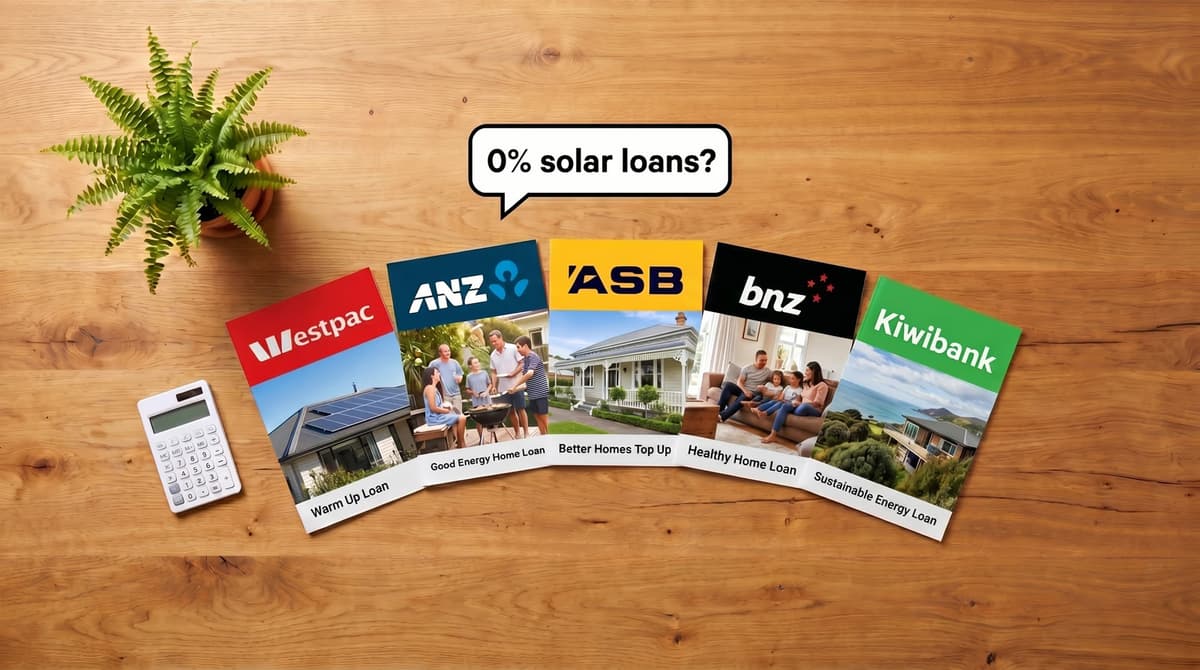
Solar Finance NZ: Green Loans Compared
Westpac 0.20% margin discount, ANZ floating green loan, ASB/BNZ/Kiwibank per-application rates. Total costs, eligibility, and which bank fits your install.
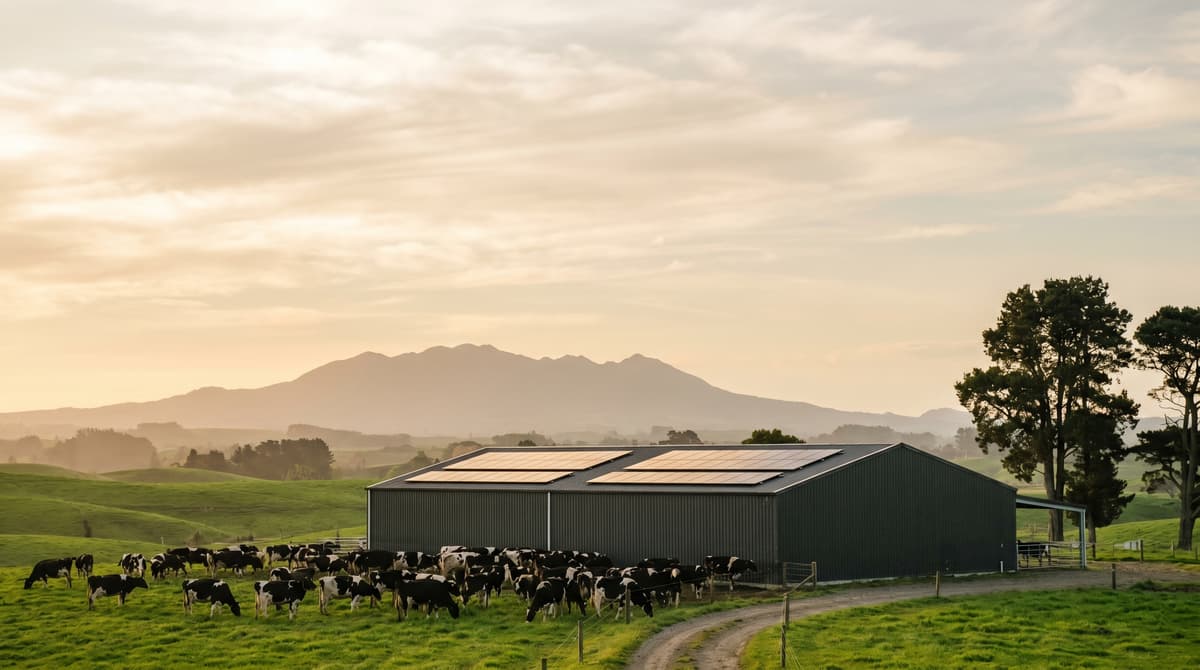
Solar for Farms NZ: The Working-Farm Funding Stack
Honest numbers on solar for NZ farms. Working-farm tax stack, EECA loans, diesel offset, real Waikato and Canterbury case examples.
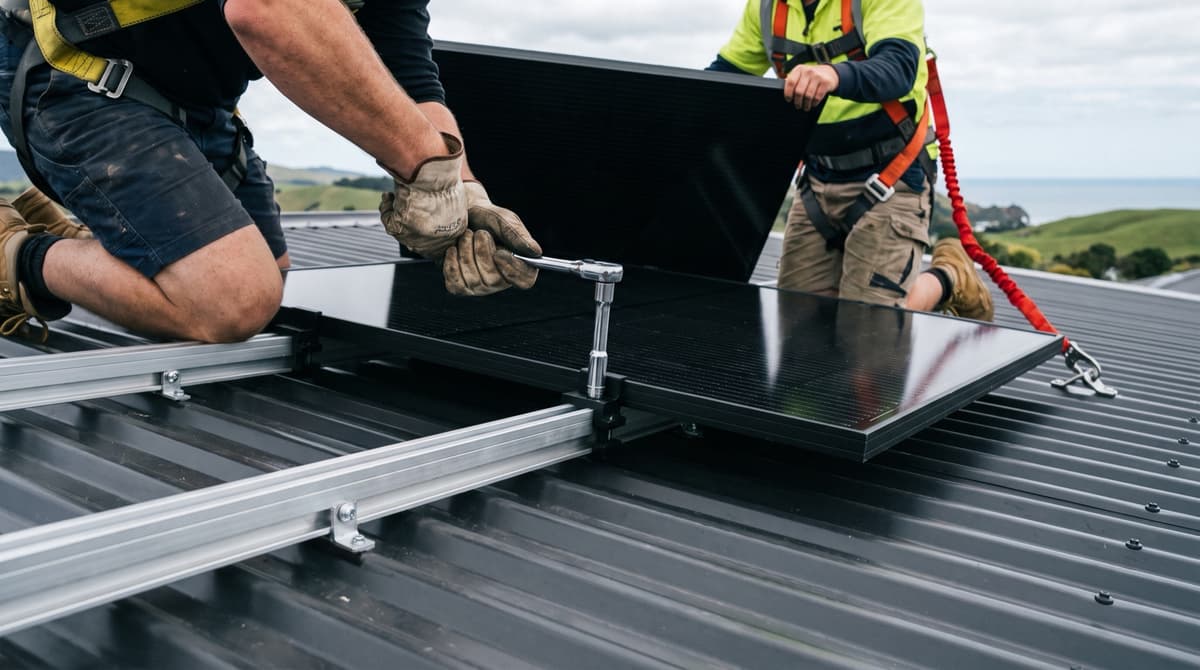
How SolarScout Vets Solar Installers
Registration, real references, industry membership, five years of solar. No shortcuts.
How to Read a Solar Quote NZ
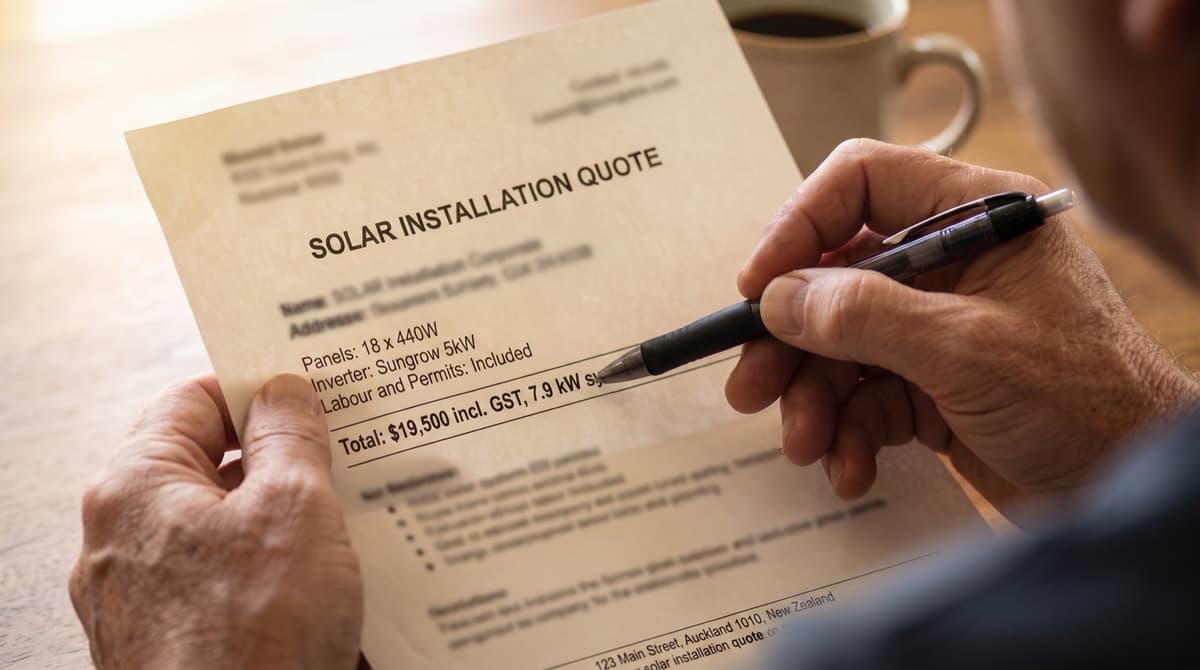
Line-by-line breakdown of what's in a NZ solar quote, what to question, and the hidden costs commercial buyers should watch for.
Join the conversation
The best comments are honest ones: Real experience. Share yours, please stay civil and on topic. No self-promo links.
Your email is never shown or shared. To change or remove a comment later, .
No comments yet. What is your experience with this? Be the first to weigh in.