
Solar for NZ farms: where the sun pays the bills
The funding stack residential buyers can't access. Real maths on a $200k dairy install.
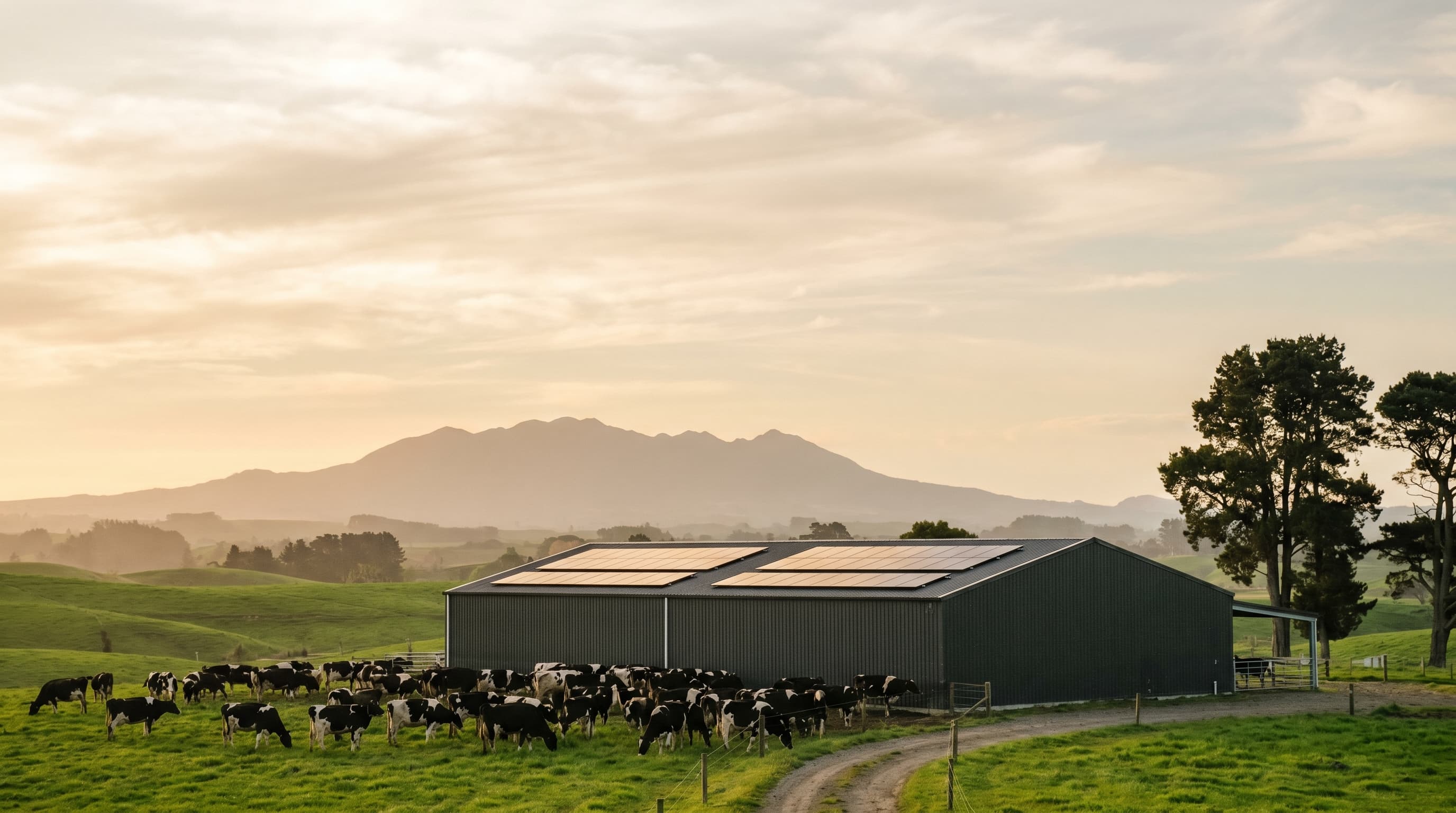

A 100 kW dairy install costs around $200,000 ex GST. A NZ farm with taxable profit, an ASB Rural facility, and reasonable timing can knock the post-tax year-one cost of that system down to roughly $184,000 before touching a grant. If the next EECA Solar on Farms round lands and the farm is accepted, that number drops again into the $120,000 to $140,000 band. No NZ residential buyer can access maths like that. Farms can.
Here’s the thing. Most of the rural solar pitch lands at the farmhouse door with a salesman who couldn’t tell a milking parlour from a haybarn, citing an “MPI grant” that was actually EECA Solar on Farms, calling Round 1 “still open” when it closed in 2025, and waving a 7-year payback that quietly assumes 75% self-consumption. That’s why this page exists.
Solar Scout connects NZ farms with up to 3 vetted installers. Every one is EWRB registered, a member of SEANZ or Master Electricians, and has at least five years of solar behind them. See how we vet installers. This page lays out the funding stack honestly: what’s live, what’s closed, what’s coming, and the worked maths on a real dairy install.
The NZ farm-solar funding stack at a glance
Four levers live on a NZ farm in May 2026. None of them work alone. Stacked correctly, they cover most of a mid-scale install. Every figure below is dated and sourced.
 Live. Runs to 30 June 2027
ASB Rural SMART Solar Loan
0% interest for 5 years on up to $150,000
- ASB Rural customers, rural farm property as security, main source of revenue from primary production.
- After 5 years: ASB Floating Base Rate plus applicable margin.
- Apply early. ASB's own caveat is the offer may be withdrawn at any time.
 Round 1 closed. Be ready for Round 2
EECA Solar on Farms demonstration fund
Up to $200,000 per farm, 40% of inverter + battery cost
- Round 1 closed for new applications. Approved farms must complete installs by 30 June 2026.
- Co-funding shape: 40% inverter + battery, 20% panels + racking, $450/kWh battery cap, $100k battery component cap.
- Eligibility: commercial agricultural operations, 30 kW to 500 kW with battery storage.
- As of 11 February 2026: 32 demonstration farms confirmed, 3,616 kWp.
- Subscribe to the EECA solar mailing list. EECA's pattern across decarbonisation co-funding is pilots followed by rollouts.
 Live since 22 May 2025
IRD Investment Boost
20% of asset cost deductible in year one
- Remaining 80% depreciates at normal rates.
- Applies to new or new-to-NZ business assets.
- Solar PV on income-producing farm property qualifies.
- No upper limit on asset value. All NZ business structures eligible.
- Talk to your accountant. A deduction is not cash, and break-even or loss-making years carry the benefit forward.
 Rate, not rebate
Agribusiness green-loan options
Margin discounts and sustainability-linked rates
- ANZ Good Energy Agri: up to $80,000 top-up, minimum $5,000, 3-year fixed then floating, 5-year max term, SEANZ installer required.
- Westpac Sustainable Farm Loan: 0.20% margin discount when the farm passes the Westpac Sustainable Farm Standard.
- BNZ Agribusiness Sustainability-Linked Loan: interest savings linked to agreed environmental targets.
- Rabobank NZ: case-by-case sustainable financing through the relationship manager. Phone call, not a published rate.
Want to see if it stacks up for your farm? Drop your details below and we’ll come back with quotes from up to 3 vetted installers plus the funding stack that fits.
power bill?$2,500
A $200k dairy install (May 2026 numbers)
A 100 kW solar plus 50 kWh battery system on a 350-cow dairy farm, total quoted price $200,000 ex GST. The farm operates as a NZ company, GST-registered, ASB Rural customer.
The Investment Boost cash benefit only lands in year one if the farm has the taxable profit to absorb the deduction. Break-even years carry it forward as a tax loss. A 28% rate assumes a NZ company structure. Sole-trader, partnership, trust and Māori-authority rates differ.
Talk to your accountant before you sign the dotted line on the install date. Year-end timing matters here.
A working farm with profit, with ASB Rural backing, and with reasonable timing can take a quoted $200k system down to a real year-one outlay around $184,000 without any grant. GST isn’t in that figure: the $200k is already ex GST, and a GST-registered farm claims back the GST on the invoice separately. If a future EECA round lands and the farm is accepted, that number sits in the $120k to $140k band. No NZ residential buyer touches numbers like this.
power bill?$2,500
What each farm type actually consumes
Dairy
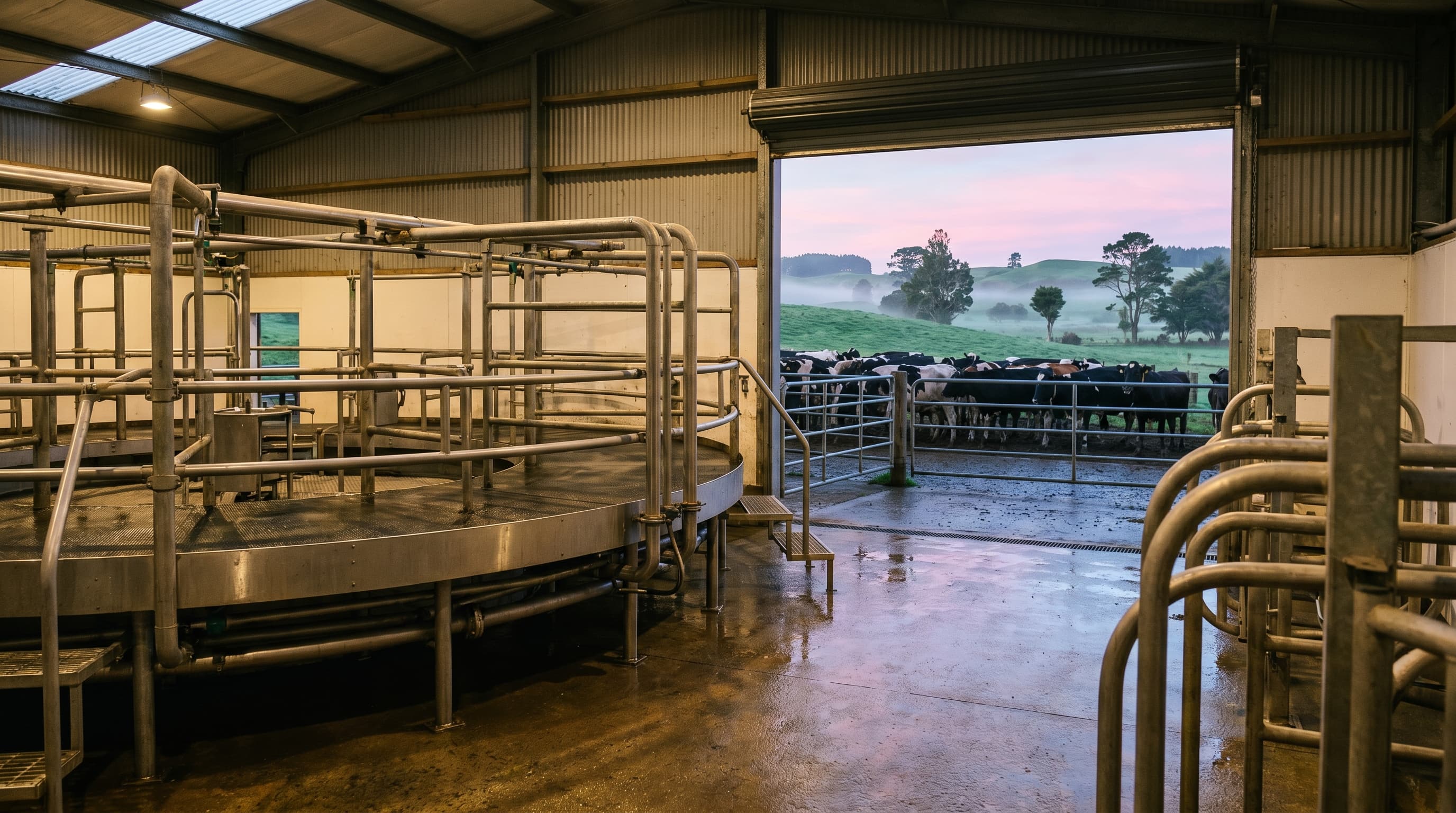
Non-irrigated NZ dairy farms run around 160 kWh per cow per year (Wells 2001 / Sims 2004, still the standing benchmark per DairyNZ). Add irrigation and the average jumps to roughly 112,100 kWh/yr per DairyNZ Energy Saving on Farm.
- Milking system + water pump runs ~36% of farm electricity during fixed milking windows
- Milk cooling and refrigeration is ~30% of total energy cost, the third-largest single user
- Heat recovery from milk chilling can cut shed electricity by up to 30%, with payback often under 2 years
- Vat wraps save 15–25% of milk-cooling cost. Only ~20% of NZ dairy farms have them
- Top-quartile farms use ~5x less energy per kg milk solid than worst-quartile
The structural problem: milking peaks land 5am to 7am and 2pm to 5pm. Rooftop solar peaks 10am to 3pm. There’s overlap on the afternoon milking, but the morning milking is dark or near-dark for half the year. A right-sized battery is the answer. This is exactly why the EECA demonstration fund required battery storage.
Horticulture and orchards
Forest Lodge Orchard (Cromwell, Central Otago), a 6-hectare cherry orchard fully electrified, runs around 100 MWh/yr for irrigation, frost fans, electric tractor, cool storage, and packing (EECA case study).
- A 30 kW electric frost fan vs equivalent diesel: ~$16,000 more capex, saves ~$4,000/yr, 4-year payback before counting solar
- Diesel frost fans burn 20–40 litres/hour during a frost event
- Frost events are pre-dawn (pure off-peak grid load, battery-friendly)
- Irrigation is largely daytime, the best possible match for rooftop solar
This is the strongest “why farms not houses” pitch. Orchard self-consumption with daytime irrigation can run 70 to 90%. A suburban house empty 9am to 3pm cannot match this.
Sheep and beef
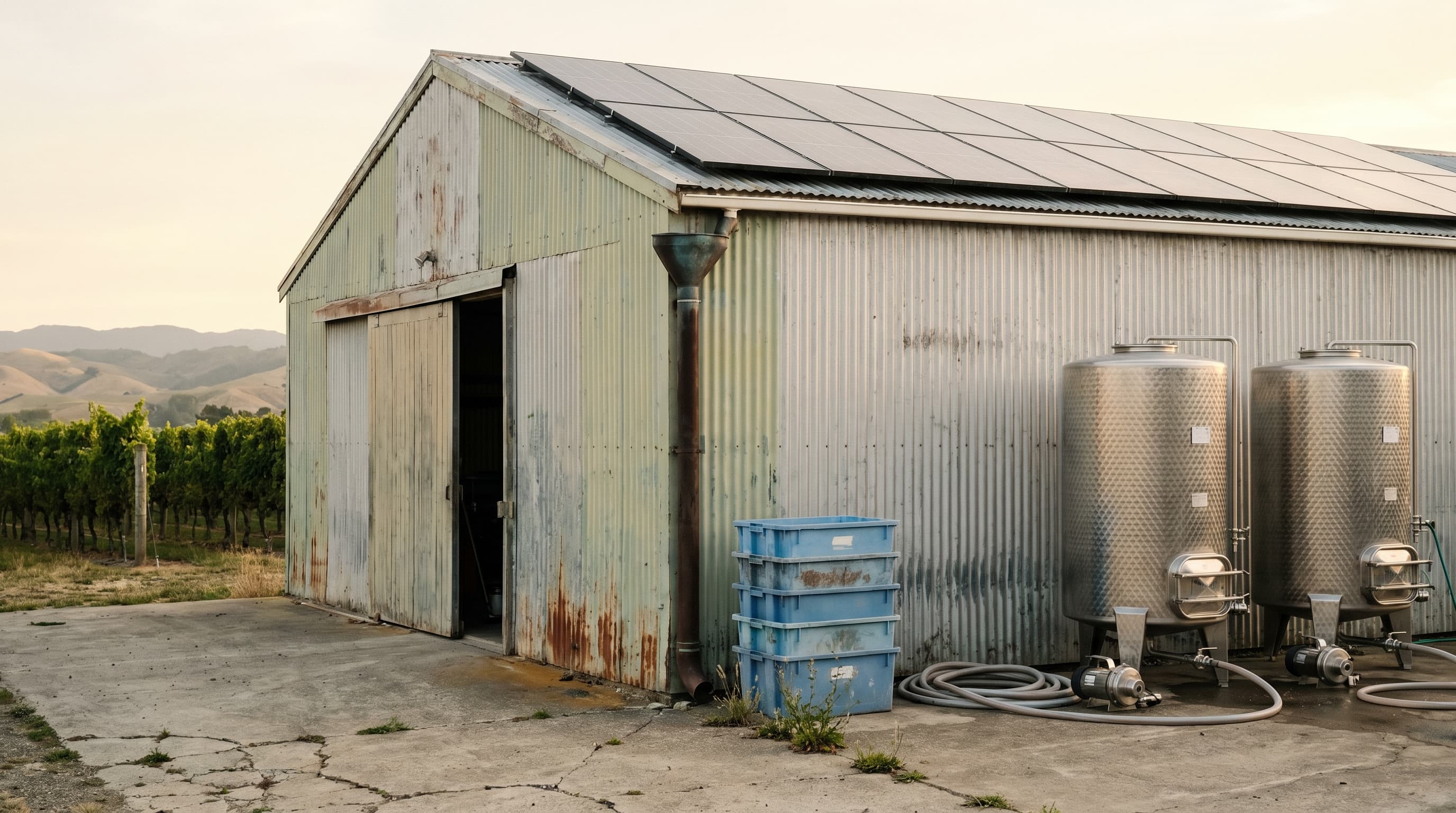
Woolshed load is intermittent (shearing season). Electric fencing, water pumping and homestead combine to typical use of 5,000 to 15,000 kWh/yr. A common pattern is 8 to 15 kW single or three-phase, with the maths closer to residential than a milking operation.
Lifestyle blocks
Single house plus small farm load, typically 6,000 to 12,000 kWh/yr. See Section 7. Lifestyle blocks fall outside EECA Solar on Farms and need their own framing.
The reason farms work better than houses for solar isn’t the size of the roof. It’s the size of the daytime load.
Need your real numbers, not benchmarks? Drop your last 12 months of bills into our farm-solar quote tool and we’ll size the system against your actual half-hour data.
System sizing benchmarks by farm type
Self-consumption ranges (Matt’s field range, EECA case-study aligned): lifestyle blocks 30–50%, dairy with battery 60–80%, orchard with daytime irrigation 70–90%, greenhouse with active lighting during peak generation 85%+.
Same flag as our solar scams guide applies here. Ask each installer who quotes you: “What self-consumption rate did you assume?” If the answer is over 50% on a farm without a battery, ask why. If “I’m not sure,” walk.
Three-phase, EDB rules, and SWER lines
Why most farms need three-phase
- Milking sheds, cool stores, irrigation pump sets and packing operations almost always run on a three-phase connection
- A three-phase inverter outputs a balanced supply across phases and does not place current on the neutral conductor
- Commercial PV can run up to 1,500V DC vs 1,000V DC for residential (per AS/NZS 5033:2021)
- Single-phase inverters on three-phase supplies create voltage imbalance the EDB will reject
- Real cost premium: three-phase inverters typically run $2,000 to $5,000 more than single-phase equivalents, plus extra labour for balanced wiring
Verified rural EDB export limits (May 2026)
Notable rural quirks worth flagging:
- Marlborough Lines explicitly publishes a 2 kW SWER default, the hardest-coded SWER constraint of any EDB checked
- Alpine Energy caps at 5 kW per phase, tighter than the new Electricity Authority national 10 kW default
- Counties Energy publishes two named constrained feeders (Churchill Rd, Manukau Heads/Awhitu), so farms there face restricted export from day one
- Top Energy’s 2025 AMP notes 35%+ of lines were built on RERC rural-subsidy single-phase feeders, so Far North farms are heavily single-phase-exposed
- The Electricity Authority’s national 10 kW default from 11 May 2026is the universal backstop where the EDB hasn’t published their own
SWER (Single Wire Earth Return)
SWER was invented in NZ by Lloyd Mandeno in the 1920s and is still the backbone of low-density rural distribution. SWER lines are single-phase, low-capacity by design, with transformers as small as 5 to 25 kVA at each customer.
Practical implication:if your farm is on a SWER line, the realistic strategy is self-consumption-heavy plus battery, not export-heavy. The Investment Boost and ASB Rural maths still work because the savings come from offsetting purchased kWh, not from buy-back revenue. Ask the EDB for the specific transformer rating on your ICP before any installer sizes a system. If the installer doesn’t ask you for this, that’s a flag.
The EDB application is the gating event. Get it in before you sign with an installer, not after.
The legitimate-installer checklist (farm edition)
Eight checks. Every one is a real reason a farm install ends up in dispute.
- SEANZ-member installer if your bank asks for one. ANZ’s Good Energy Agri loan only pays out on a SEANZ member’s quote. The ASB Rural SMART Solar Loan has no such rule. Check your own bank’s current terms, and verify membership at seanz.org.nz/directory
- EWRB-registered electrician with Mains Parallel Generation endorsement. Per SEANZ, the original 1 Sep 2025 deadline has been extended to 1 September 2026. Verify at ewrb.govt.nz
- AS/NZS 5033:2021 compliance documented. Including Type 1 + Type 2 SPDs on both DC and AC sides. Rural sites take more lightning hits than urban
- DG application lodged with the EDB before install, not after. Insist on a copy of the lodged application before the install date
- Three documents on completion: Certificate of Compliance (CoC), Electrical Safety Certificate (ESC), and Record of Inspection (ROI). All three
- CoC issued in the farm operating entity’s name, not a director’s personal name. If the entity on the CoC doesn’t match the entity claiming Investment Boost or holding the FMG policy, you create paperwork chaos in year five
- Cap deposit at 10 to 20%.Industry guidance per Consumer NZ and SEANZ. Refuse “100% on order” demands
- Master Electricians membership where available. Their $20,000 / 12-month workmanship guarantee survives installer insolvency because it sits at the trade-association level
Every installer we match is EWRB registered and a member of SEANZ or Master Electricians. The checklist above is what to ask them about your job. Compare quotes from up to 3 vetted farm-solar installers. Free, and you choose who to talk to.
power bill?$2,500
Lifestyle blocks: the carve-out
A lifestyle block on a residential rate code with a single house and small farm load does not qualify for the EECA Solar on Farms demonstration fund. EECA’s criteria are explicit: commercial agricultural operations only.
What you can still use
- ASB Rural SMART Solar:the eligibility is “rural farm property” and “main source of revenue from primary production on the farm.” Verify with ASB Rural directly. Not all lifestyle blocks meet the revenue test
- Investment Boost:works only if the solar sits on an asset used to produce taxable income (a Schedule 4A horticulture activity, a registered grazing arrangement, etc.). For a lifestyle block with no income production, you’re in the residential lane. Talk to your accountant
- Residential green loans from Westpac, ANZ, ASB and BNZ at 0 to 1% interest are usually the right tool. Same $0-upfront ownership, far less paperwork
If your block has no income production, see Buying solar panels in NZ. If your block is off-grid or on a SWER line that won’t host meaningful export, see Off-grid solar in NZ.
Not every rural property is a working farm in the eyes of EECA. Be honest about which lane you’re in. The maths is still good either way.
Field-practitioner pitfalls (Matt's seven)
The things that aren’t in the brochure. Half the rural solar mistakes Matt sees in the field weren’t made on install day. They were made on quote day, by someone who’d never wired a cool store.
1. The 'ag rate' trap
Some EDB tariffs labelled “agricultural” or “rural commercial” have far lower kWh charges in exchange for higher daily fixed charges. Solar attacks the kWh side, not the fixed side. Always price the same system against the actual current tariff on the farm’s 12-month bill, never the residential default the installer’s software defaults to.
2. Old switchboards on older sheds
Many dairy and woolshed switchboards are 30+ years old, ceramic-fuse era. Putting a new inverter alongside them often forces a panel upgrade. Budget $3,000 to $8,000 before any solar work begins.
3. Three-phase that isn't actually three-phase
A surprising number of farms have a three-phase supply but legacy single-phase loads wired across two phases. The inverter has to balance to what the loads actually do, not what the connection label says. Before designing a three-phase PV system, walk the loads on the meter.
4. The DG application that sits with the installer
EDBs increasingly require the application before install, not after. Customers told “we’ll handle it” sometimes find out the application sits in the installer’s folder for months. Insist on a copy of the lodged DG application before the install date.
5. Earthing under worst-case site conditions
Loose dry soil in summer, wet clay in winter, rural earthing resistance varies seasonally. AS/NZS 5033 + AS/NZS 3000 earthing must be tested under the worst-case site condition, not the day of install.
6. Ground-mount and wind zones
Paddock-corner ground-mounts need racking footings engineered for wind loading on exposed sites. NZ Wind Zone 3 or above is common in rural Canterbury, Wairarapa, South Otago, Manawatū. A roof system designed for a Wellington suburb is not the same engineering as a ground-mount on a Wairarapa hill.
7. CoC in the farm entity name (the year-five fix)
Get the CoC issued to the operating farm entity. If the name on the CoC doesn’t match the entity claiming the Investment Boost or holding the FMG policy, you create paperwork chaos later. Trivial to fix on day one. Expensive in year five.
Half the rural solar mistakes I see weren’t made on install day. They were made on quote day, by someone who’d never wired a cool store.
Matt, registered electrician, 12 yrs PV
The funding-stack action plan
What to do this week, this month, this quarter.
- Pull 12 months of actual bills. Half-hour data is gold. Request from your retailer. Know your tariff structure (controlled vs uncontrolled, peak vs off-peak, ag rate vs commercial)
- Phone your EDB and request a constraint check on your ICP. Transformer rating, hosting capacity, any export constraints flagged on the feeder. Five-minute call
- Talk to ASB Rural in parallel with quoting, not after. ASB says the 0% offer runs until 30 June 2027 and may be withdrawn at any time. If you’re already ASB Rural, your manager knows the form. If you’re with another bank, ANZ Good Energy Agri, Westpac Sustainable Farm Loan, BNZ Agribusiness SLL, or Rabobank case-by-case are real alternatives
- Get vetted quotes, and ask each installer about their three-phase work. Insist on model numbers in writing, not “premium 580W.” Cap deposit at 10 to 20%
- Validate Investment Boost timing with your accountant before invoicing dates are locked in. Year-end matters. The asset must be “first available for use” on or after 22 May 2025
- Notify FMG (or your insurer) before energisation. Provide system value, photo of installed panels, CoC for the policy file
- Subscribe to EECA’s solar mailing list. When Round 2 of Solar on Farms opens, the lead time on competitive applications will be short
For NZ farms
See if it stacks up?
Tell us about your farm. We’ll come back with up to 3 installer quotes to compare, plus financing options
Common questions
Yes for most working farms. Daytime loads (irrigation, cool stores, milking) overlap with solar generation in a way suburban homes can't match. Payback: 5 to 7 years for orchards, 6 to 9 for dairy with battery, 8 to 12 for sheep & beef and lifestyle blocks.
It's EECA, not MPI. The $200k programme was the EECA Solar on Farms demonstration fund. Round 1 is closed; Round 2 timing TBC. If a salesperson pitches an “MPI solar grant,” that's a flag.
Almost certainly yes if you have a milking shed, irrigation, cool store, or packing operation. Three-phase inverters cost $2,000 to $5,000 more than single-phase. Lifestyle blocks with a house and small pumps can usually run single-phase.
Whatever's running while the sun's up. Irrigation matches solar peak naturally (best ROI). Milking peaks (5am/3pm) need a battery to bridge. Woolsheds are seasonal, the homestead + pumps usually drive sheep & beef payback.
Required for EECA-funded systems. Strongly recommended on dairy (shifts midday generation to the 5am milking). Optional on orchards with daytime irrigation. Size against your real load profile, not a rule of thumb.
Yes. The Investment Boost lets you deduct 20% of the asset cost in year one. The remaining 80% depreciates normally. Talk to your accountant about year-end timing.
ASB SMART Solar Loan: 0% interest for 5 years on up to $150,000 for on-farm solar. ASB Rural customers, primary production as main revenue. ASB says the offer runs until 30 June 2027 and may be withdrawn at any time. Apply early.
Depends on farm type. Small dairy: 15 to 30 kW. Medium dairy with irrigation: 30 to 100 kW. Orchard: 30 to 150 kW. Sheep & beef: 8 to 15 kW. Lifestyle block: 5 to 10 kW. Size against your actual bill data, not kW-per-cow.
Yes on modern long-run colorsteel with manufacturer flashings. Older roofs (asbestos cement, native-timber-purlin woolsheds) need an engineer to assess load. Marginal roof? A paddock-corner ground-mount is usually cleaner.
SWER lines cap export at the local transformer (5 to 25 kVA). Go self-consumption-heavy plus battery, not export-heavy. The Investment Boost and ASB Rural maths still work because savings come from offsetting purchased kWh, not buy-back revenue.
Next steps for your solar journey
- Compare ASB Rural SMART, ANZ Good Energy Agri and Westpac Sustainable Farm Loan side by side
- Every NZ solar grant and rebate, beyond the farm-specific ones
- If your farm is on a SWER line or off-grid entirely
- Before signing a farm-solar quote, work through the 13 red flags
- The SolarZero / Solar Group / Guru NZ pattern, and how to avoid it
Written by Ben Wallis
Ben has worked as a licenced electrician in New Zealand for over six years, from residential rooftop systems to large industrial projects. He writes Solar Scout's guides based on real experience in the field, so Kiwi homeowners hear what installers actually think, not what salespeople say.
Related guides
View all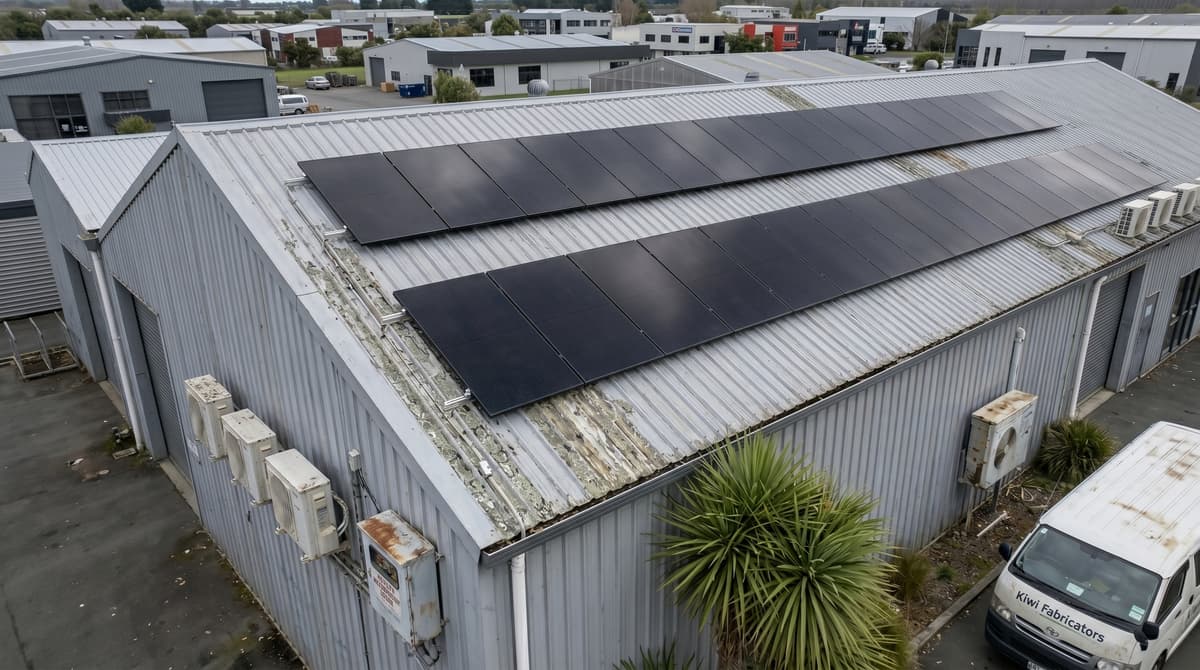
Commercial Solar NZ: Real Costs, Payback & Tax (2026)
Sister B2B pillar. Investment Boost, GST reclaim, the five bank green loans, and the maths on a 30 kW commercial system.
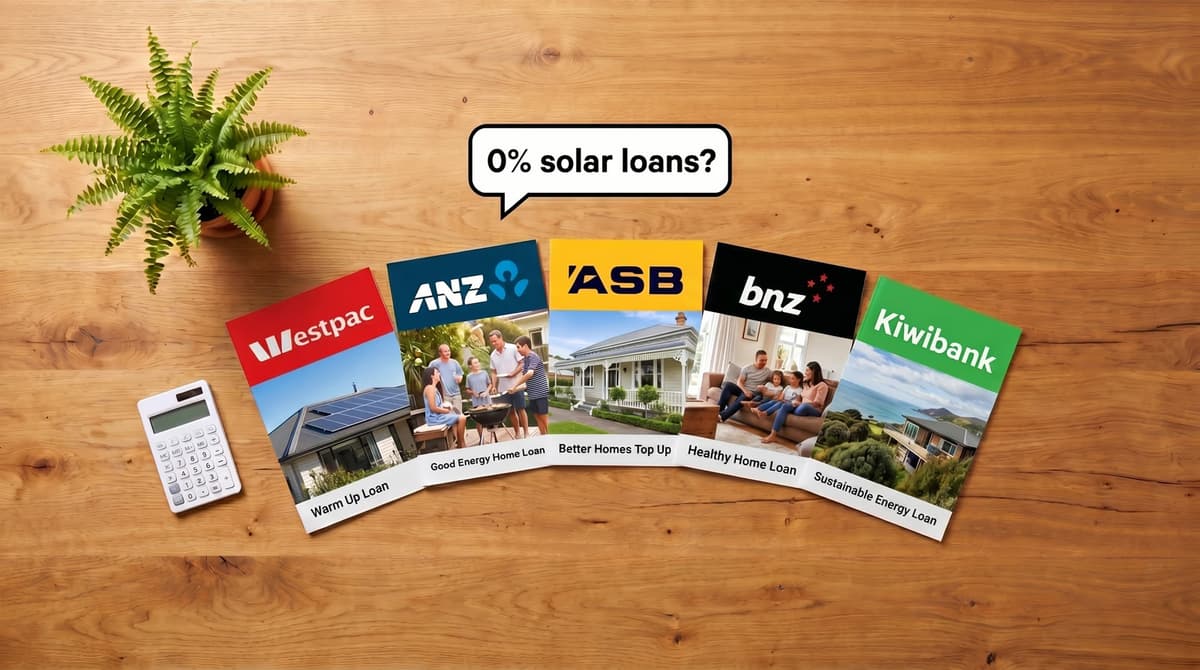
Solar Finance NZ: Green Loans Compared
Bank-by-bank green loan comparison including ASB Rural SMART Solar (0% to $150k) and how the rural product compares to standard green lending.
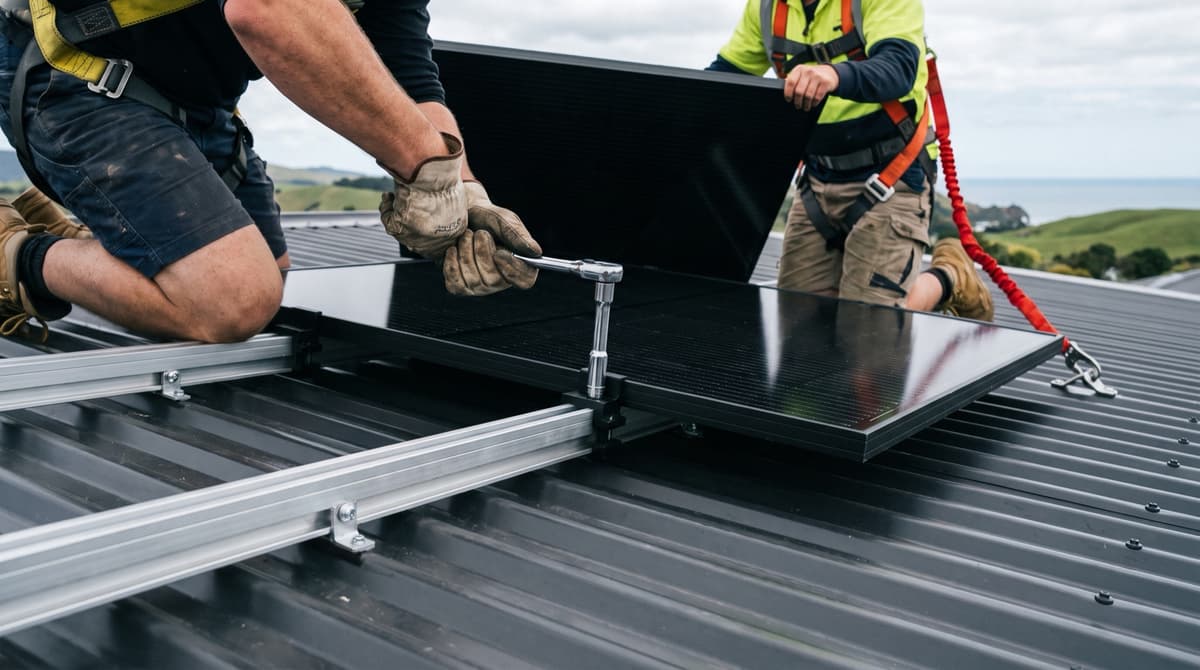
How SolarScout Vets Solar Installers
Registration, real references, industry membership, five years of solar. No shortcuts.
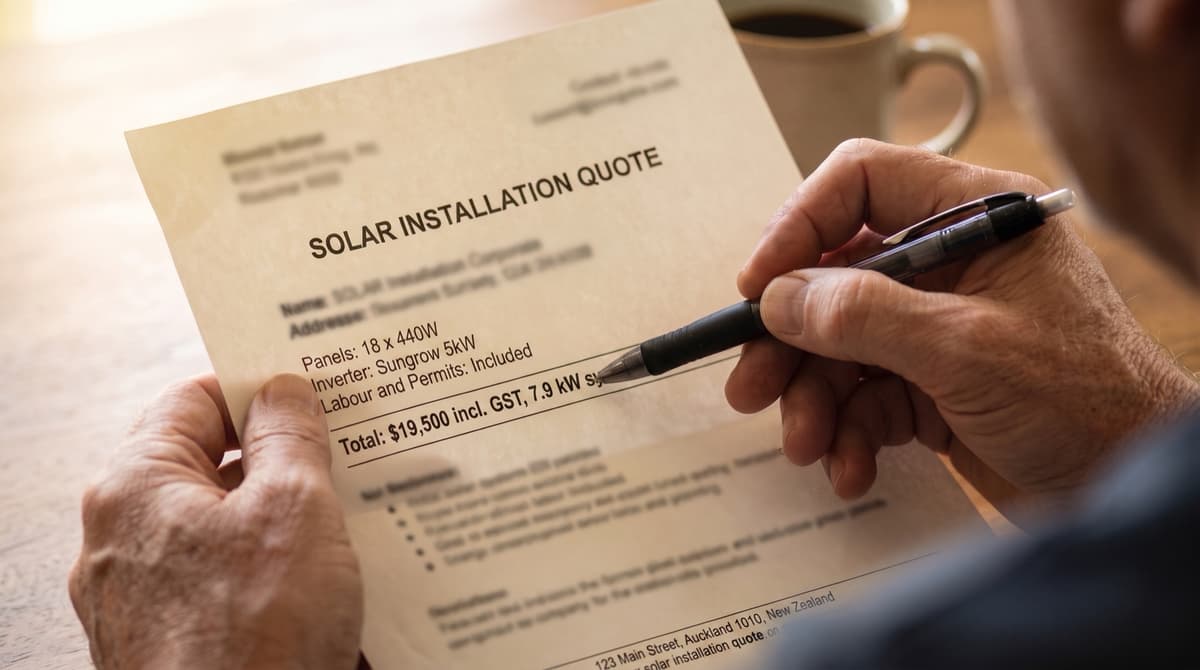
How to Read a Solar Quote NZ
Line-by-line breakdown of a NZ solar quote and the 13 red flags to question before signing. Works for farms and commercial too.
Join the conversation
The best comments are honest ones: Real experience. Share yours, please stay civil and on topic. No self-promo links.
Your email is never shown or shared. To change or remove a comment later, .
No comments yet. What is your experience with this? Be the first to weigh in.