
Solar Panels for Rental Property NZ: The Landlord's Guide
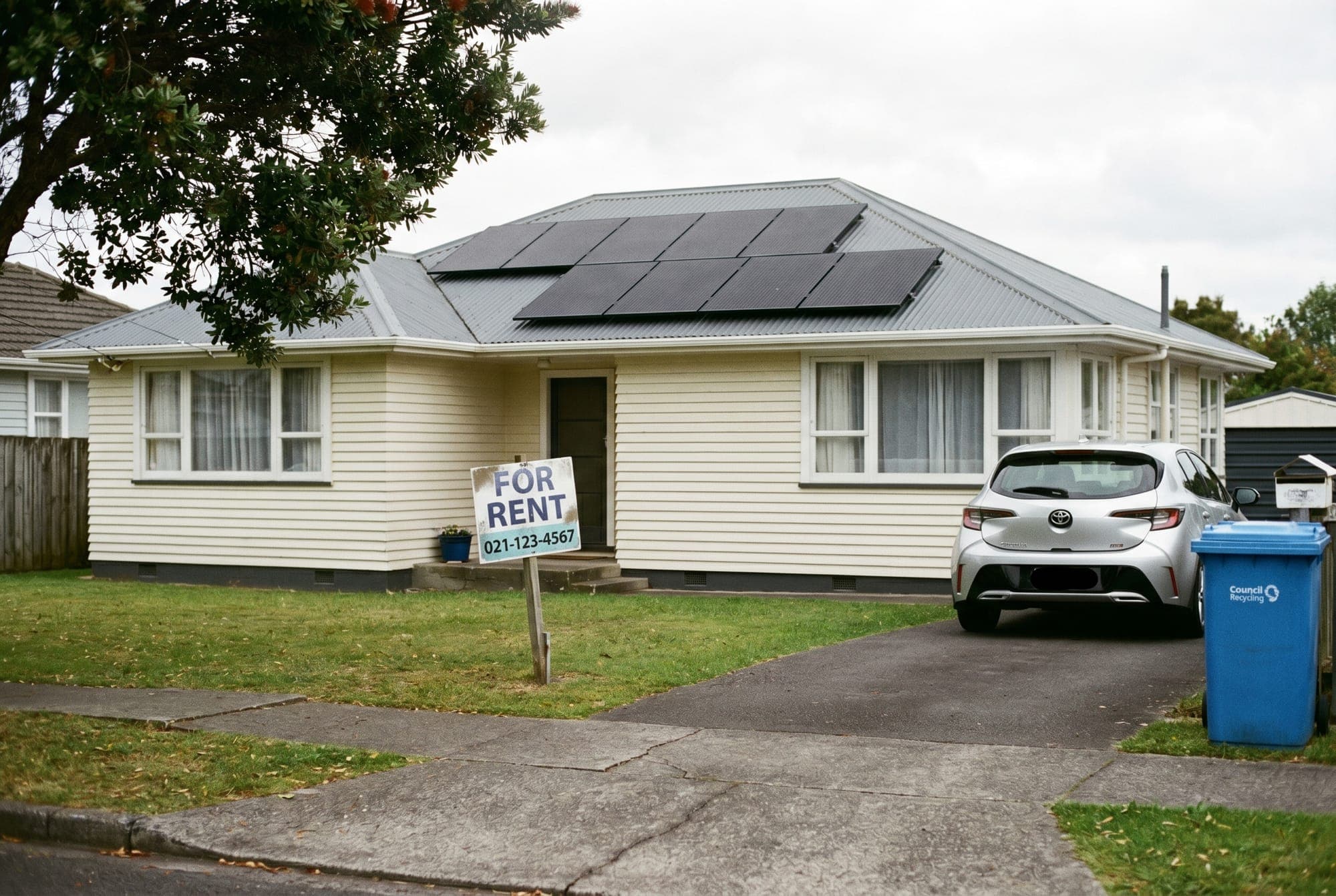

You own a rental. You’re thinking solar. You’ve heard it’s a good idea. You’ve also heard the tenant gets the savings. Both are true, depending on which scenario you’re in.
Here’s what nobody puts in the marketing brochure: for a typical NZ residential rental, your tenant’s name is on the power bill. Solar reduces theirbill, not yours. Your return as a landlord comes from somewhere different. Depreciation, buy-back revenue, property value uplift, faster vacancy fills. It’s still real money. It’s just not the money the salesperson points at.
This is the honest landlord guide. Tax, RTA, body corp, the maths, the decision rules, and the one legal trap most landlords don’t know about.
Who Actually Benefits When You Put Solar on a Rental
Three scenarios, three completely different return profiles. Knowing which one you’re in is the first decision.
Owner-paid power bill
Holiday lets, short-stay, fully-furnished executive rentals where power is included in rent. You capture 100% of the self-consumption savings plus the export revenue. The economics here look like an owner-occupier install. Strong case for solar.
Tenant-paid power bill (the standard NZ rental)
Your tenant’s name is on the power bill. They capture the daily-use savings. You capture buy-back revenue (export only), the depreciation tax shield, and any property value uplift at sale. Different return profile. Still real money, just smaller and slower.
Boarding house / multi-tenant
Different RTA rules, sometimes commercial electricity classifications. Out of scope for this guide. Talk to a specialist who deals with HMO and boarding scenarios.
The legal trap most landlords miss
A landlord cannot legally on-sell solar electricity to their tenant under the standard model. The Electricity Industry Participation Code 2010 requires each ICP (your home’s connection point) to be registered with a single licensed retailer. Your tenant pays their retailer the standard residential tariff. You export surplus to your retailer and receive the buy-back rate.
The only working exception in NZ is the Kāinga Ora / Allume “SolShare” multi-trading trial, which runs under a specific Electricity Authority Code exemption. Not available to private landlords.
Your tenant pays for the power they use, full stop. You can’t sell it to them at a discount and pocket the margin. The system is designed to keep landlords out of the electricity retailing business.
Where the landlord money actually comes from
Four streams, in rough order of size:
- Buy-back revenue: your meter exports surplus, your retailer pays you. Typically 12-17c/kWh in 2026 depending on retailer. See our retailer comparison.
- Depreciation tax shield: the system is plant and equipment, not building. You can depreciate it against rental income. Big section coming up.
- Property value uplift: modest but real. Around 2-4% on the data we have.
- Faster vacancy fills + lower tenant turnover: soft revenue, but compounds over a long hold.
Tax: Depreciation, GST, Interest
General info, current as at April 2026.Tax rules change. Talk to your accountant or check with IRD before relying on any number here. Solar Scout doesn’t give tax advice.
Depreciation: yes, but the rate is the question
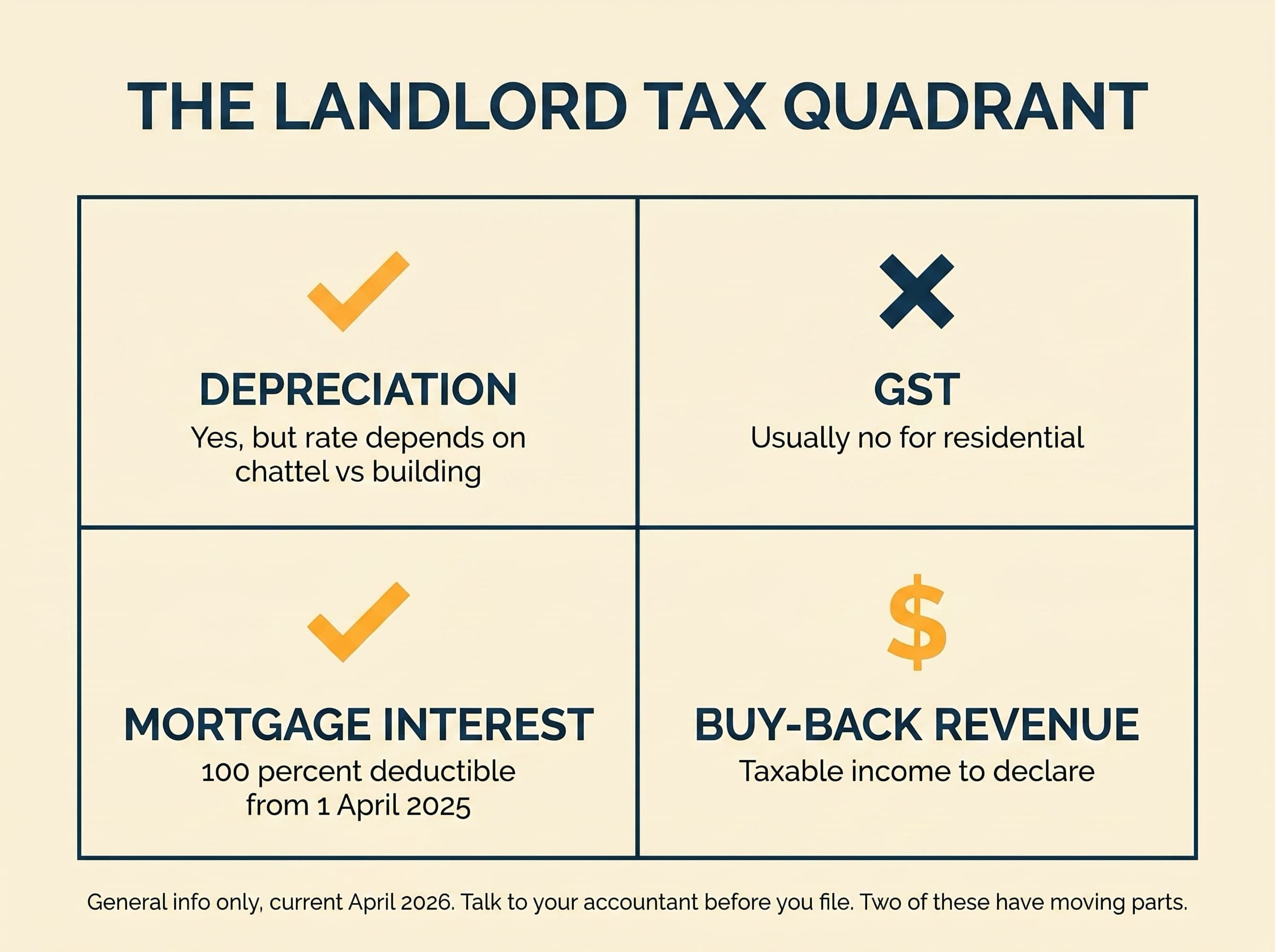
Residential buildings in NZ are not depreciable for tax (the 2024 reform reinstated commercial building depreciation but excluded residential rentals: they remain at 0% from 1 April 2024).
Plant and equipment attached to a residential rental are still depreciable. Solar PV is plant and equipment, not part of the building structure. That’s the key mechanic.
EECA’s commercial-scale solar modelling assumes a 16% diminishing value rate (10-year life), sourced from IRD. Whether your residential rental install qualifies for the same rate depends on classification and how the chattels valuer assigns line items. Some parts of the install (roof penetrations, conduit, switchboard work) may be treated as building improvement vs plant.
Get a chattels/plant valuation done by a registered valuer at install time. Costs $300-$600. The cost itself is deductible. It locks in your depreciation position and gives your accountant a defensible number.
Repairs vs capital: get this right
A new solar system is unambiguously a capital improvement, not a repair. You cannot deduct the $14,000 in year one. You depreciate it over years. Plenty of landlords get this wrong on their first IR3R.
Mortgage interest: 100% deductible from 1 April 2025
If you borrow to fund the install, the interest is deductible against rental income at 100% from the 2025/26 tax year forward. Mortgage interest deductibility was fully restored. This is a meaningful boost to the financing case if you don’t want to fund from cash.
GST: usually no for residential landlords
Standard residential rental income is GST-exempt, which means most landlords are not GST-registered, which means you cannot claim back the 15% GST on the install. The $14,000 install includes GST, full stop.
GST-registered landlords (commercial-scale, short-stay or Airbnb registered) can claim input tax in proportion to GST-taxable use. Buy-back revenue then becomes GST-output-bearing. For a short-stay landlord, the 15% claim- back turns a $14,000 install into ~$12,200 net.
Buy-back revenue is taxable income
Add it to rental income on your IR3R. At a 33% marginal rate, $810/year of buy-back revenue equals about $543 after tax. Not life-changing, but real.
Bright-line considerations
The 2-year bright-line test (in force from 1 July 2024) means most landlords selling outside two years of acquisition pay no tax on the capital gain. For landlords inside the bright-line, capital improvements (including solar) lift the cost base and reduce the taxable gain.
Property Value Uplift: The Honest Number
NZ studies on solar’s impact on property value are thin. No peer-reviewed REINZ paper with a published methodology exists that we could verify. Here’s what’s out there.
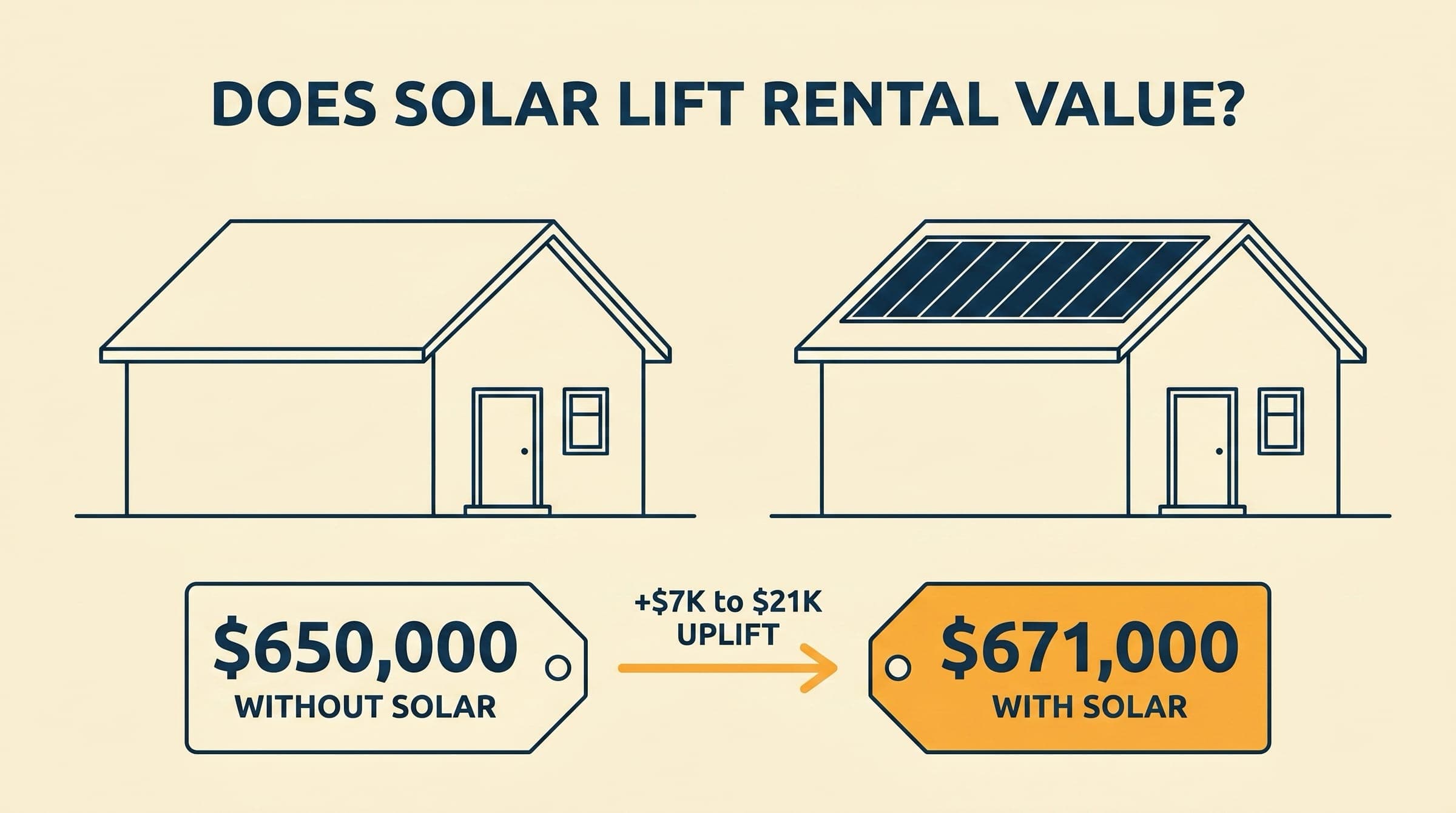
For a typical $700k-$1.2M NZ home, that’s roughly $7,000-$21,000 of likely uplift. Real, but observational rather than peer-reviewed. NZ solar penetration was ~3.6% by 2026 (up from 0.3% in 2014), so the comparison set is finally usable but still small.
Solar lifts asking-price expectations and shortens days-on- market for the buyer who specifically wants it. Whether it “pays for itself at sale” is property-, suburb-, and buyer-specific. Don’t bank on it as your primary return. Bank on the buy-back, depreciation, and tenant retention. The uplift is the cherry on top.
Can You Raise the Rent Because of Solar?
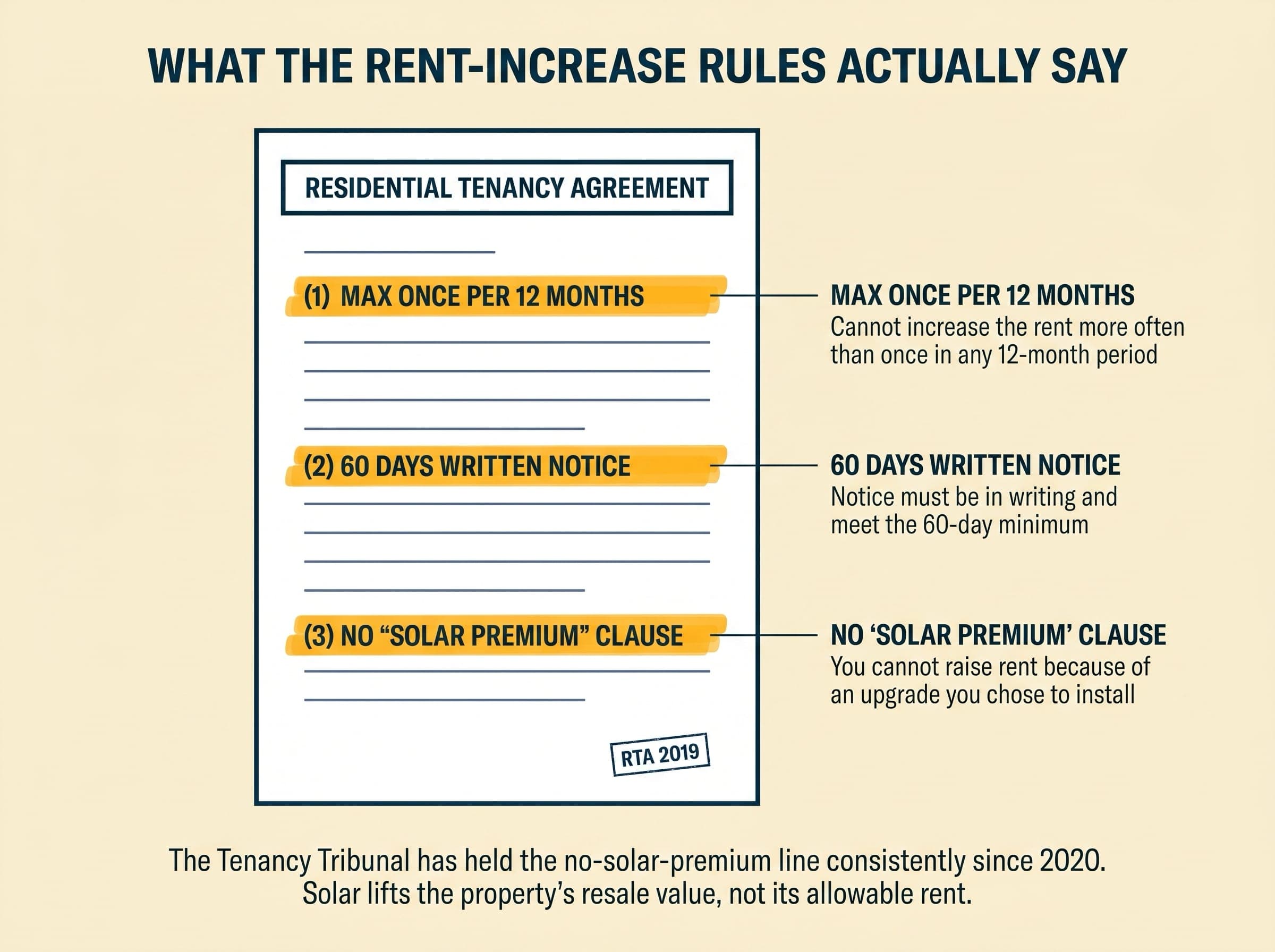
Rent rules under the Residential Tenancies Act 1986:
- Once every 12 months, with 60 days written notice
- No statutory cap on the amount, but Tenancy Tribunal can review increases “substantially above market rent”
- For a fixed-term tenancy, the agreement must allow it
- Out-of-cycle increases are permitted if you’ve materially improved the property and the tenant agrees in writing. Solar may qualify, but it’s rarely tested at Tribunal. Want a paper trail.
The math landlords actually want
If solar saves a tenant ~$650/year on power, can you raise the rent $13/week and stay at market rent? Yes, if the local market supports it. The constraint is “market rent for comparable properties”, not “tenant’s solar saving.” If five comparable rentals next door without solar list at $700/week, a Tribunal will likely find $713/week still within market range. But it’s tested on comparables.
Cleaner framing: solar as a positioning lever
- Faster fill on vacancy.Listings flagged “Solar power” get more saved searches and enquiries on TradeMe Rentals.
- Lower tenant turnover.Tenants whose power bill drops $50/month don’t move for $20/week elsewhere.
- Premium positioning.Fits the “top of market band” justification on comparables.
Don’t try to recover the solar install through a rent increase. Use the install to fill vacancies faster and keep good tenants longer. That’s the real money.
Want to compare
quotes?
Get matched with vetted local installers and see real quotes for your home. It’s free, with no obligation.
Compare up to 3 quotesBody Corp / Unit-Title Rentals
If your rental is a unit-titled apartment or townhouse, the roof is common property. That changes everything.
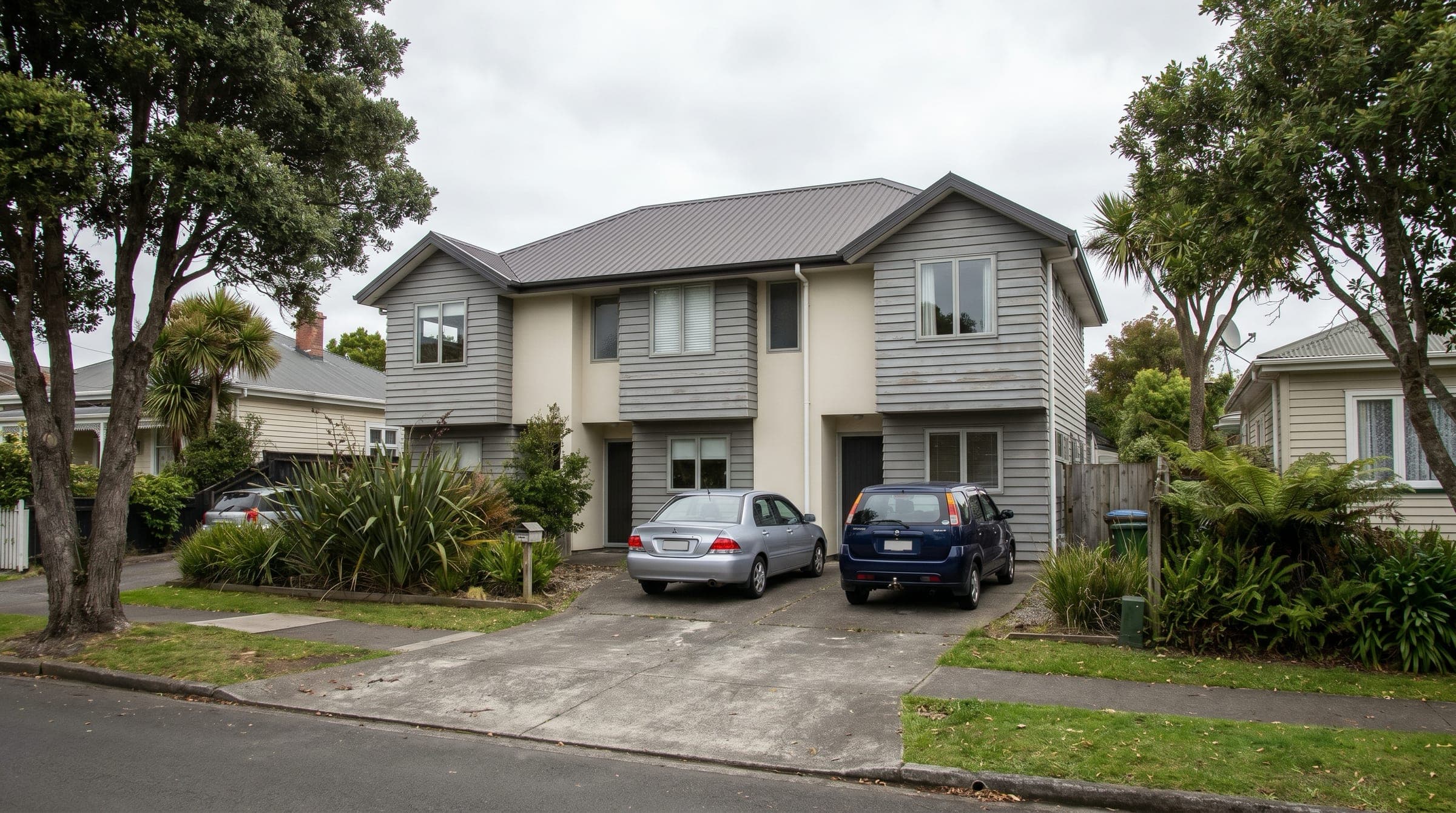
- Solar installs affecting common property require a special resolution under Unit Titles Act 2010 s 209. Typically 75% of voting owners present and voting must agree.
- Body corps frequently refuse, citing roof warranty, aesthetics, future maintenance access, or insurance complications.
- The 2022 Unit Titles amendments did not introduce a specific solar-friendly provision. Vote thresholds remain the bottleneck.
Practical advice
Read your body corp rules first. Sound out the chair before you spend a cent. Don’t pay for design work until you have the special resolution in writing. We’ve seen landlords spend $1,500 on engineering plans for a rental that the body corp then declined to approve.
The shared-system option (the future)
Allume SolShare technology used in the Kāinga Ora trial (Whāngārei, Christchurch, Hamilton) shows the technical model works in NZ: one rooftop array, multiple tenant ICPs benefiting. Commercial deployment to private landlords is gated by Electricity Authority Code exemptions that don’t currently exist outside the trial. Watch this space.
When Solar Makes Sense for a Rental (and When It Doesn't)
The shorthand decision rule. Print it, screenshot it, share it.
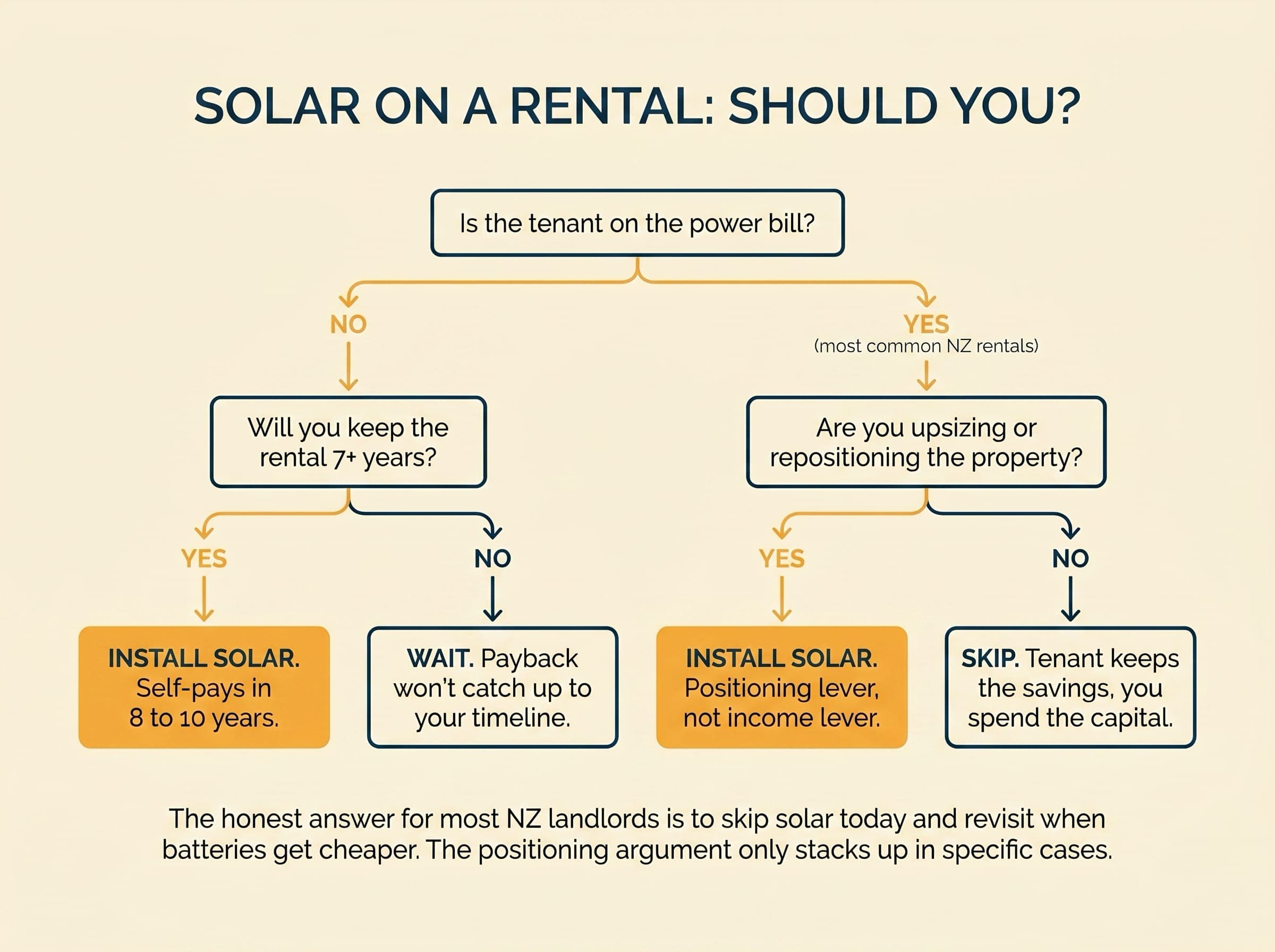
The landlord’s “best return” rental for solar is paradoxically the one where the tenants are out all day. Less self-consumption, more export. Counterintuitive, but the maths checks out.
Worked Example: 6.6kW on an Auckland Rental
Caveat: illustrative only. Numbers rounded, ignore inflation. Your numbers will differ, but the shape of the maths is what matters.
The year 1 landlord position
~$810 buy-back income + ~$740 tax shield − $267 tax on buy- back at 33% = ~$1,283 net.
Repeats annually with diminishing tax shield (DV depreciation falls each year as the book value drops).
Simple cash payback
~10-12 years on cash alone. Faster (6-8) if you credit property uplift on sale.
The honest caveat
Self-consumption of 20-30% reflects an empty-by-day rental. If your tenants are home a lot (kids, retirees, work-from- home), self-consumption climbs and the tenant’s benefit grows, which weakens your cash return but strengthens retention and listing premium. The “best return” rental for solar is paradoxically the one where the tenants are out all day.
The Install Process and Consents
Most rental solar installs don’t need a building consent. The Building (Exempt Roof-mounted Solar Panel Arrays and Building Work) Order 2025 (SL 2025/216), in force from 23 October 2025, exempts roof-mounted arrays under 40m² in wind zones up to “High.”
What you do still need:
- A professional installer with the EWRB Mains Parallel Generation endorsement (mandatory from 1 September 2026)
- The Certificate of Compliance issued in your name as the property owner
- Distributed Generation approval from your lines company before commissioning
- Disclosure to your landlord building insurer
For the full timeline, see the NZ solar installation process. Before you sign anything, walk through how to read a solar quote for the line items most likely to surprise you, and our guide to choosing a vetted NZ solar installer for who to actually trust with the job.
Want three quotes built around your rental’s specifics, including the depreciation paperwork your accountant will need? Compare up to 3 quotes from vetted installers (free, takes about 2 minutes, no spammy free-for-all).
Want to compare
quotes?
Get matched with vetted local installers and see real quotes for your home. It’s free, with no obligation.
Compare up to 3 quotesCommon Questions
Can I claim depreciation on solar panels on a rental property in NZ?
Yes. Solar PV is plant and equipment, not part of the building, so it can be depreciated against your rental income. EECA’s modelling uses 16% diminishing value (a 10-year life) sourced from IRD. The exact rate for your specific install depends on classification. Get a chattels valuation done at install time and have your accountant confirm the rate.
Does solar increase rental property value in NZ?
The data we have suggests 2-4% uplift, with NZ-specific estimates running 1.3 to 4%. On a $700k-$1.2M home that’s roughly $7,000-$21,000. Real, but observational rather than peer-reviewed. Don’t make it your primary return reason.
Can a landlord charge tenants for solar power in NZ?
Not directly under the standard model. The Electricity Industry Participation Code 2010 requires each ICP to be registered with a licensed retailer. Your tenant pays their retailer, you export to yours and get the buy-back. The only NZ exception is the Kāinga Ora SolShare trial, which runs under a specific code exemption.
Can I raise the rent because I installed solar?
You can raise the rent under the normal RTA rules (once per 12 months, 60 days notice). The increase has to stay within market rent for comparable properties. Solar is a positioning lever for faster vacancy fills and lower turnover, not a guaranteed rent recovery mechanism.
Is solar a tax deduction for landlords NZ?
The install isn’t an immediate deduction (it’s capital, not repairs), but you can depreciate it over its useful life. The interest on any borrowing is fully deductible from 1 April 2025 onwards. Buy-back revenue is taxable income on your IR3R.
Can I claim GST on a solar install for my rental?
Standard residential landlords can’t (residential rental income is GST-exempt). Short-stay or Airbnb landlords who are GST-registered, and commercial-scale landlords, can claim the 15% input tax in proportion to GST-taxable use.
Do I need a building consent for solar on my rental?
In most cases, no. The Building (Exempt Roof-mounted Solar Panel Arrays and Building Work) Order 2025 came into force on 23 October 2025. Roof-mounted arrays under 40m² in wind zones up to “High” are exempt. The Building Code still applies, the installer still issues a Certificate of Compliance, and the EDB still needs to approve the DG connection.
What about apartments or unit-titled rentals?
The roof is common property. You need a special resolution from the body corp (typically 75% of voting owners). Body corps frequently refuse, citing roof warranty and aesthetics. Read your body corp rules first. Don’t pay for design work until you have the resolution in writing.
Should I install solar on a rental I'm planning to sell within 5 years?
Probably not. The cash return profile depends on years of buy-back plus depreciation, and the property uplift at sale rarely covers the full install cost on a short hold. Short-stay/Airbnb or the GST-registered case is the exception.
What insurance changes when I add solar to a rental?
Tell your landlord building insurer. Most cover solar provided it’s installed by a SEANZ-member installer with a CoC issued. Some carriers may adjust premiums slightly. Don’t skip the disclosure. Undisclosed installs can void cover.
Next steps for your solar journey
Related guides
View all
Can I Claim Solar Panels on Tax in NZ? (2026)
How solar interacts with NZ tax, by audience. Owner-occupier, landlord, business, lifestyle block, Air BnB, and buy-back income. General info, not tax advice.
Read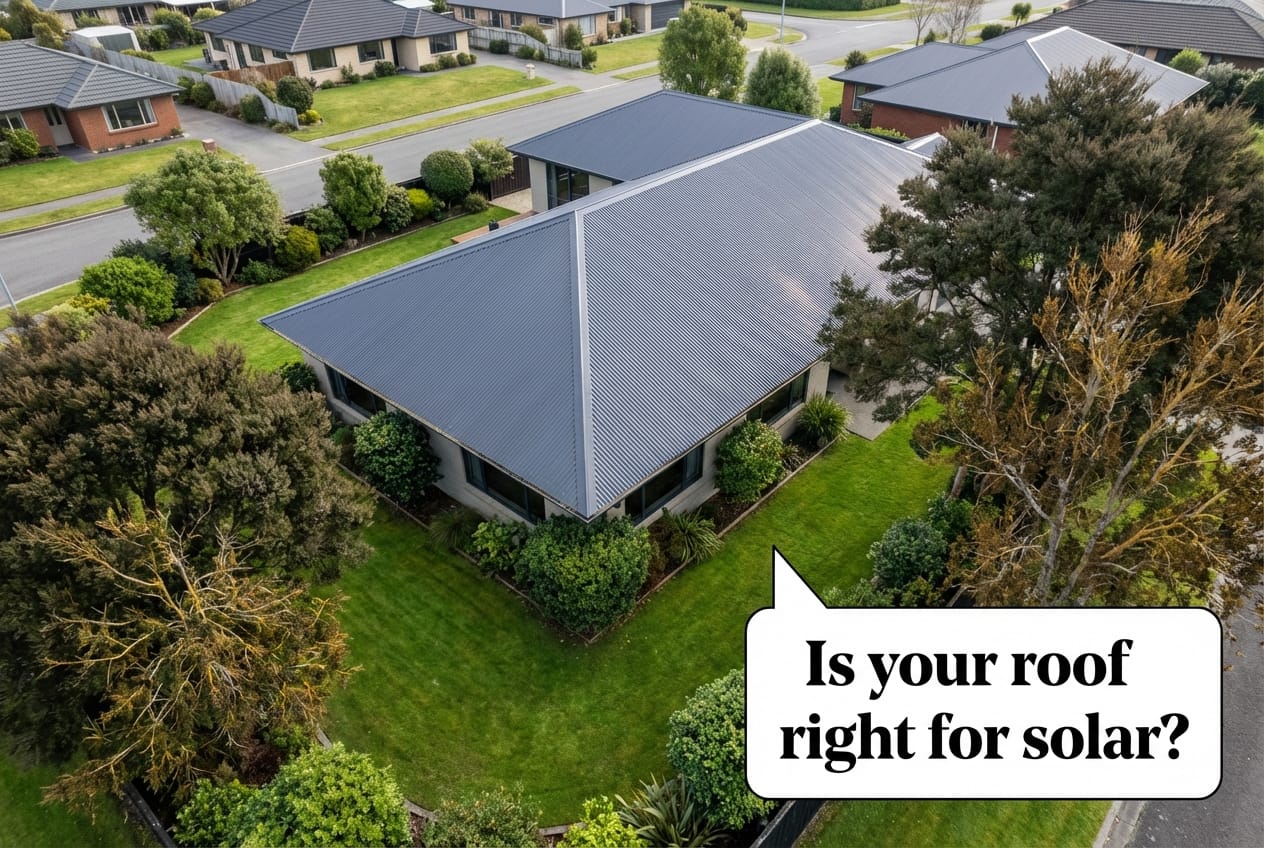
Is My House Suitable for Solar Panels?
Check if your NZ home is right for solar. Roof direction, pitch, shade, and structural factors explained for Kiwi houses.
Read
Paying for Solar in NZ: Cash vs Green Loans vs Personal Loans (2026)
Cash vs green loans vs personal loans for solar in NZ. Real monthly payments, total interest costs, opportunity cost analysis, and the gotchas banks don't mention.
Read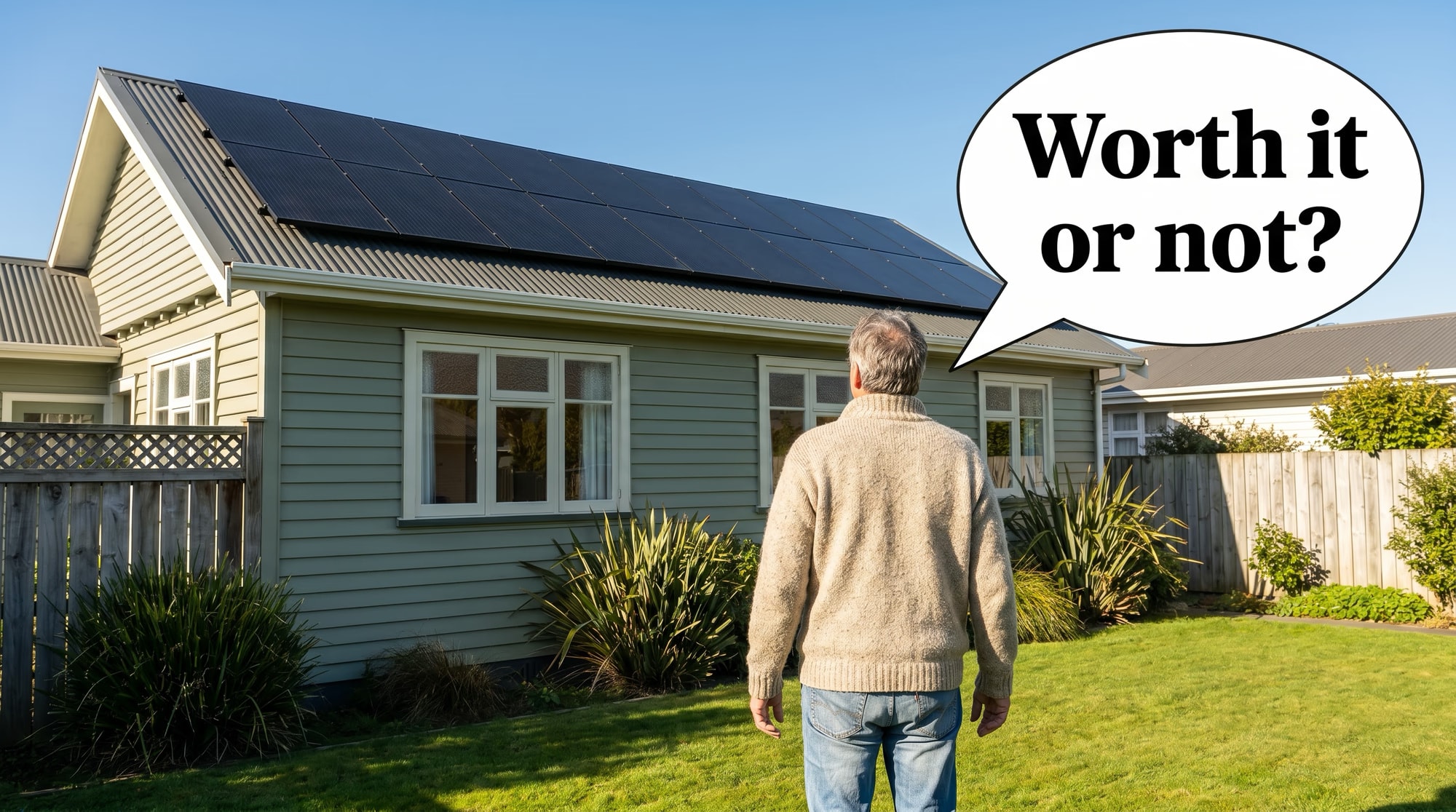
Are Solar Panels Worth It in New Zealand?
An honest look at whether solar makes financial sense for NZ homeowners. Payback periods, savings data, and the scenarios where it doesn't stack up.
Read
How Many Solar Panels Do I Need?
Work out how many solar panels your NZ home needs. Based on your power usage, roof space, and whether you're adding a battery or EV charger.
Read
Do Solar Panels Work in Winter and on Cloudy Days in NZ?
Solar panels still generate power on cloudy days and through NZ winters. Here's exactly how much output changes and why it still works.
Read
Join the conversation
The best comments are honest ones: Real experience. Share yours, please stay civil and on topic. No self-promo links.
Your email is never shown or shared. To change or remove a comment later, .
No comments yet. What is your experience with this? Be the first to weigh in.