
Solar Scams in NZ: Real Cases and What They Look Like
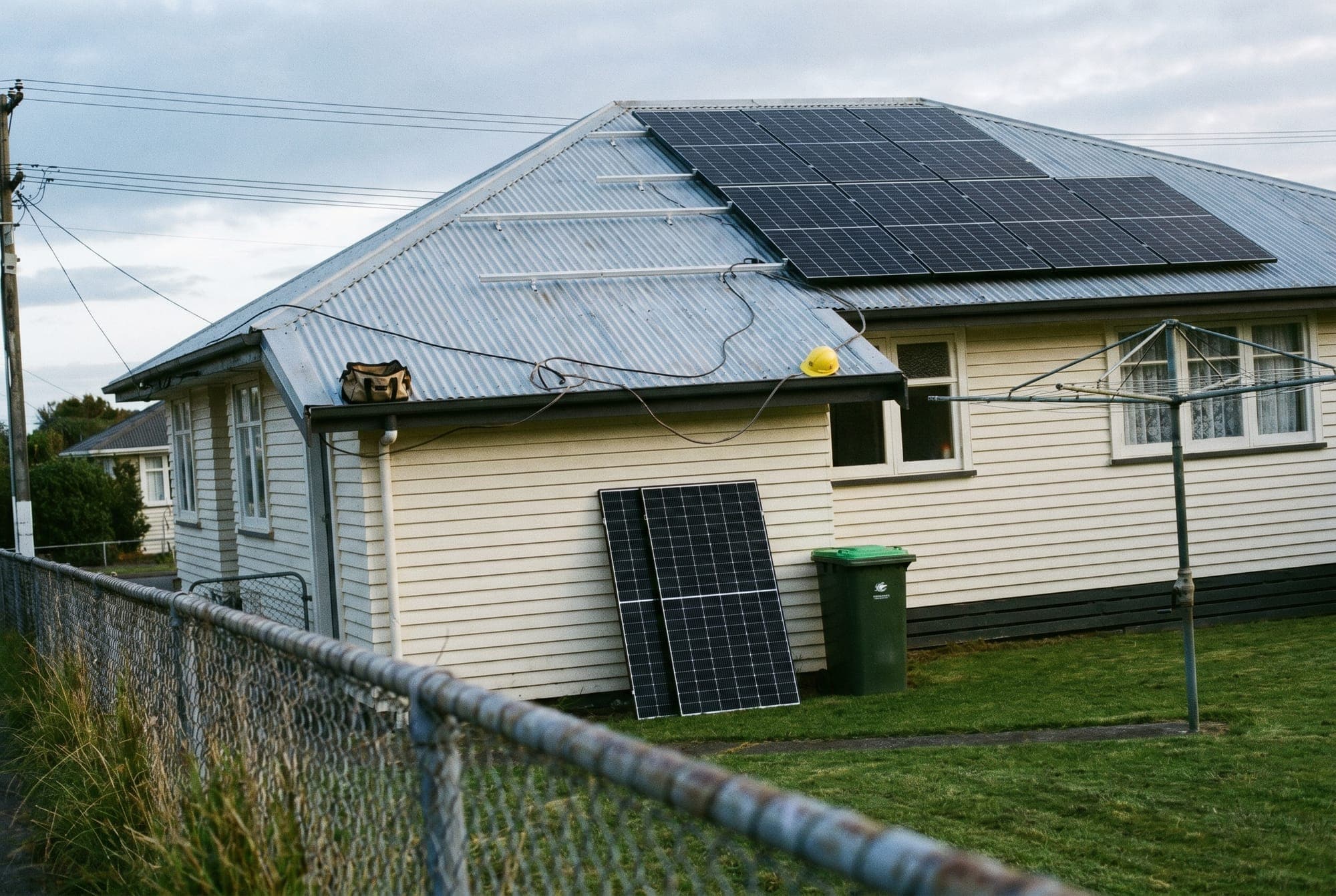

Three NZ solar companies entered liquidation in the eight months between November 2024 and July 2025. Roughly 15,000 households were directly affected by the largest one alone. The Commerce Commission has opened a preliminary investigation. The Government has wound down its $145m green-finance vehicle. Hundreds of millions in customer deposits, employee wages, and government loan exposure have been written off.
Solar technology is sound. Sun hits the panels, panels make power, the maths works. The business models and sales tactics that have grown up around the technology are where the trouble lives.
This is the honest case-study guide. Three named NZ companies, what actually happened to their customers, the patterns that link them, and the simple checks that would have flagged most of it before any deposit changed hands.
Three NZ Insolvencies in 8 Months: The Pattern
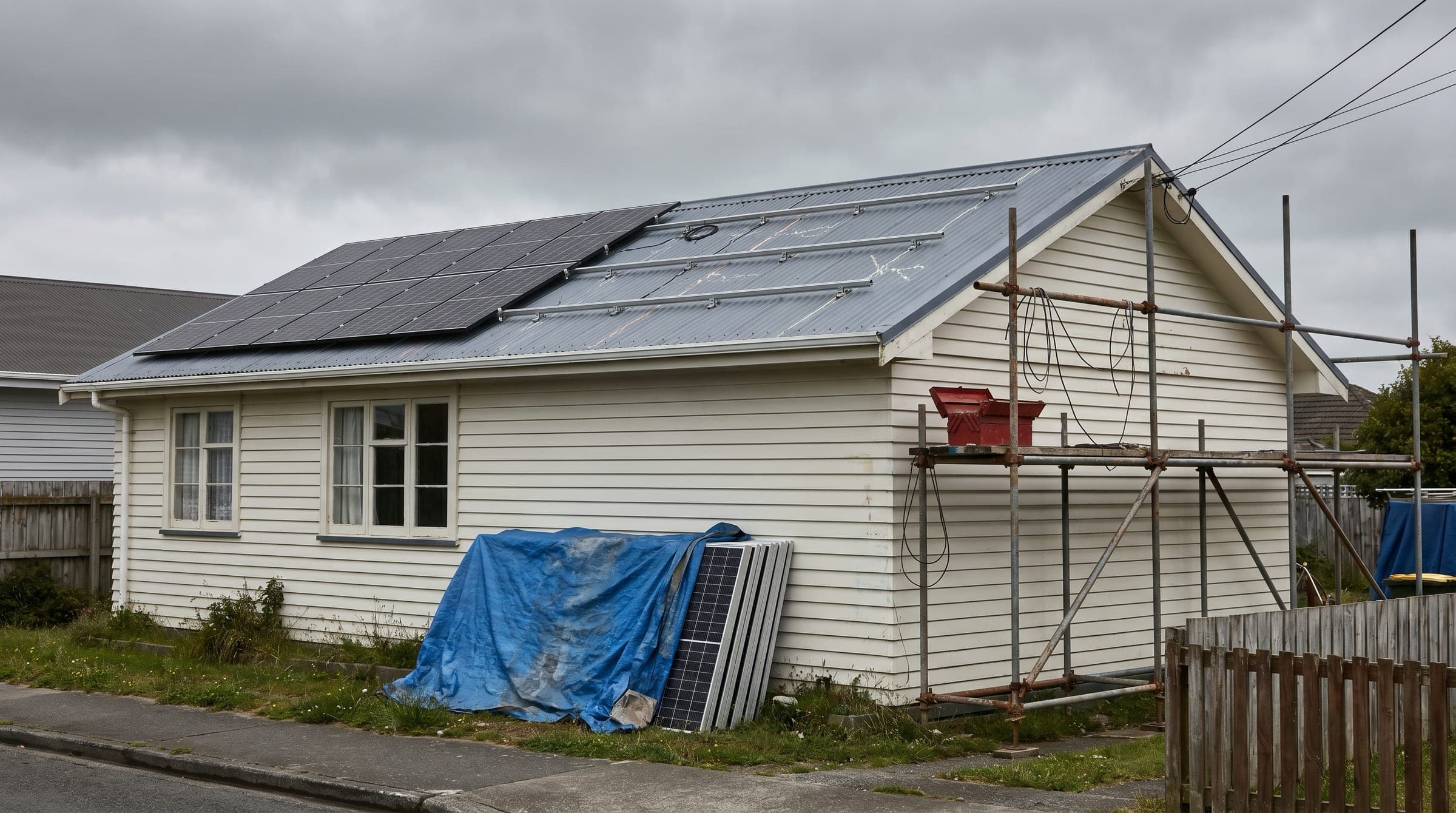
Three named NZ solar entities formally distressed in eight months:
- November 2024: SolarZero Limited (BlackRock- backed, ~15,000 customers) entered liquidation
- March 2025: Guru NZ Limited / Holdings, receivers appointed by China Construction Bank
- July 2025: Solar Group Limited entered liquidation, more than $3m owed to creditors
The industry view, per Rewiring NZ: the technology works. The business models (long-term subscription contracts, undercapitalised installers, aggressive growth funded by debt) are the exposure.
The solar panels are not the scam. The contract you sign to get them onto your roof sometimes is.
Case 1: SolarZero. What 15,000 Customers Learned
What happened
- Entered liquidation 26 November 2024
- Liquidators: Russell Moore and Stephen Keen, Grant Thornton New Zealand (joint and several)
- Owner at liquidation: BlackRock (acquired from NZ founders in 2022)
- Approximately 15,000 residential subscription customers, approximately 40% of the NZ residential market share at August 2024
- Per the first liquidators’ report: more than $40 million owed to creditors, including around 200 staff and contractors owed approximately $4m
- NZ Green Investment Finance had approximately $145m loan exposure and recorded a $113.3m impairment. The Government announced the wind-down of NZGIF in April 2025.
What customers experienced
The model wasn’t ownership. It was a 20 to 25-year subscription where SolarZero owned the hardware and customers paid monthly for “energy as a service.” Servicing was taken over by Verofi Limited, with Public Trust managing the customer contract trust.
According to Newsroom (September 2025), the 8c/kWh price protection cap on grid energy was reportedly removed post-liquidation. One customer’s bill was reported to have gone from $124.11 in February to $503.34 in March.
Customers wanting to sell their house were reportedly quoted upwards of $20,000 to buy out the system or relocate it (Newsroom, June 2025).
The Commerce Commission opened a preliminary investigation in October 2025. 162 Fair Trading Act complaints were received, 66 of them post-liquidation. The investigation is ongoing. Complaints allege breaches; no findings have been made.
Newsroom reported in October 2025 that 26 customers had stopped payments, with live cases at Utilities Disputes.
What it teaches
The single most important point in this guide:
A solar subscription is not the same as solar ownership. The contract sits with the company. If the company changes hands or fails, the contract terms can be assigned to a new servicer. Conditions like price caps can change.
A genuine green loan from a NZ bank (Westpac, ANZ, ASB, BNZ, Kiwibank) is also $0 upfront, but you own the system and the loan is separable from the property. That’s the honest version of “no upfront cost.”
Case 2: Solar Group Limited. The $3m Collapse
Public-record facts only.
- Entered liquidation 7 July 2025 at 8:15am (per NZ Gazette notice 2025-al3691)
- Liquidators: David Ruscoe and Stephen Keen, Grant Thornton New Zealand
- More than $3 million owed to creditors
- Secured creditor: Kiwibank (approximately $1.8m via General Security Agreement)
- Other creditors: Inland Revenue (~$1m), ACC, Fuji Xerox, Meridian Energy, MPI, NZ Couriers, Spark NZ
- Director’s stated reasons (per the liquidators’ report cited in NZ Herald): “cash flow constraints, declining sales, pricing pressure, low adoption of solar and reliance on financial incentives or subsidies”
What it teaches
A registered NZ company with a real bank facility, a real IRD relationship, and dozens of trade creditors can still fail. Customer deposits behind a $1.8m Kiwibank General Security Agreement are unsecured creditors: they queue behind the bank in liquidation. This is structural, not unusual.
Case 3: Guru NZ. The Receivership Pattern
Gazette facts only.
- Receivers and managers appointed 3 March 2025 by China Construction Bank (New Zealand) Limited
- Receivers: Kare Johnstone and Andrew Grenfell, McGrathNicol (Auckland)
- Guru NZ Limited was already in liquidation at the time of receivership; Guru NZ Holdings Limited in receivership
- Per NZ Gazette notice 2025-ar1186
We don’t have verified independent reporting on customer impact specifics. The pattern point stands: a third NZ solar entity formally distressed inside an eight-month window.
The "Free Solar" / PPA Pattern Explained
The single biggest takeaway from SolarZero. “Free solar” or “no upfront cost” is sometimes a 20 to 25-year subscription or Power Purchase Agreement (PPA) in disguise.
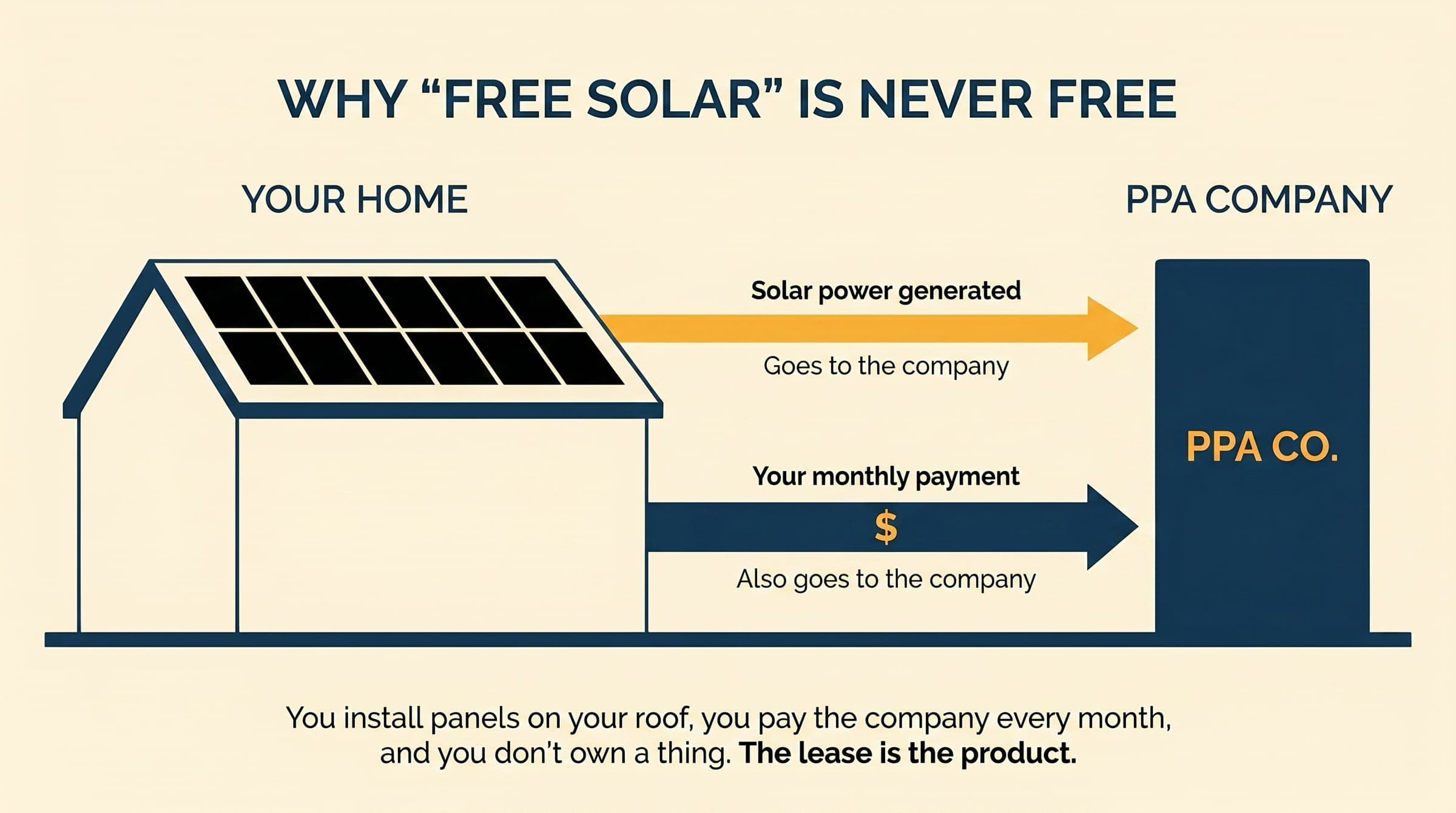
The structure
- You don’t own the panels or battery
- The hardware sits on your roof but is the company’s asset
- You pay a monthly fee for two decades or more
- When you sell the house, the buyer must accept the contract or you pay a buyout (SolarZero buyouts reported upwards of $20,000)
- If the company fails, the contract can be assigned to a new servicer with new conditions
The honest "no upfront cost" version
A genuine green loan from a NZ bank:
- $0 upfront, same as a PPA
- Interest typically 0-1% (Westpac 0%, ANZ/ASB/BNZ 1%, Kiwibank with cashback)
- You own the system from day one
- The loan is separable from the property: you can sell the house, repay the loan, move on
- If the bank had a problem, your panels would still be your panels
If the contract is more than five pages long, runs for more than ten years, and includes a price-per-kWh you’ll be charged for power generated on your own roof, you’re looking at a PPA, not solar ownership.
Want to compare
quotes?
Get matched with vetted local installers and see real quotes for your home. It’s free, with no obligation.
Compare up to 3 quotesDoor-Knocking and Your 5-Day Cooling-Off Right
When an uninvited solar salesperson approaches you (at the door, on the phone, at a market stall), the Fair Trading Act 1986 (s 36L) gives you a 5 working dayscooling-off right to cancel any contract you sign. Free, no reason needed. Most NZers don’t know they have this.

Where the right does NOT apply
- You searched online and visited their showroom
- You phoned them after seeing an ad
- You booked a quote at a home show stall after asking them
Where the right DOES apply
- Door-knocker pitches at your home
- Cold telemarketing
- Uninvited approach at a market or shopping centre
If a salesperson knocks on your door and tells you the price is “today only,” they’re describing the cooling-off period. They just don’t know it.
The Inflated-Payback Maths Trick
The Consumer NZ flag: quote software has a hidden setting for self-consumption rate: what percentage of the power you generate that you actually use yourself versus export to the grid. Adjusting this number is the easiest way to make a quote look better than it is.
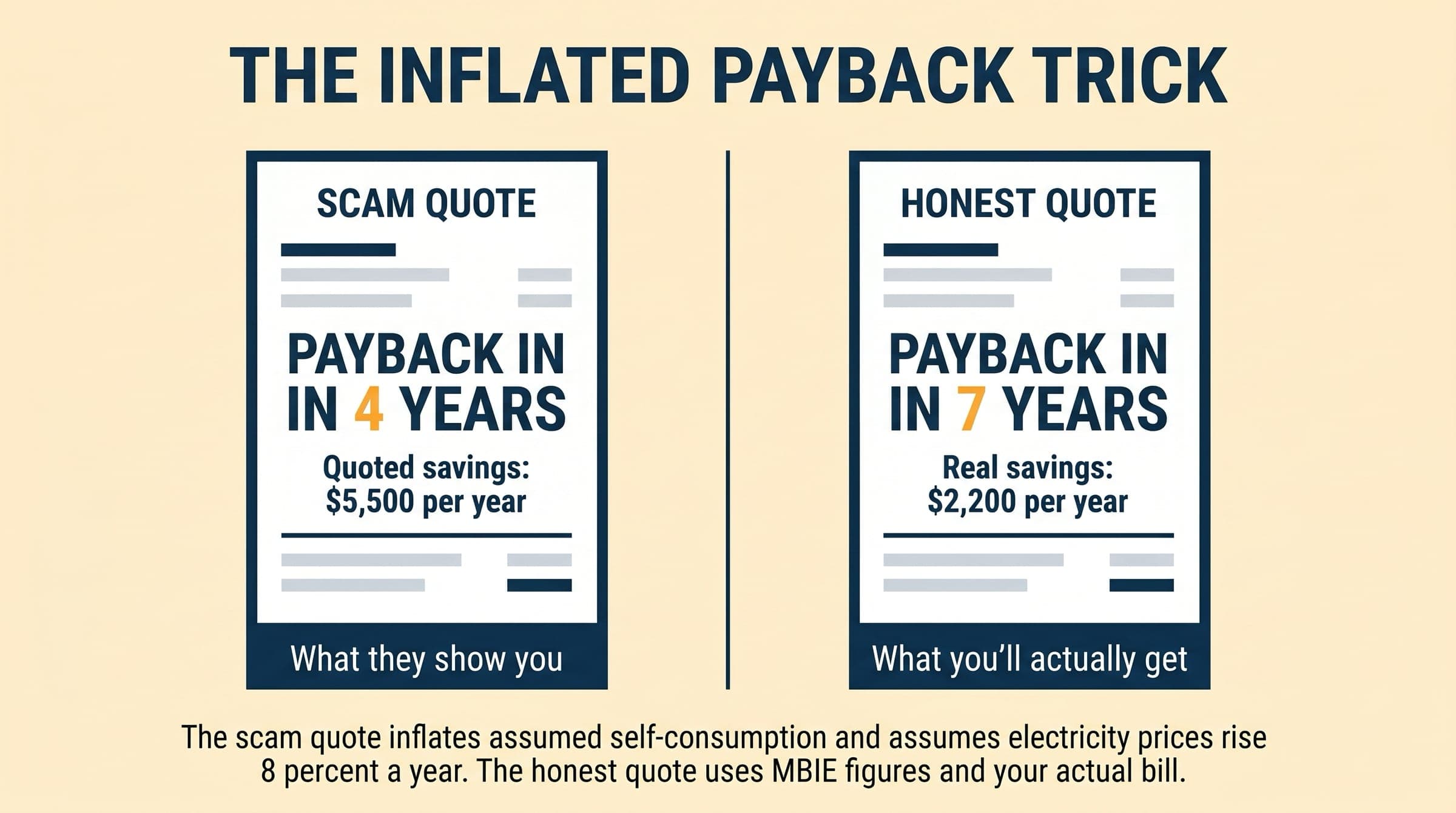
Why the gap matters
- A 6.6kW system generates ~9,000 kWh/yr in most of NZ
- NZ buy-back rates are 8-17c/kWh; retail rates are ~30-35c/kWh
- The gap between import (~30c) and export (~12c) is what makes the self-consumption assumption matter so much
- 75% self-consumption is achievable only with deliberate load-shifting (timer-controlled hot water cylinder, EV charging during the day, scheduled appliance use). Not the default.
How to spot it
Ask the installer: “What self-consumption rate did you assume in this quote?” If the answer is over 50% without a battery, ask why. If the answer is “I’m not sure,” walk. Our full payback breakdown for NZ households shows what realistic 30-50% self-consumption actually means for your bill.
Substituted Panels and Disappearing Paperwork
Two patterns Matt sees in the field.
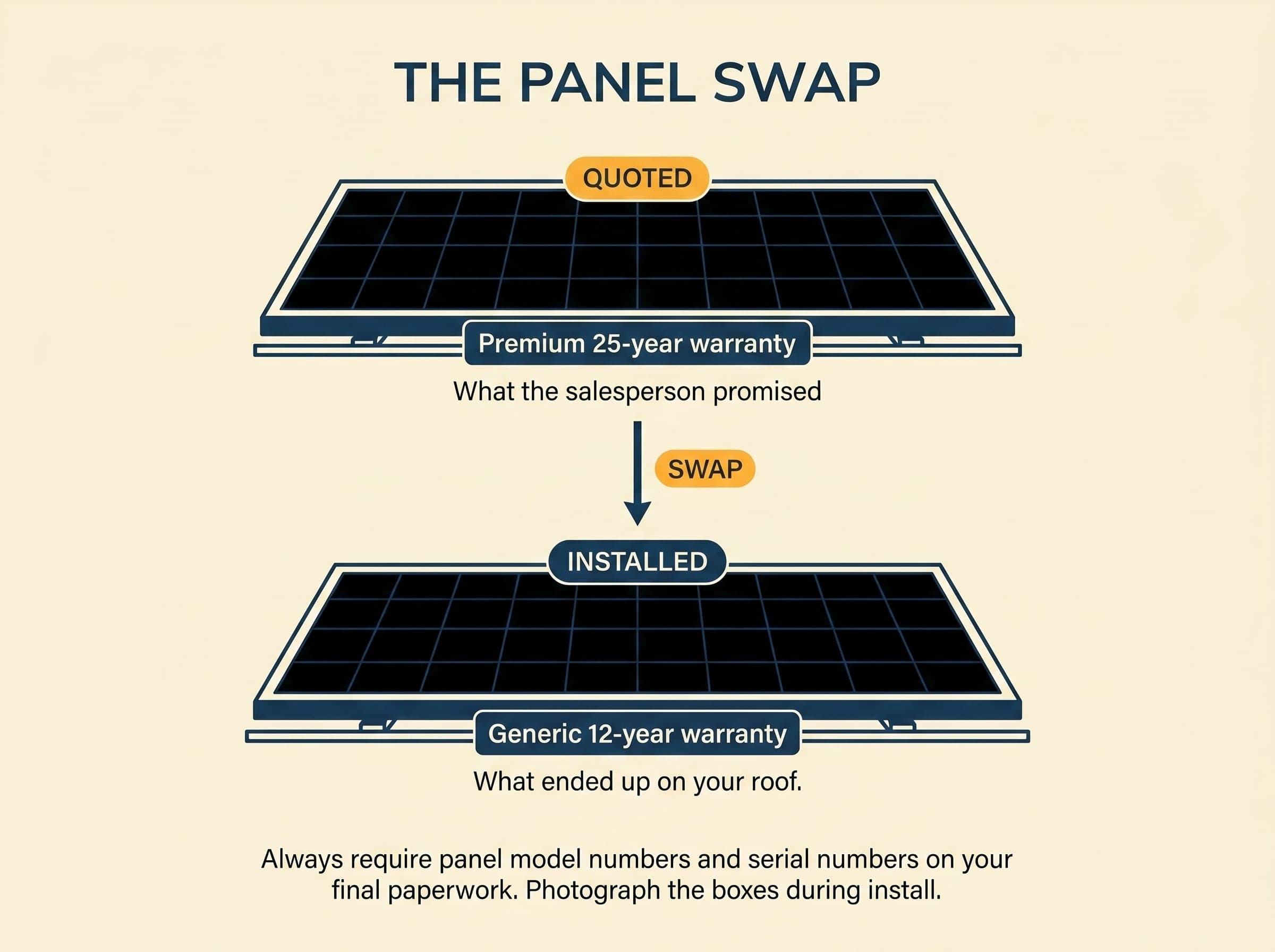
Substitution at install
The quote says “16 × 580W premium panels.” No model number. The installer turns up with whatever Tier 2 580W product they’ve got in stock. Customer doesn’t know to ask. Six months later, the system is operating fine but it’s not Tier 1. It’s not the panel the customer paid for, and the warranty may be shorter. Hard to undo.
The fix:insist on the model number in writing, before deposit. “JKM580N-72HL4-BDV,” not “premium 580W.”
Paperwork that walks away
Three documents the installer must hand you on completion:
- Certificate of Compliance (CoC): issued within 5 working days of completion, lodged with council within 10
- Electrical Safety Certificate (ESC): confirms the work is safe to use
- Record of Inspection (ROI): issued by an independent inspector, because grid-connected solar is high-risk prescribed electrical work
If the installer enters liquidation between completion and issuance, you can be left without a complete document chain. Insurance claims, warranty claims, and future-buyer inspections all hinge on these. Don’t pay the final invoice until you have all three documents in your name.
What to Do Before You Sign
The 9-step checklist.
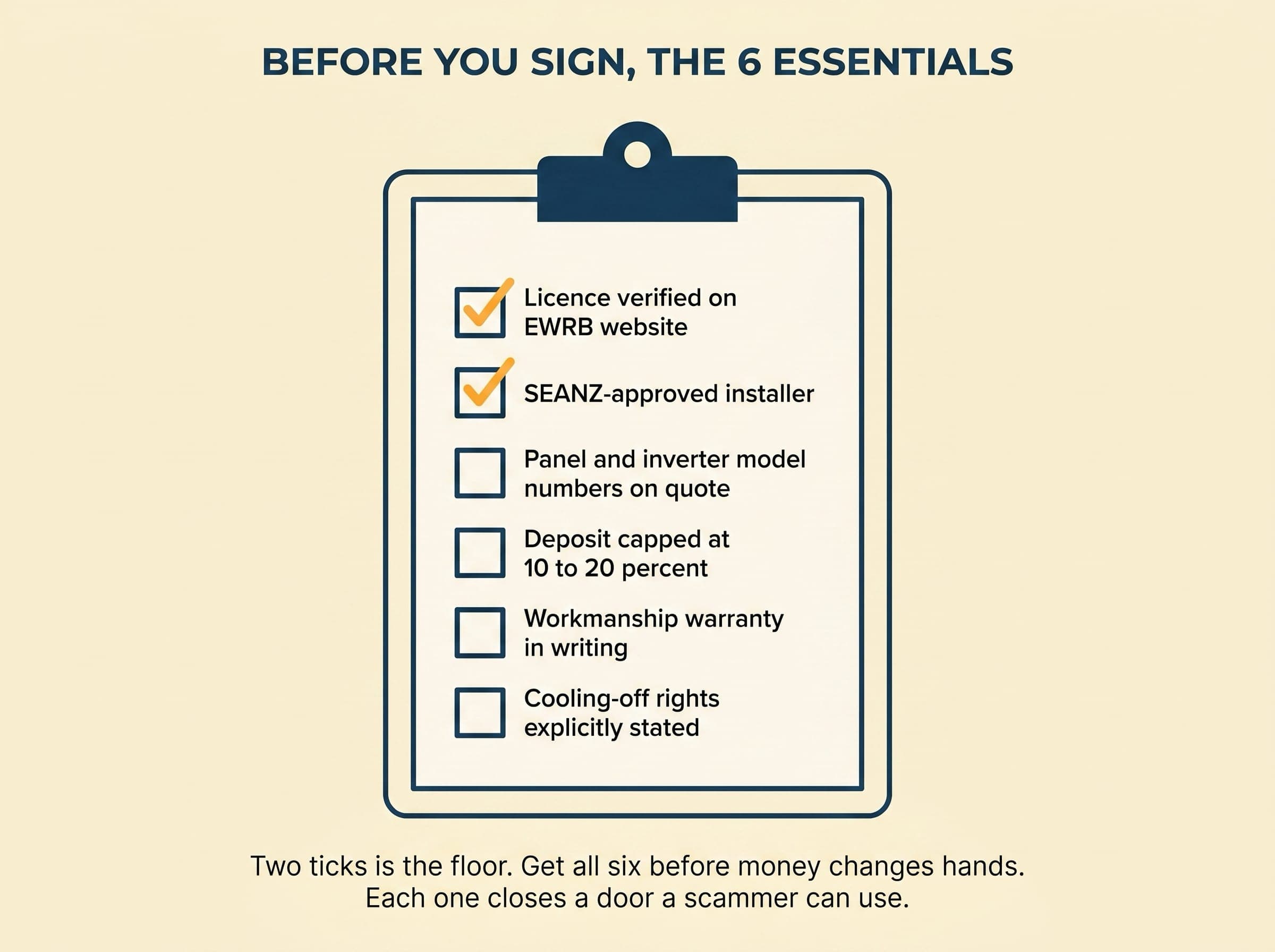
1. Verify the company at companies.govt.nz
NZBN, current registration, director history. Look for prior insolvent companies linked to the same directors.
2. Verify each electrician at ewrb.govt.nz
Registration class must be appropriate for high-risk PEW. The Mains Parallel Generation Systems endorsement has been mandatory in NZ from 1 September 2026.
3. Check SEANZ membership at seanz.org.nz
Members commit to a code of conduct and AS/NZS 5033 compliance. SEANZ membership is required for the ANZ and Kiwibank green loans, and is a quality signal for everyone else. Our guide to choosing a vetted NZ solar installer covers what SEANZ membership actually means in practice.
4. Cap deposit at 10-20%
Industry norm. Refuse “100% on order” demands.
5. Pay by credit card if possible
Chargeback rights via the bank if goods or services aren’t delivered.
6. Demand model numbers in writing
For panels, inverter, optimisers, battery. Not wattage. Not “premium.” Specific SKU. Our line-by-line guide to reading a solar quote walks through what every line should contain and the silent substitutions to watch for.
7. Insist the contract names the deposit-holder
And references your 5 working day cooling-off right if it was an uninvited sale.
8. Get all paperwork on completion
CoC, ESC, ROI, DG approval, monitoring login, manufacturer warranty registrations.
9. Use a Master Electricians member where possible
Their $20,000 / 12-month workmanship guarantee survives installer insolvency because it’s at the trade-association level (not the individual company).
Want to skip the homework? We pre-vet NZ solar installers on every step in this checklist before they appear on our network. Compare up to 3 quotes from vetted installers (free, takes 2 minutes, a vetted shortlist not the whole market).
Want to compare
quotes?
Get matched with vetted local installers and see real quotes for your home. It’s free, with no obligation.
Compare up to 3 quotesIf Your Installer Has Already Gone Bust
Practical recovery steps.
- Pay-by-credit-card?Initiate chargeback within the bank’s claim window (typically 120 days from transaction)
- Master Electricians member? Lodge the workmanship guarantee claim within 12 months of CoC
- Manufacturer warranty:survives the installer. Register or reactivate registration. You’ll need a new SEANZ-member installer to validate any future claim, but the panel warranty itself is still good.
- PPA / subscription contract? Free dispute service at Utilities Disputes (binding for participating retailers and providers)
- Ownership models? Disputes Tribunal for claims up to $30,000; District Court for larger
- Commerce Commission: report Fair Trading Act concerns at comcom.govt.nz
- Insurance: notify your insurer of the installer change so the system stays covered
If you lost a deposit and the company is in liquidation: register as an unsecured creditor with the named liquidator. Most unsecured creditors don’t see meaningful recovery, but the registration matters for any future class action.
Common Questions
Are solar panels a scam in NZ?
No. The panels themselves are a mature, well-tested technology: Tier 1 panels from Jinko, REC, Trina, JA Solar, and Aiko all carry 25+ year performance warranties from manufacturers operating at multi-gigawatt scale. The risk in NZ is the business model and sales tactics around solar, not the hardware. Three named installers entered liquidation in the eight months between November 2024 and July 2025.
Is "free solar" legitimate in NZ?
It depends on what’s being sold. A “free solar” offer that’s actually a 20-25 year subscription or PPA contract is legitimate but not ownership. You don’t own the panels, you pay monthly, and the contract attaches to your house. A “free solar” offer that’s actually a green loan from one of the big banks (Westpac, ANZ, ASB, BNZ, Kiwibank) is genuine $0-upfront ownership and is a much better deal for most homeowners.
What happens to my solar warranty if the installer goes bust?
The workmanship warranty (the installer’s promise that they did the work right) is gone. The manufacturer warranties on the panels and inverter typically survive: they’re registered to the system, not the installer. A new SEANZ-member installer is needed to validate future claims. Master Electricians’ $20,000 / 12-month workmanship guarantee survives installer insolvency if the original installer was an ME member.
How do I know if a NZ solar company is legit?
Four checks. (1) Verify the company at companies.govt.nz: look at director history. (2) Verify the named electrician at ewrb.govt.nz. (3) Check SEANZ membership at seanz.org.nz. (4) Cap your deposit at 10-20% and pay by credit card if possible. If all four check out, you’ve ruled out most of the documented patterns.
What is the self-consumption rate trick on solar quotes?
Quote software has a back-end setting for what percentage of generated solar power you’ll use yourself versus export. Realistic NZ residential is 30-50% without a battery. Some quotes assume 75%+, which doubles the apparent year-1 savings and halves the apparent payback. Same hardware, completely different number. Ask explicitly: “What self-consumption rate did you assume?”
Do I have a cooling-off period after signing a solar contract?
Only if the sale was uninvited (door-knocking, cold telemarketing, market stall approach). Under Fair Trading Act 1986 s 36L, you have 5 working days from receipt of the written agreement to cancel for any reason. Cancellation can be oral or written; a full refund is required. The right doesn’t apply if you initiated contact (online search, phone enquiry, showroom visit).
Can I get my deposit back if the solar company goes bust?
Usually no. Deposits are unsecured creditor claims and rank behind banks and IRD in liquidation. Mitigation: pay by credit card and use the bank’s chargeback process within the claim window (typically 120 days from transaction). Some installers participate in bank-issued installation guarantees: ask before signing.
What's the difference between a CoC and an ESC for solar?
The Certificate of Compliance (CoC) is issued by the installer within 5 working days of completion confirming the work meets standards. The Electrical Safety Certificate (ESC) confirms the work is safe to energise. Both are issued together in practice. Grid-connected solar also requires a Record of Inspection (ROI) from an independent inspector because it’s classified as high-risk prescribed electrical work.
Should I use a SEANZ-member installer?
It depends on your bank. SEANZ membership is required by the ANZ and Kiwibank green loans; Westpac, ASB and BNZ ask for a qualified professional installer instead. With an ANZ or Kiwibank mortgage, a non-SEANZ installer locks you out of the green loan. SEANZ members also commit to a published code of conduct and AS/NZS 5033 compliance, with continuity arrangements if a member exits the industry.
I think I've signed a dodgy solar contract. What do I do?
Check if the cooling-off period applies (uninvited direct sale, within 5 working days). If yes, cancel in writing today. If no, check whether the company is registered, what their workmanship warranty actually says, and whether the named electrician is on the EWRB register. If you’ve identified misleading conduct, file a complaint with the Commerce Commission at comcom.govt.nz. If the work has been done and you’re in dispute, the Disputes Tribunal handles claims up to $30,000.
Next steps for your solar journey
Related guides
View all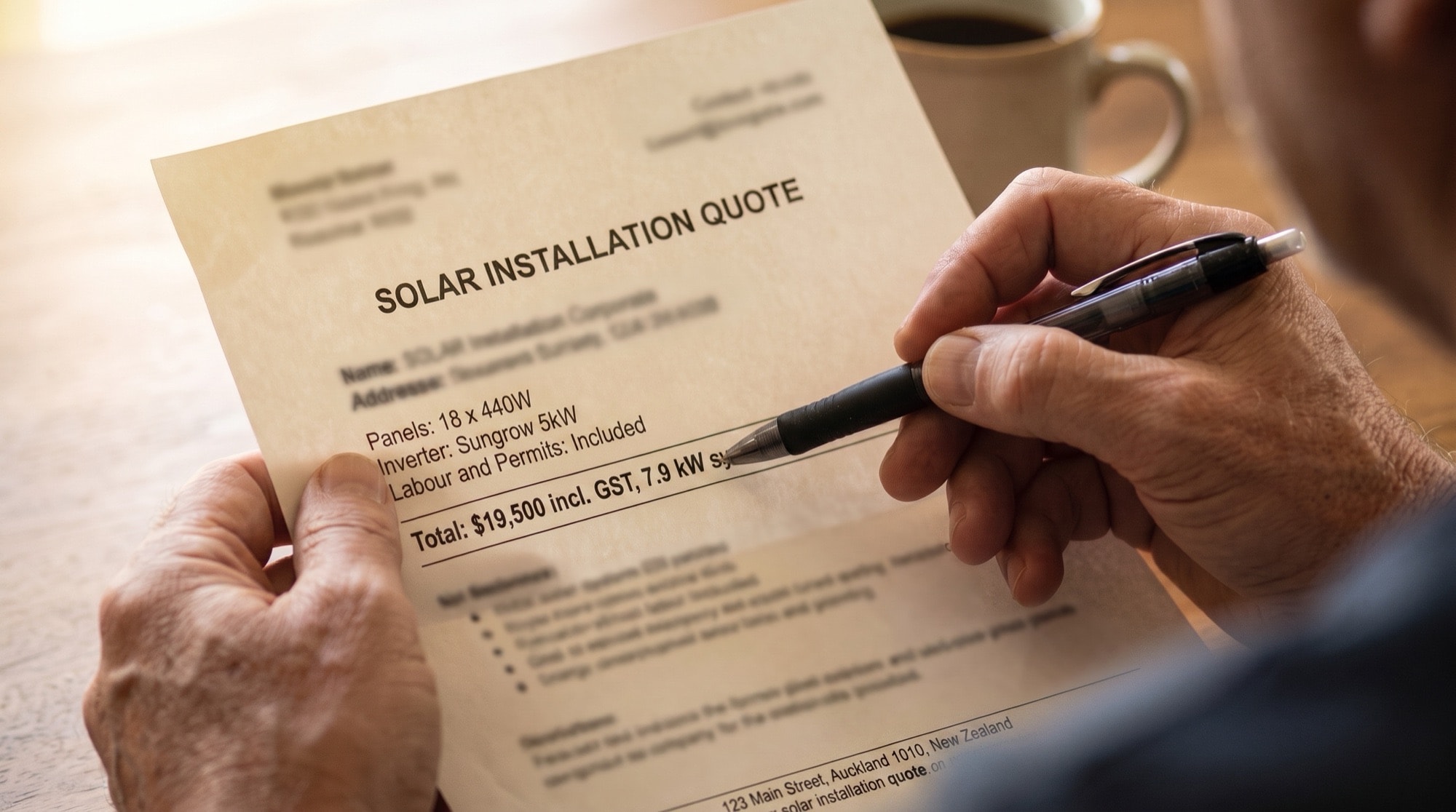
How to Read a Solar Quote: The Kiwi Buyer's Guide
Real Kiwi solar quotes have hidden gotchas. Line-by-line anatomy, the per-watt sanity check, what's missing, red flags, and a 26-row comparison rubric for 2026.
Read
Best Solar Panel Installers NZ (2026)
How to find a quality solar installer in NZ. What to look for, red flags to avoid, and when SEANZ membership matters for your bank loan.
Read
Buying Solar Panels in NZ: What You Need to Know
Everything NZ homeowners need to know before buying solar. The buying process, common mistakes, installer insolvency risks, and the gotchas nobody mentions.
Read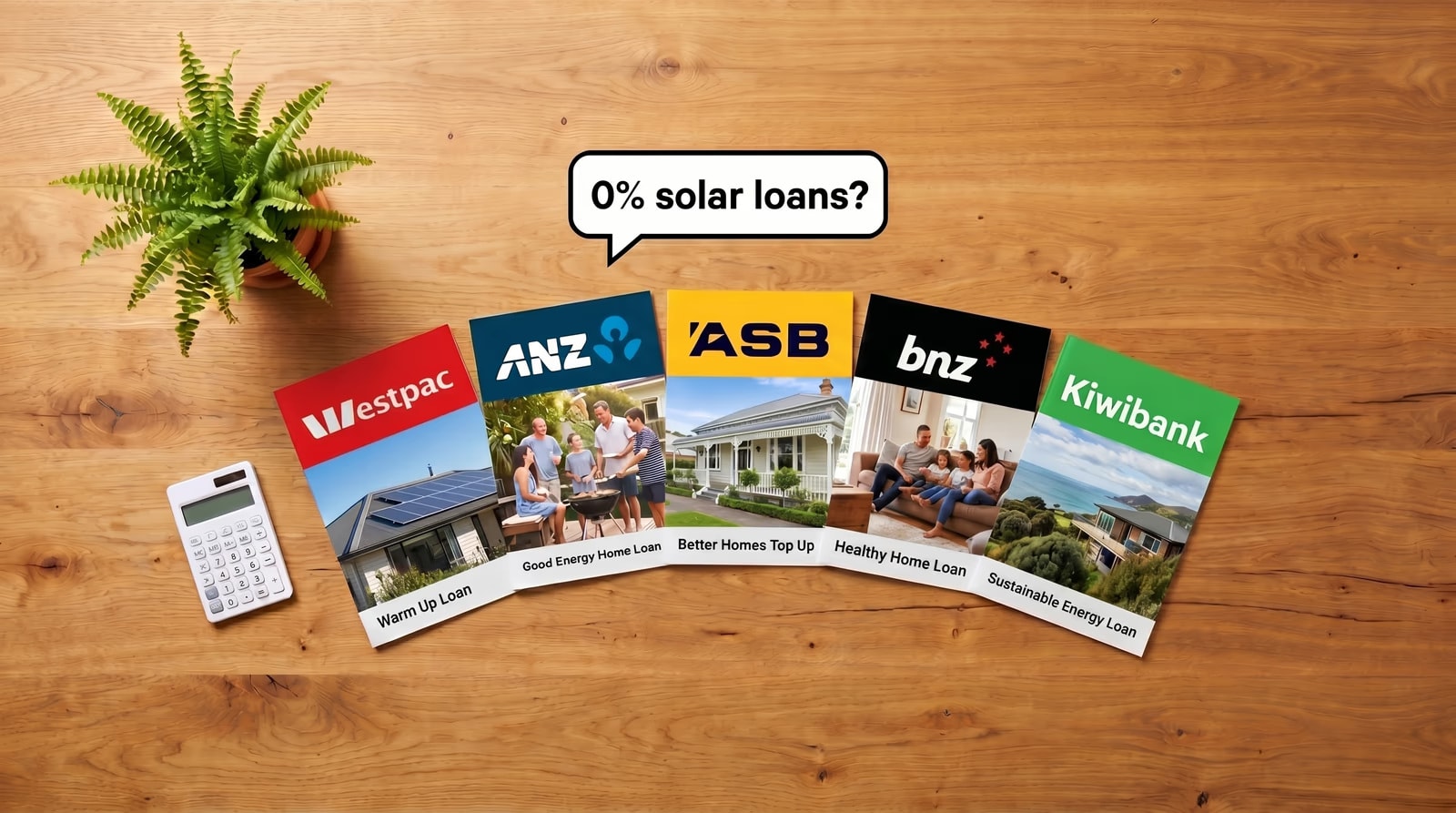
Solar Finance NZ: Green Loans Compared (2026)
Compare NZ solar green loans: Westpac 0%, ANZ 1%, ASB 1%, BNZ 1%, Kiwibank variable + cashback. Eligibility, terms, and which is best for you.
Read
Can I Claim Solar Panels on Tax in NZ? (2026)
How solar interacts with NZ tax, by audience. Owner-occupier, landlord, business, lifestyle block, Air BnB, and buy-back income. General info, not tax advice.
Read
Solar Panel Grants and Incentives NZ (2026)
What financial help is available for solar in NZ? Green loans, EECA programmes, and what NZ doesn't have compared to Australia and the UK.
Read
Join the conversation
The best comments are honest ones: Real experience. Share yours, please stay civil and on topic. No self-promo links.
Your email is never shown or shared. To change or remove a comment later, .
No comments yet. What is your experience with this? Be the first to weigh in.