
Can I Claim Solar Panels on Tax in NZ? (2026)

General information only, current as at May 2026. This guide is not tax advice. Tax rules change, and the right answer for you depends on your specific circumstances. Talk to a registered NZ tax adviser or chartered accountant before making any decisions.
Most New Zealand homeowners cannot claim solar panels on their tax. If you own your home and install solar for your own family's power use, that's private capital expenditure: no deduction, no depreciation, no GST claim. The boring answer is the honest answer.
But the second you're not an owner-occupier, things change. A residential landlord can depreciate the panels against rental income. A business owner can claim deductions AND GST. A lifestyle-block owner with mixed use needs to apportion. An Air BnB host crosses the GST threshold at $60k turnover and the whole picture flips. And if you're earning meaningful buy-back income from a large rural array, that might be assessable too.
This guide is the honest map of how solar interacts with NZ tax, broken down by who you are. Not advice. General information, current as at May 2026, and you should still talk to your accountant before signing anything.
The Honest Short Answer
The short answer depends entirely on what you do with your solar. Here's the honest summary:
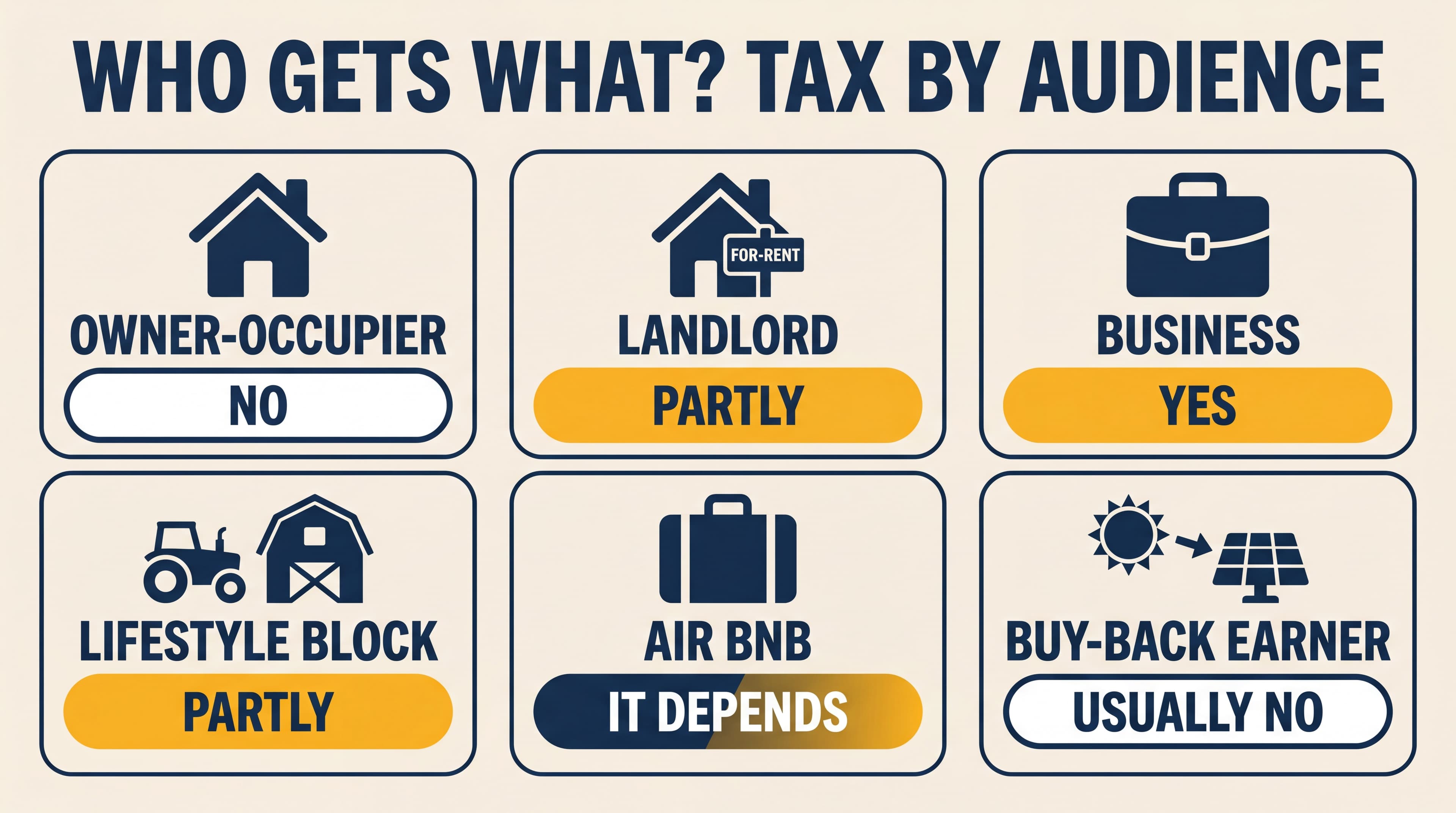
If you're in the first row (owner-occupier), the rest of this guide is a quick read. The section that applies to you is short. If you're in any other row, keep going. Each audience has its own section below.
Key takeaways
- Owner-occupiers in NZ generally cannot claim anything on their own home solar.
- Residential landlords can depreciate the plant and equipment but not the building.
- Business owners and commercial premises get the strongest tax case: full deductibility plus GST. The commercial solar page covers the business case beyond tax.
- The depreciation rate matters. EECA's commercial-scale modelling uses 16% diminishing value (10-year life), but classification varies by installer paperwork.
- GST registration kicks in at $60k turnover. Above that, Air BnB hosts can claim install GST.
- Buy-back income is generally not taxable for residential users. It only becomes assessable if you're operating an income-earning enterprise.
Want to compare
quotes?
Get matched with vetted local installers and see real quotes for your home. It’s free, with no obligation.
Compare up to 3 quotesIf You're an Owner-Occupier
The honest answer
Solar on your own home is private capital expenditure. What does help an owner-occupier is the lending rate: the bank green loans for solar sit at 0 to 1%.
- No income tax deduction (you're not earning rental or business income from it).
- No depreciation (you can't depreciate assets used for private purposes).
- No GST claim (you're not GST-registered for personal expenditure).
- Buy-back credits from your power retailer: generally not taxable for a typical household. The IRD's position is that small-scale private generation isn't a taxable enterprise.
What that means in practice
You pay the full cost (including GST) out of after-tax income. The "tax savings" you might have heard about don't apply to your situation. The value still comes from the power-bill savings and the export buy-back, not from the tax system. Read our Are Solar Panels Worth It? guide for the actual maths on owner-occupier returns.
If You're a Residential Landlord
Residential buildings have not been depreciable since 1 April 2024 (the 2024 reform reinstated commercial-building depreciation but excluded residential). But plant and equipment attached to a residential rental IS still depreciable. Solar PV is plant and equipment, not part of the building structure.
- The depreciation rate depends on classification. EECA cites 16% diminishing value (10-year life) for commercial-scale, but residential rental classifications can vary.
- GST is NOT claimable on a residential rental install. Residential rental income is GST-exempt.
- Mortgage interest is 100% deductible against rental income from 1 April 2025.
For the full landlord story (chattels valuation, depreciation rate negotiation, the legal trap most landlords miss on on-selling solar to tenants, and the worked example for a 6.6kW Auckland rental), see our solar panels for rental property NZ guide. The depreciation mechanic alone can shift the payback maths meaningfully for a landlord.
If You Have a Business or Commercial Premises
The tax position
- Solar on a commercial premises (or installed by a business for use in income-earning activity) is plant and equipment.
- Fully deductible via depreciation. Rate per IRD's general depreciation determination (current EECA modelling cites 16% DV / 10.5% SL, confirm current rate with your accountant).
- If you're GST-registered, you can claim the GST on the install (subject to apportionment if there's any private use).
- Interest on any loan used to buy the system is generally deductible against business income.
The instant write-off question
The COVID-era instant asset write-off thresholds expired. Confirm with your accountant whether any small-asset write-off applies to your install components (the threshold is currently $1,000 per asset for a low-value asset write-off, which is below typical solar install costs).
What this means in practice
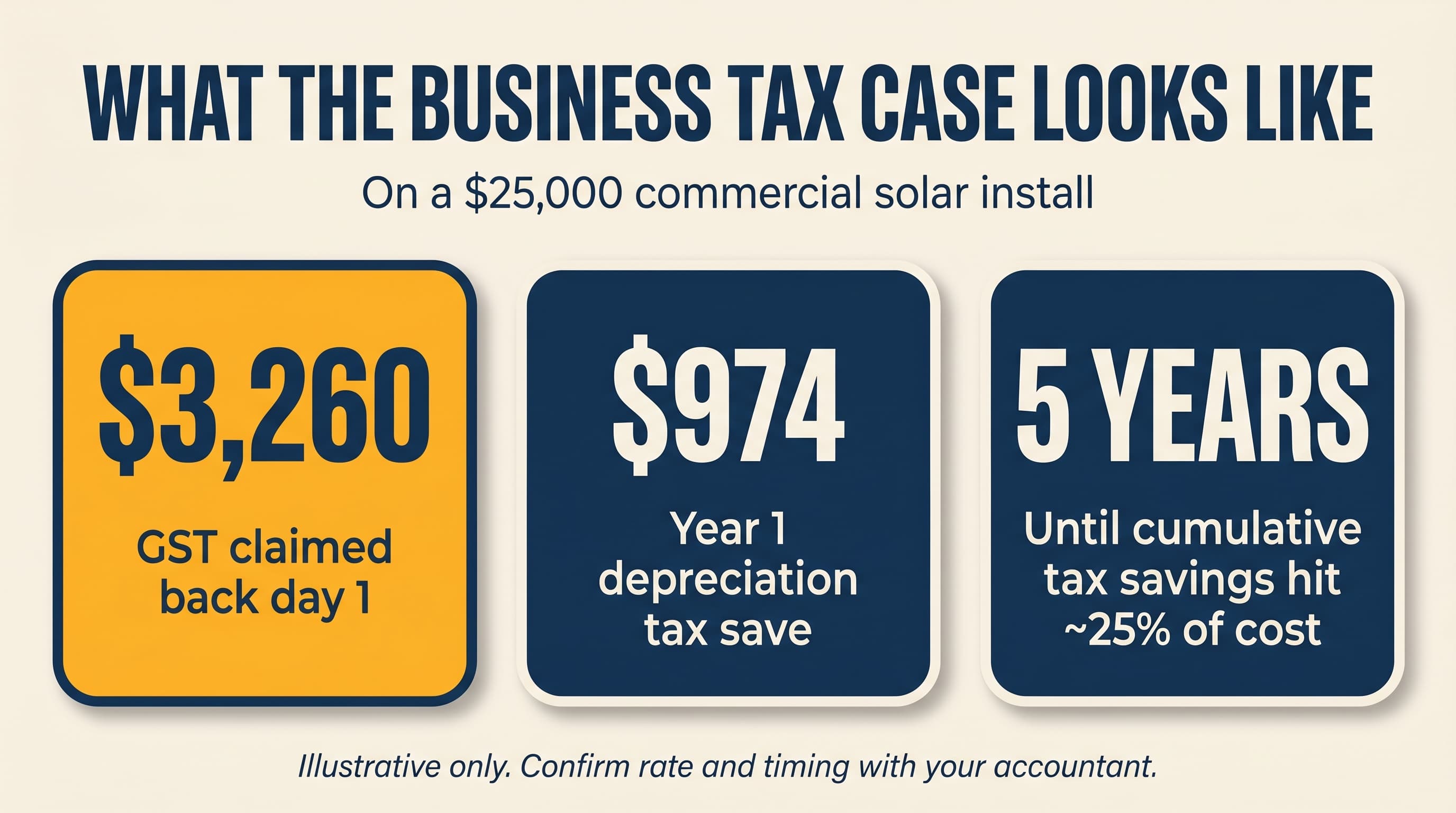
Say a business installs a $25,000 commercial solar system. They claim back $3,260 GST on day one (15% of the GST-inclusive price). The remaining $21,740 capital cost is depreciated over the asset's useful life at the rate IRD has assigned. At 16% DV, the first-year depreciation deduction is around $3,478, which at a 28% company tax rate reduces tax by roughly $974. By year five, cumulative tax savings can be a meaningful portion of the install cost.
Talk to your accountant about your specific rate and timing. The depreciation rules change and the worked example above is illustrative, not prescriptive.
Lifestyle Block or Mixed-Use Property
Lifestyle blocks often have mixed use: house (private), farm shed or workshop (income-earning), grazing block (potentially income-earning).
- Subpart DG of the Income Tax Act 2007 governs mixed-use assets. If your solar serves both private and income-earning uses, the deductible portion is the income-earning percentage.
- The apportionment can be based on physical separation (separate meters for each use) OR on a reasonable use-based formula. Your accountant works this out.
- Get a separate meter at install time if you want clean apportionment. Worth $500-$1,500 for the metering work to avoid years of apportionment debate.
- Same depreciation principles as the business case, just scaled by the apportionment factor.
For the farming-specific deep-dive, see our solar for farms NZ guide.
Want to compare
quotes?
Get matched with vetted local installers and see real quotes for your home. It’s free, with no obligation.
Compare up to 3 quotesIf You Run an Air BnB or Short-Term Rental
Air BnB / Bookabach / short-term rental income is generally a taxable supply (unlike residential rental).
- If your annual turnover from this activity is under $60,000, you can choose whether to register for GST. Most don't.
- If you go over $60,000 (typical for a productive holiday home in Queenstown or Wanaka), GST registration becomes compulsory.
- Once GST-registered, you can claim the GST on the solar install (subject to apportionment if you also use the property privately).
- Depreciation works similarly to residential rental: plant and equipment is depreciable, building is not.
- Mixed-use asset rules (Subpart DG) apply if you also live at the property part of the year.
A GST-registered Queenstown Air BnB owner claims back $2,608 GST on a $20,000 install. Private-use weeks shrink the depreciation deduction proportionally. Apportionment is an accountant conversation.
Is Solar Buy-Back Income Taxable?
For a typical residential homeowner exporting excess solar to their power retailer, the buy-back credit is generally not taxable income. The IRD's position is that small-scale private generation is not a taxable enterprise. The credit is effectively a discount on your power bill, not income.
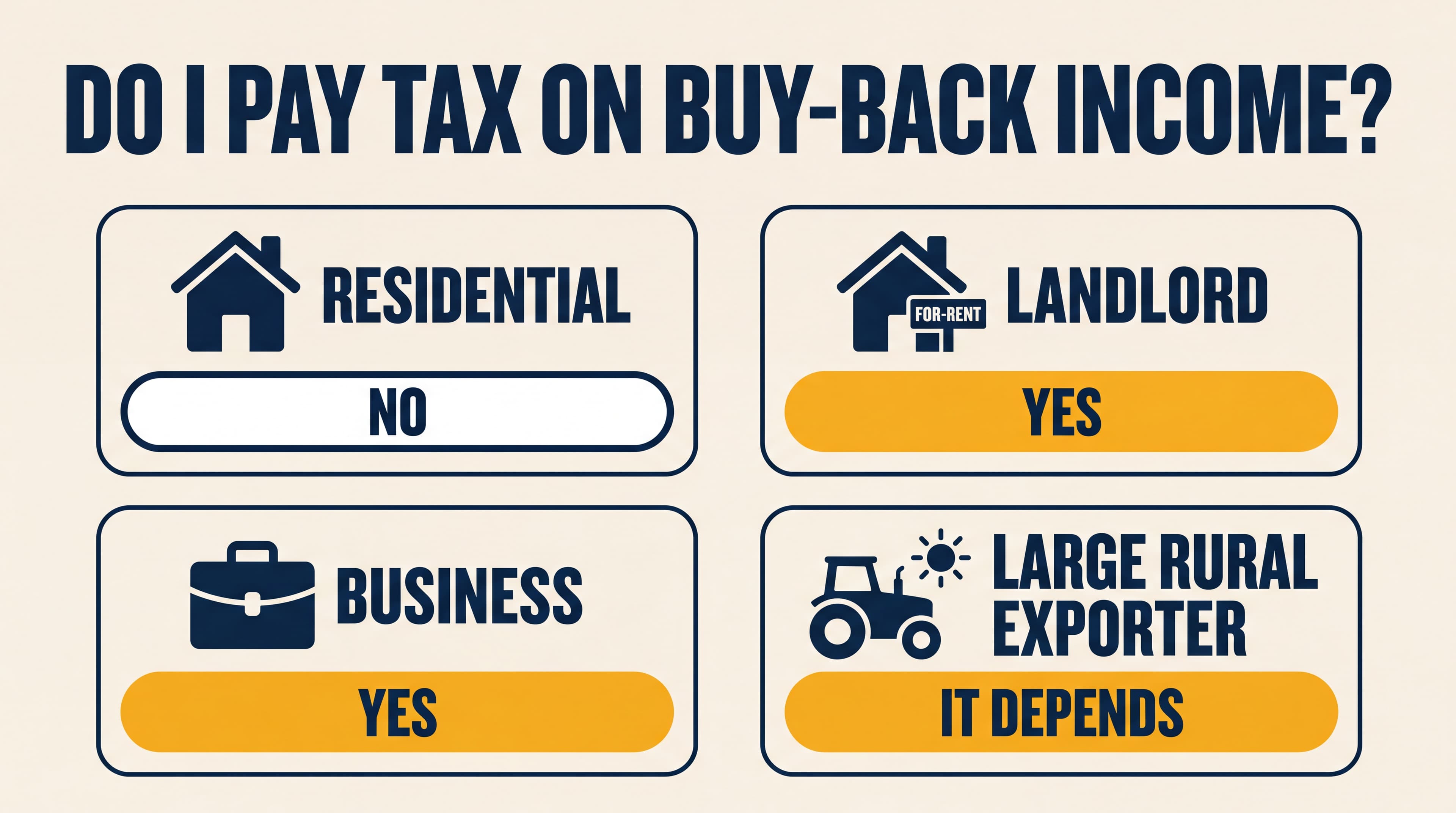
- For a landlord: buy-back income earned on a rental property IS taxable as part of rental income.
- For a business or commercial premises: buy-back income IS taxable business income.
- For a lifestyle block or large rural property exporting significant amounts: this can get murky. The Income Tax Act's distributed-generation provisions may apply. If your export volumes are large enough that the activity looks like an income-earning enterprise (for example, a 30 kW system on a small property exporting most of the production), IRD's general anti-avoidance and "trading" tests may apply. Talk to your accountant.
GST: When It's Claimable and When It Isn't
The general rule: GST claim follows the GST registration of the activity. If the install supports a GST-registered activity, you can claim. If it supports private or GST-exempt activity, you can't.
The Depreciation Maths
IRD's general depreciation determination (IR265) lists rates by asset class.
- Solar PV is typically classified under "Generators and ancillary equipment" (confirm class as of the 2026 financial year with your accountant).
- EECA's published commercial-scale solar modelling cites a 16% diminishing-value rate (10-year asset life). Equivalent straight-line rate is around 10.5%.
- Battery storage can be classified separately (typical asset life 10 years, similar DV rate).
- Inverters can be classified separately (typical asset life shorter, 7-10 years).
- A chattels valuer or your accountant assigns the line items at install time. Cost $300-$600. Worth doing for any rental, business, or mixed-use install.
Documentation You'll Need
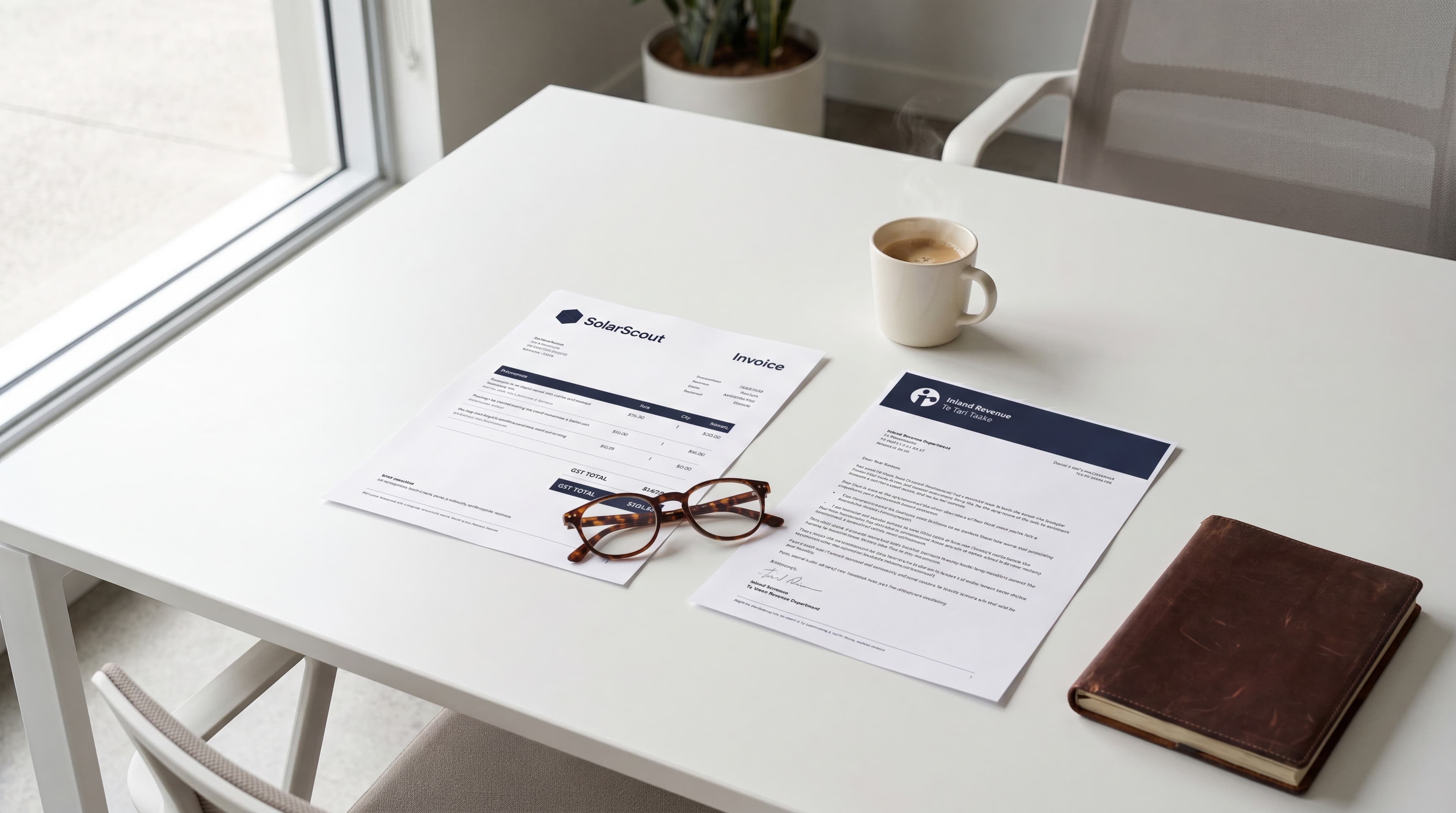
If your situation qualifies for any tax claim:
- A full GST-inclusive itemised invoice from your installer
- Separate line items for panels, inverter, battery, mounting, and electrical work (so the chattels valuer can apportion)
- Your installer's GST number on the invoice
- A chattels/plant valuation report if you're a landlord or mixed-use property owner ($300-$600)
- Asset register entry for each component
- Bank statements showing payment dates (timing matters for depreciation)
- For Air BnB: turnover records (the $60k threshold check)
- For business: evidence of business use (location, percentage, supporting business activity)
Keep all of the above for at least seven years (IRD's standard retention period for tax records).
When to Talk to an Accountant
Every tax outcome in this guide depends on classification, timing, and your circumstances. A 30-minute conversation with a chartered accountant before you sign the install quote can be the difference between claiming everything and claiming nothing.
If you're an owner-occupier, you probably don't need an accountant just for this. The answer is "you can't claim it" and the conversation ends there.
If you're a landlord, business owner, lifestyle-block owner, or Air BnB host, the conversation is worth its weight in cumulative tax savings. Most chartered accountants charge $200-$400 for a one-hour consultation. The advice routinely returns 10x to 50x that over the asset life.
Solar Scout doesn't recommend specific accountants. Ask your existing accountant about solar tax treatment, or search the Chartered Accountants Australia and New Zealand member directory at charteredaccountantsanz.com for a registered NZ practitioner.
Next steps for your solar journey
Want to compare
quotes?
Get matched with vetted local installers and see real quotes for your home. It’s free, with no obligation.
Compare up to 3 quotesFrequently Asked Questions
Can I claim solar panels on my tax return in NZ?
The honest answer is: it depends on who you are. Owner-occupiers, generally no. Landlords can depreciate the plant and equipment. Business owners can claim deductions and GST. The full picture is in the sections above. Talk to your accountant about your specific situation.
What's the depreciation rate for solar panels in NZ?
EECA's published commercial-scale modelling cites 16% diminishing value (10-year asset life), based on IRD classification. Equivalent straight-line rate is around 10.5%. Your accountant or a chattels valuer will confirm the right rate for your specific install and classification.
Can I claim GST on solar panels?
Only if you're GST-registered and using the install for a GST-registered activity. Owner-occupiers can't. Residential landlords can't (residential rental is GST-exempt). Business owners with commercial premises typically can. Air BnB hosts over $60k turnover can.
Do I have to pay tax on solar buy-back income in NZ?
For typical residential private generation, no. The IRD's general position is that small-scale private generation isn't a taxable enterprise. If you're earning significant buy-back income from a larger array (for example, 20kW+ on a lifestyle block), the situation can change. Talk to your accountant.
How does solar tax work for a rental property in NZ?
The building isn't depreciable (0% from 1 April 2024), but the solar PV system is plant and equipment, so it IS depreciable against rental income. No GST claim (residential rental is GST-exempt). Mortgage interest is 100% deductible from 1 April 2025. Our rental property guide has the full landlord deep-dive including the chattels valuation tip.
Are solar panels considered plant and equipment or part of the building?
Plant and equipment. This matters because residential buildings aren't depreciable in NZ (0% from 1 April 2024) but plant and equipment attached to them still is. Solar PV systems are classified as plant, same as a hot water cylinder or a heat pump.
Can a business write off solar panels in one year?
Generally no, unless the install meets the low-value asset write-off threshold (currently $1,000 per asset). Most solar systems exceed this and are depreciated over the asset life. Some 2020s instant asset write-off thresholds expired. Confirm current rules with your accountant.
Do I need a chattels valuation for my solar install?
If you're a landlord, business owner, or mixed-use property owner, yes. It's a $300-$600 expense that's itself deductible, and it locks in your depreciation position. If you're an owner-occupier, no.
Is interest on a green loan tax-deductible for solar?
Only if the loan is used for an income-earning activity. Owner-occupiers can't deduct mortgage or loan interest on their own home. Residential landlords can deduct interest at 100% (from 1 April 2025). Business owners can deduct interest on business loans against business income.
How is solar tax different for an Air BnB versus a residential rental?
Air BnB or short-term rental income is generally a taxable supply (unlike residential rental). Over $60,000 turnover, GST registration is compulsory and the install GST is claimable. Below $60k, the host can choose to register. Residential long-term rental is GST-exempt and the install GST is never claimable.
Related guides
View all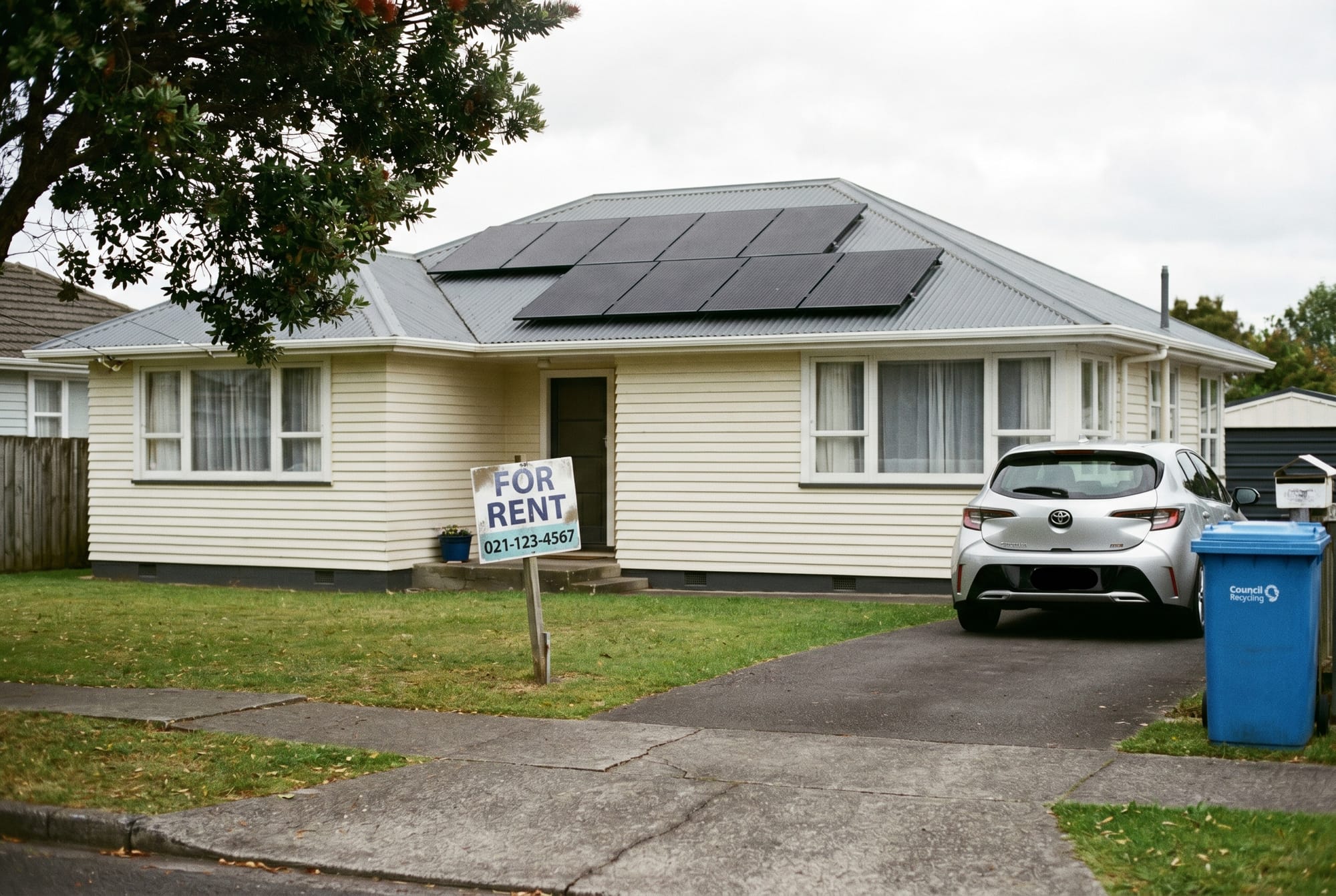
Solar Panels for Rental Property NZ: The Landlord's Guide
Should you put solar on your NZ rental? The honest answer: depreciation tax shield, buy-back, property uplift, body corp realities, and the legal trap most landlords miss.
Read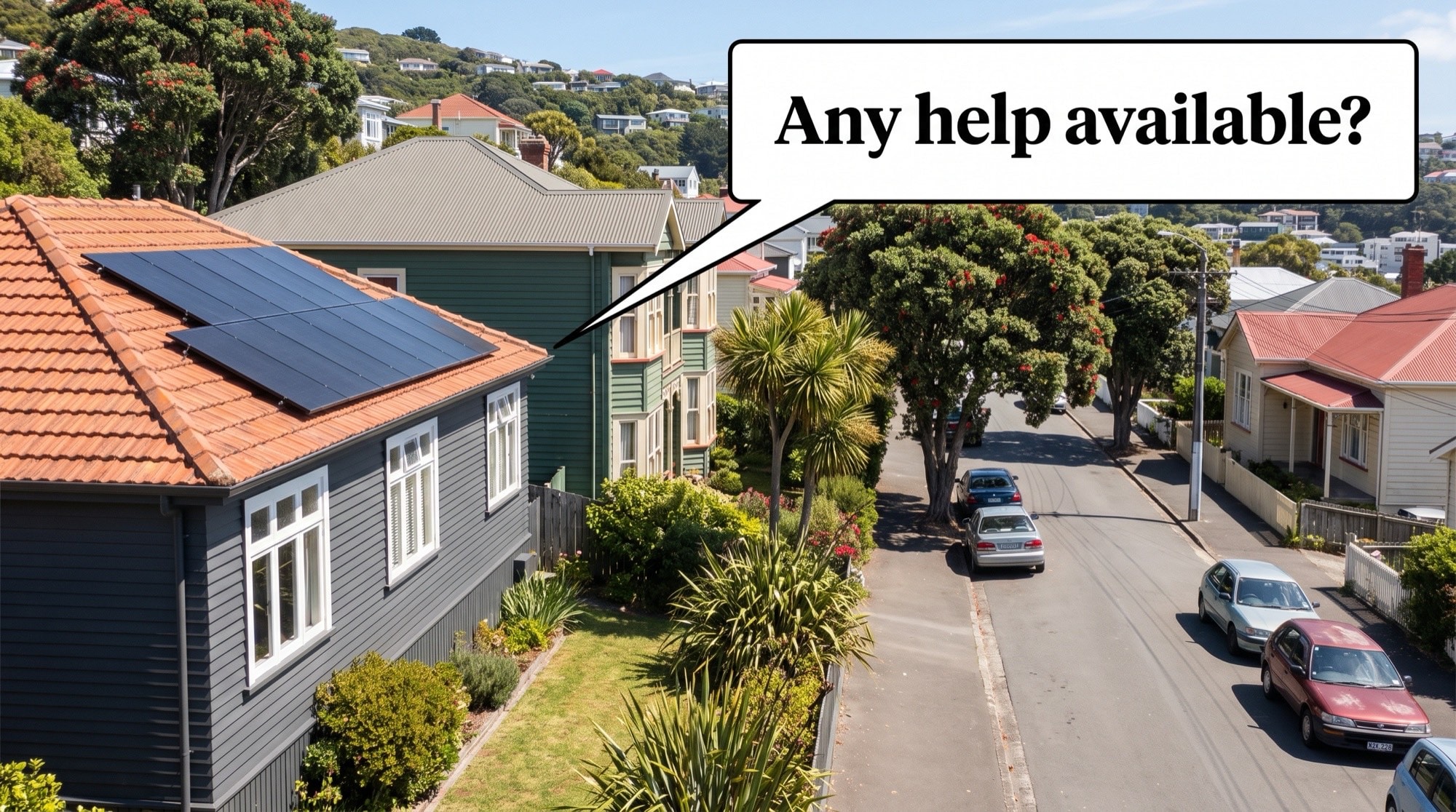
Solar Panel Grants and Incentives NZ (2026)
What financial help is available for solar in NZ? Green loans, EECA programmes, and what NZ doesn't have compared to Australia and the UK.
Read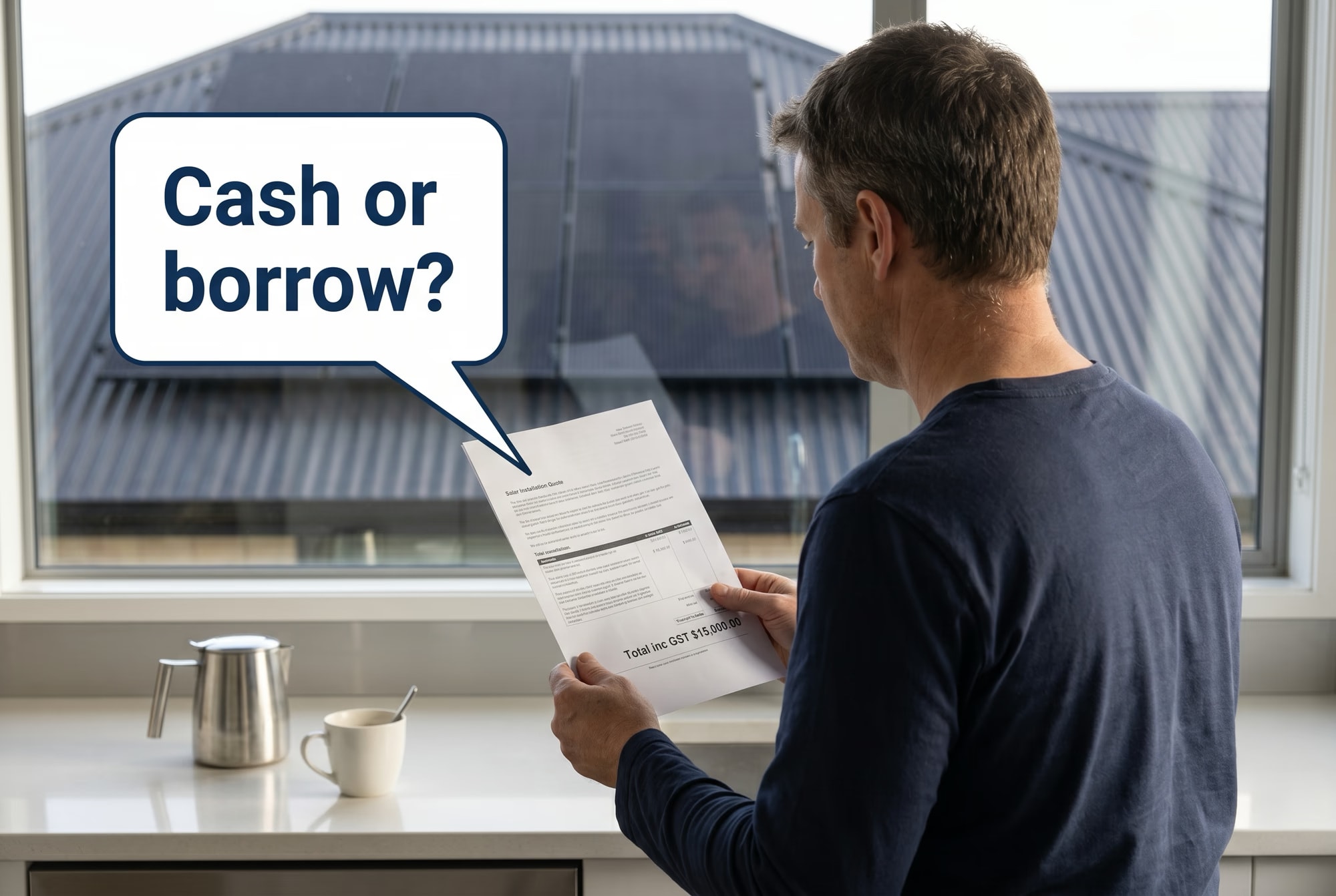
How to Pay for Solar in NZ: Cash, Loans and Payment Plans (2026)
Cash vs green loans vs personal loans for solar in NZ. Real monthly payments, total interest costs, opportunity cost analysis, and the gotchas banks don't mention.
Read
Best Solar Buy-Back Rates NZ: 13 Power Companies Compared (2026)
Compare solar buy-back rates across 13 NZ power companies. Octopus, Meridian, Mercury, Genesis, Contact, Power Edge and more.
Read
Green Loans NZ: Every Bank's Solar Loan Compared (2026)
Compare NZ solar green loans: Westpac 0%, ANZ 1%, ASB 1%, BNZ 1%, Kiwibank variable + cashback. Eligibility, terms, and which is best for you.
Read
Solar Panel Costs NZ: What You'll Actually Pay in 2026 (From $14,000)
Real pricing data for NZ solar in 2026. System costs by size, what affects price, and how to tell if a quote is fair.
Read
Join the conversation
The best comments are honest ones: Real experience. Share yours, please stay civil and on topic. No self-promo links.
Your email is never shown or shared. To change or remove a comment later, .
No comments yet. What is your experience with this? Be the first to weigh in.