

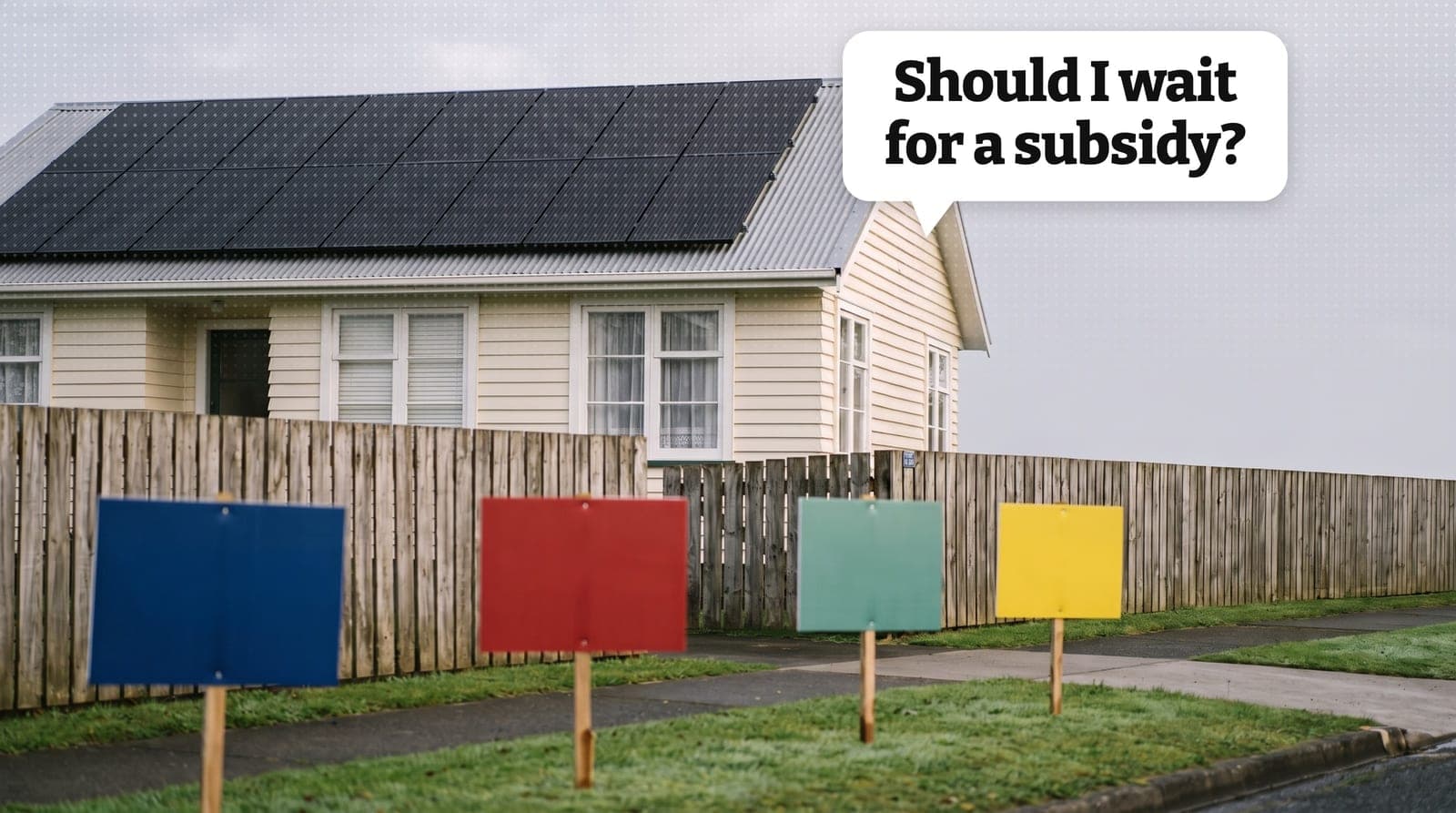
If you are sitting on a couple of solar quotes and wondering whether to hold off for a government subsidy before you sign, here is the honest answer: there is nothing to wait for.
The number of government grants for household solar panels you can apply for in New Zealand today is zero. Not "small", not "means-tested". Zero. Anyone telling you a subsidy is about to land and you should sign tonight is describing a policy that is not law, from a party that has not won an election that has not been held.
Key Points
- Right now there is no government solar grant, rebate or feed-in tariff in New Zealand. Zero you can apply for.
- Four parties have put solar money on the table for the 7 November election: Labour and National with dated loan mechanics, the Greens with a $980m package announced on 20 July, and none of it passed into law.
- Labour is promising a kickstart subsidy of up to $3,000. National is promising a low-interest loan repaid through your rates, not a grant.
- Both of the big promises lean on the Ratepayer Assistance Scheme, which Parliament has not passed.
- Waiting for a subsidy is realistically about 18 months, and on EECA's own figures that costs you roughly $1,500 in savings you would otherwise have banked.
There is no solar subsidy in New Zealand today
No national grant, no rebate, no feed-in tariff. EECA's page on home solar costs and savings lists bank loans and nothing else. Warmer Kiwi Homes co-funds insulation, a heat pump and LED downlights, but not a single solar panel. The one real government solar grant this year, Solar on Schools, is $30 million for up to 500 schools between 2026 and 2028: nothing for your roof. Today only your bank and your power company pay you anything toward solar.
One disclosure before the arithmetic: Solar Scout gets paid by installers when we introduce them to a homeowner, so if you wait we do not get paid. To stay honest we have used the government's own figures rather than an installer's, the bottom of EECA's savings range rather than the top, and left in the one scenario where waiting wins.
What you can actually get today
There are four banks offering discounted green lending that covers solar, all on EECA's home energy loans page, re-verified 14 July 2026, with each bank's terms re-checked on its own product page in August 2026.
EECA counts solar panels, batteries and inverters, or solar hot water. Kiwibank is not on EECA's list, but its Sustainable Energy Loan pays a $2,000 cashback over four years, at the standard variable rate. The catch runs through the whole table: every one is a top-up on a home loan you already hold with that bank, which rules out mortgage-free retirees, anyone who banks elsewhere, and renters. Labour reckons four out of five households cannot reach this finance; we could not verify that ratio, so treat it as Labour's claim, though the structural catch is real.
Every one of those loans, with its current rate, cap and conditions, is compared on our green loans page.
The other thing you can claim today has nothing to do with the government: what your power company pays you for the power you export, which varies more between retailers than anything any party has promised. Here is every retailer's buy-back rate.
We take the parties below in order of how much detail each has published, not our view or any poll. We report no polling.
Labour: SolarSaver, $160m and a $3,000 kickstart
Labour announced SolarSaver on 8 July 2026, and every figure here is off Labour's own SolarSaver page, re-verified 14 July 2026. It "costs $160 million over four years, funded by repurposing the Government's Gas Security of Supply fund". The centrepiece is a "kickstart subsidy of up to $3,000" for low and middle income households, renters included: Labour calls it a subsidy, not a grant, with no repayment. Alongside it sit a lines company loan repaid through your power bill, the Ratepayer Assistance Scheme (a loan attached to the property), and a $30 million community battery fund. An independent breakdown shows a chunk of that $160 million is scaffolding, EECA delivery and workforce training, rather than subsidy.
Two unpublished things matter more than the total. There is no income threshold, so you cannot check today whether you would qualify, the single biggest unknown here. And reporting cannot agree whether the $3,000 is repayable: Labour's page, RNZ and Stuff call it a subsidy, the NZ Herald a loan. The $750 and $1,000-a-year figures you will see are independent modelling from SEANZ and Rewiring Aotearoa on a larger 8 kilowatt system: projections, not savings.
The renter-facing part is plug-in solar, a two-panel kit Labour says "costs around $1,500, saves $300 to $400 a year". The catch, and the strongest verified fact here: plug-in "balcony" solar is currently illegal in New Zealand, because WorkSafe has prohibited the inverters these kits use, and Energy Minister Simeon Brown says making them legal takes about 12 months of standards work. Since then the Ministry for Regulation's 30 July 2026 review recommended legalising plug-in solar, with nine to 12 months of secondary legislation, and on 17 August 2026 Cabinet agreed to "continue work to enable plug-in solar". So the plug-in part of Labour's promise is being started by the current government, and it is still illegal today.
National: the Home Energy Fund is a loan, not a grant
National's pitch, announced 25 June 2026, is the Home Energy Fund, and it is a loan, not a grant: low-interest, long-term, repaid through your rates, no cash handout. Two conditions matter: your council has to opt in, and that is voluntary, so ratepayers in councils that do not join miss out; and you need 20% equity in your home, the same test a bank applies.
The Crown chips in $7 million for a 20% shareholding, with LGNZ expecting around $30 million to flow into the fund. National's page says repayment over ten years (Luxon has said ten or fifteen) and promises "low, competitive interest rates" with no figure; the roughly 3.8% used here is our estimate from LGNZ's claim of 2% to 2.5% below floating rates (near 5.8%), not National's number. It covers solar, batteries, insulation and heat pumps, and National would scrap the remaining council-consent rules for solar, though the government already cleared most of that from 1 October 2025. National expects 80,000 households over 15 years, about 5,300 a year.
One outlet asked what the fund offers that you cannot already get: access, not price. It is not cheaper than a green loan, it is available to more people. Put $11,500 on the table, EECA's typical installed cost for a 5kW system, and line the two up.
The fair point is cash flow: Westpac's 0% costs about $192 a month, National's about $84 for three times as long, so a household that cannot find $192 a month can still service the dearer loan. A wider door, not a cheaper one.
Both Labour's second loan route and National's entire fund run on the same plumbing: the Ratepayer Assistance Scheme. LGNZ describes it as "a new local government-led, low-cost loan scheme" with solar in scope, priced "typically 2% to 2.5% below equivalent bank floating mortgage rates" (LGNZ's claim, not a regulated rate). The business case is now with the government; without enabling legislation it cannot run, the clearest reason nothing on this page is claimable in 2026. Since then: 24 councils have given non-binding in-principle support (Kāpiti Coast joined 23 others on 3 September 2026); the business case sits with Local Government Minister Simon Watts, who told Newsroom in July it "is not something that could realistically be done before the election"; no bill was introduced before Parliament was dissolved on 1 October 2026; and on 15 October 2026 Chris Hipkins committed Labour to the full three-part scheme, rates postponement and development contributions as well as the property loans, at LGNZ's conference in Rotorua.
The Greens and the smaller parties
The Greens' 2026 package arrived on 20 July: KiwiPower, a $980 million public power entity funded from the party's proposed wealth tax, with zero-interest loans for solar and batteries for up to 90% of homeowners, $460 million to put solar on more than half of public homes within four years, $200 million for community energy, $80 million for Māori housing, legal plug-in solar and a renters' right to solar, all on the party's policy page. There is no grant in it, and the loan scheme is not costed in any source we could verify, so the 2023 Clean Power Payment figures ($6,000 grants, $30,000 interest-free loans) are history, not policy. On 8 July 2026 the Greens called on Parliament to pass the Ratepayer Assistance Scheme before the House rose, offering "our 15 votes". It rose without passing it, and was dissolved on 1 October.
ACT openly opposes solar subsidies. Energy spokesperson Simon Court, put to RNZ: "ACT believes that if solar stacks up, Kiwis are going to invest without handouts." A real argument: a subsidy mostly pays people who were going to buy anyway. The counter, at equal strength: solar sits on roughly 1 in 35 New Zealand households, while in Australia, after about A$11.5 billion in grants that cut the upfront cost by around 30%, it is closer to 1 in 3, though Australia also has more sun, higher prices and a two-decade head start. ACT's 18 September 2026 electricity policy has no subsidy or loan in it: households could sell surplus power to any buyer at market prices, the gentailers stay whole, and private money is let into transmission.
NZ First: we could not locate a 2026 rooftop solar policy. Deputy leader Shane Jones told RNZ he was "quite interested" in the council loan scheme, but told Rewiring Aotearoa he is "very leery of creating a subsidy trap". Te Pāti Māori has previously floated a $1 billion Pūngao Auaha fund for Māori-owned community energy, plus solar on marae, kura and papakāinga, but that sourcing is from September 2023 and we found no 2026 restatement. Newsroom's September survey of the parties found the same: NZ First and Te Pāti Māori "did not provide specific policies at this stage but are generally supportive", while NZ First campaigns on breaking up the gentailers rather than on household solar.
What the current government did when it looked at this
The best guide to how long these promises take is the last three years. Ministers looked hard at Australia's grant model and decided not to copy it. Officials told them the up-front costs "take time to pay back", while noting that rebates accelerate uptake. What got done instead, from 1 October 2025: a no-consent clarification, fast-tracked consents for solar new-builds, and wider permitted voltage for export, tweaks officials rated "not clear and expected to be minor". Told by its own officials that rebates work, a government three years in office still chose not to have one. Two things are now in force that were not in July: since 1 October 2026 the Electricity Authority's Code obliges the big retailers that had not already done so to offer plans whose price changes through the day for both what you use and what you export, with no minimum export price; and the 17 August 2026 Cabinet package to cut the installs needing resource consent, clarify the building rules and explore risk-based inspections, with approval for a standard install expected to fall from ten working days to the next working day.
The constraint none of the four policies mentions
None of the four policies mentions the one thing that actually caps what your roof can earn: your network's export limit, set by your lines company, varying from network to network, and applying whoever wins in November.
This is our live registry, built from each network's own published limits, re-verified 21 October 2026. Most now wave through the 10kW default; on the handful that do not, the system you can buy is smaller than the one in the brochure.
So when could any of this actually arrive?
Here is the calendar, from the parties' own words. Election day is Saturday 7 November 2026. Advance voting opens on 26 October, official results come on 27 November and the writ is returned on 3 December; a government forms in the weeks after, our estimate late November into December. Labour's promise is "up and running within 12 months of taking office", so around late 2027. Making plug-in solar legal is nine to 12 months of secondary legislation that the current government agreed in August to start. And both loan routes wait on the Ratepayer Assistance Scheme: pass the legislation first, then 12 to 18 months to stand it up. A homeowner who waits today is looking at a minimum of about 16 months, realistically longer. Round it to 18 months, an estimate.
What waiting costs, including the case where waiting wins
Now the number you came for, on stated assumptions: a 5kW system at $11,500 installed (EECA's figure, not an installer's), saving $1,000 a year. EECA's regional range runs from $1,047 in Southland up to $1,467 in Marlborough, and we have rounded down to $1,000 on purpose. It assumes a house using a fair bit of daytime power; if that is not you, your saving and your cost of waiting are both smaller. The arithmetic is simple: $1,000 a year, foregone for a year and a half, is $1,500 you never banked.
And $1,500 is the floor, because the bill solar offsets keeps climbing. The Electricity Authority's data shows bills rose 6.8% in the first half of 2026 after 8.0% in 2025, with lines charges 54% of the rise, and some retailers are raising prices again before Christmas: Contact from 3 December, Genesis for most customers, most by under 10%.
One last part of your bill solar cannot touch is the daily fixed charge: the low-user cap comes off on 1 April 2027, after stepping up from 30 cents a day in 2021 to $1.80 (before GST) on 1 April 2026. Solar shaves the variable units you use, not the fixed line, and we pull the real change apart from the scare story wrapped around it in our piece on the 1 April 2027 shock.
If the arithmetic says sign, every installer we match you with is EWRB registered and a member of Master Electricians. Get matched with vetted installers: free, about two minutes.
Right of reply, and our corrections policy
The Greens published their 2026 package on 20 July and it is reported above; we could not find a 2026 rooftop solar policy on the NZ First or Te Pāti Māori sites, so we have said exactly that rather than guess at their positions. If any party thinks we have them wrong, or Labour or National spot a figure we have got wrong, tell us and we will publish it and update this page. Corrections go at the top of this page, not buried at the bottom.
Keep reading

Sources
All fetched 14 July 2026; the Greens, ACT, Cabinet, Electricity Authority, council and Labour items dated after July were added on 19 October 2026.
Government and regulator (primary)
- General Election to be held on 7 November, Beehive
- Solar on schools to boost future resilience, Beehive
- Government announces new Solar on Schools programme, MBIE
- Mid-point review of the phase-out of the low fixed charge regulations, MBIE
- Electricity Authority takes closer look at price increases, Electricity Authority
- Understanding why changes to lines charges may impact your electricity bill, Commerce Commission
- Breaking down home solar costs and savings, EECA
- Understand home energy loans, EECA
- Warmer Kiwi Homes programme, EECA
Party and sector (primary)
- SolarSaver, New Zealand Labour Party
- Green Party calls on Parliament to get on with solar loans before election, Green Party of Aotearoa New Zealand
- Power for all of us, Green Party of Aotearoa New Zealand, 2026 package
- Solar, New Zealand National Party, Home Energy Fund page
- LGNZ welcomes Labour's commitment to the full Ratepayers Assistance Scheme, LGNZ via Scoop, 15 October 2026
- Council offers in-principle support for Ratepayer Assistance Scheme, Kāpiti Coast District Council, 3 September 2026
- ACT pledges to stop power companies being broken apart, open up solar market, ACT via Scoop, 18 September 2026
- Cabinet agrees next steps for solar review recommendations, Ministry for Regulation, 17 August 2026
- Data shows 6.8% increase to power bills across households and small businesses, Electricity Authority, 12 August 2026
- Ratepayer Assistance Scheme, Local Government New Zealand
- Political Power: Shane Jones, NZ First, Rewiring Aotearoa
Journalism (secondary, attributed in the text)
- Labour promises subsidies, new loan schemes for installing solar, RNZ, 8 July 2026
- Greens promises to cut power bills and make solar more affordable with $980m KiwiPower plan, RNZ, 20 July 2026
- Plug-in solar to be charged up in regulation changes, RNZ, 17 August 2026
- Report recommends NZ legalises plug-in solar, so what is it?, 1News, 30 July 2026
- Campaign cut-through 2026: solar outshines political polarisation on energy and climate, Newsroom, 25 September 2026
- Labour leader Chris Hipkins tells Rotorua conference councils made a scapegoat for government's failures, NZ Herald, 15 October 2026
- Power prices up for some pre-Christmas despite wholesale prices falling, 1News, 19 October 2026
- Key dates and new voting rules as NZ's election countdown begins, 1News, 25 January 2026
- National promises homeowners low-cost loans to install solar power, RNZ, 25 June 2026
- What would National's solar scheme offer that we can't currently get?, RNZ
- Which political parties would subsidise your rooftop solar panels?, RNZ, 16 April 2026
- Council loans for rooftop solar still waiting on government green light, RNZ, 19 May 2026
- Government kicked the tyres on solar subsidies but went with minor tweaks instead, RNZ, 3 March 2026
- Households paying more for power because of low-user tariff phase-out, RNZ, 9 April 2025
- Labour reveals solar power policy with $3000 kickstart subsidies, plug-in rule changes for renters, Stuff
- Labour's latest policy SolarSaver offers subsidies and loans for home solar power, NZ Herald
- Labour promises low interest rate schemes, subsidies and plug-in options for renters, interest.co.nz
- No matter who the next government is, Aotearoa is going solar, The Spinoff
- Shining a light on the parties' solar policies, Carbon News (dated 20 September 2023, historical)
- Power prices predicted to surge, Consumer NZ
- Power prices in NZ, Powerswitch
- Low user vs standard user, Selectra (the post-2027 daily charge range on this page is the author's estimate, not a regulated figure)
Key Points
- Right now there is no government solar grant, rebate or feed-in tariff in New Zealand. Zero you can apply for.
- Four parties have put solar money on the table for the 7 November election: Labour and National with dated loan mechanics, the Greens with a $980m package announced on 20 July, and none of it passed into law.
- Labour is promising a kickstart subsidy of up to $3,000. National is promising a low-interest loan repaid through your rates, not a grant.
- Both of the big promises lean on the Ratepayer Assistance Scheme, which Parliament has not passed.
- Waiting for a subsidy is realistically about 18 months, and on EECA's own figures that costs you roughly $1,500 in savings you would otherwise have banked.

compare.
Related guides
View all
Do Solar Panels Work in Winter and on Cloudy Days in NZ?
Solar panels still generate power on cloudy days and through NZ winters. Here's exactly how much output changes and why it still works.
Read
Solar Panel Costs NZ: What You'll Actually Pay in 2026
Real pricing data for NZ solar in 2026. System costs by size, what affects price, and how to tell if a quote is fair.
Read
Best Solar Buy-Back Rates NZ: 13 Retailers Compared (2026)
Compare solar buy-back rates across 13 NZ power companies. Octopus, Meridian, Mercury, Genesis, Contact, Power Edge and more.
Read
Best Solar Installers NZ (2026)
How to find a quality solar installer in NZ. What to look for, red flags to avoid, and when SEANZ membership matters for your bank loan.
Read
Solar Battery Storage NZ: Powerwall 3 Price and Is It Worth It?
Solar battery prices in NZ: Tesla Powerwall, BYD, Enphase compared. When batteries make sense and when you're better off without one.
Read
How to Get Solar Quotes in NZ (and Compare Them Properly)
How to get solar quotes in NZ: EECA's 2-3 quote rule, where to get them, what to have ready, comparing $/W like-for-like, and the red flags in the quoting process.
Read
Join the conversation
The best comments are honest ones: Real experience. Share yours, please stay civil and on topic. No self-promo links.
Your email is never shown or shared. To change or remove a comment later, .
No comments yet. What is your experience with this? Be the first to weigh in.