

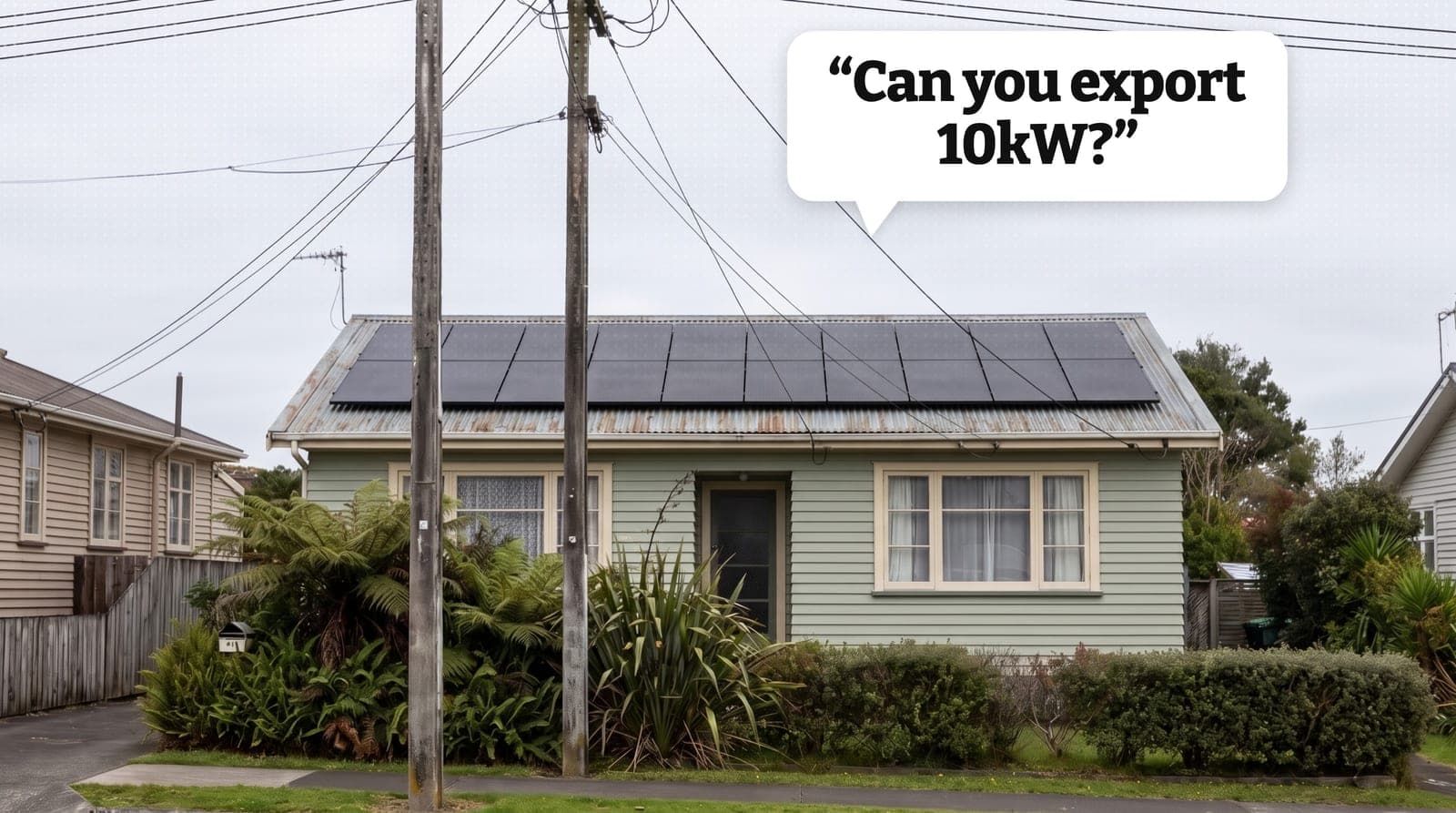
If you're sizing up solar, the one number that decides how much of it ever pays you back is your export limit. Since 11 May 2026 the grid has made that number 10kW by default, which is genuinely good news. But if your place is in Auckland or Wellington, 10kW isn't a promise. It's a probability. And a probability is a lot harder to build a system around. So we worked out what yours is actually worth, in dollars.
Key Points
- Since 11 May 2026 the grid's default solar export limit has been 10kW, and 26 of the 30 lines companies now give you a flat 10kW.
- Auckland's Vector gives you 10kW most of the time, but once its system goes live later in 2026, a home-internet dropout drops you to a fixed 2.5kW.
- Wellington swaps the flat limit for a price signal: export into a congested network and a charge lands on your power company, at a rate nobody has published.
- A 10kW export limit caps what you send out, not how big a system you build. A 10kW inverter happily carries a 12kW array and never hits the limit.
- The power you export is your cheap power, worth about 15c against the 41c you pay to buy it back, so a trimmed export costs you your least valuable units.
What changed on 11 May 2026
The Export Limits Code amendment has been live since that date. Two things. Your lines company can no longer cap how big a system you build, only how much you push back to the grid, and not below 10kW unless a network study shows the local wires genuinely can't take it. It also locks in the inverter standards new systems must meet ('Australia A' settings under AS/NZS 4777.2:2020, plus AS/NZS 4777.1:2024 for the install). Roughly 75,000 New Zealand homes already feed solar back, more than 14,700 with a battery, per the Authority's release.
But "default" is doing a lot of work. A dynamic limit gives you at least 10kW when the network isn't congested and dials it up or down remotely; a flexible one does the same on a set schedule. Both are legal. As the Authority's Tim Sparks put it, lines companies "will be able to flex above or below the 10kW as conditions on the network change". A lower limit is only allowed when the network is genuinely constrained. Still, a limit that moves is one you can't quite pin down.
Which lines companies publish a 10kW solar export limit
Twenty-six of the thirty lines companies now give you a flat 10kW, our count rechecked 21 October 2026, on the scorecard below. The Authority's decision paper put it at 25 of 30 on 1 April 2026, with four more working towards it; its press release counted 29. Different dates and tests, so the numbers wander. The scorecard is the live picture.
Every figure here comes from the lines company's own published page, on the date shown. Work for a network and think we have you wrong? Tell us and we will fix it the same week.
Auckland: 10kW, most of the time
Vector opened its dynamic export connections on 11 May 2026, single-phase, up to 10kW. In its own words, from its FAQs and connection page, a dynamic connection exports up to 10kW "most of the time", "only temporarily reduced" when the network is busy. The catch: the system that does the reducing isn't switched on yet. Vector expects it "later in 2026".
Your inverter must meet AS/NZS 4777.2, be CSIP capable (Common Smart Inverter Profile, the bit that lets Vector talk to it), and be online. On Vector's Clean Energy Council list that's about 10 business days, 30 if it needs a closer look. Vector doesn't anticipate congestion "for the next 12 months", but it has published no curtailment figure and can't, because the curtailing system isn't live. Any percentage you read today is a guess.
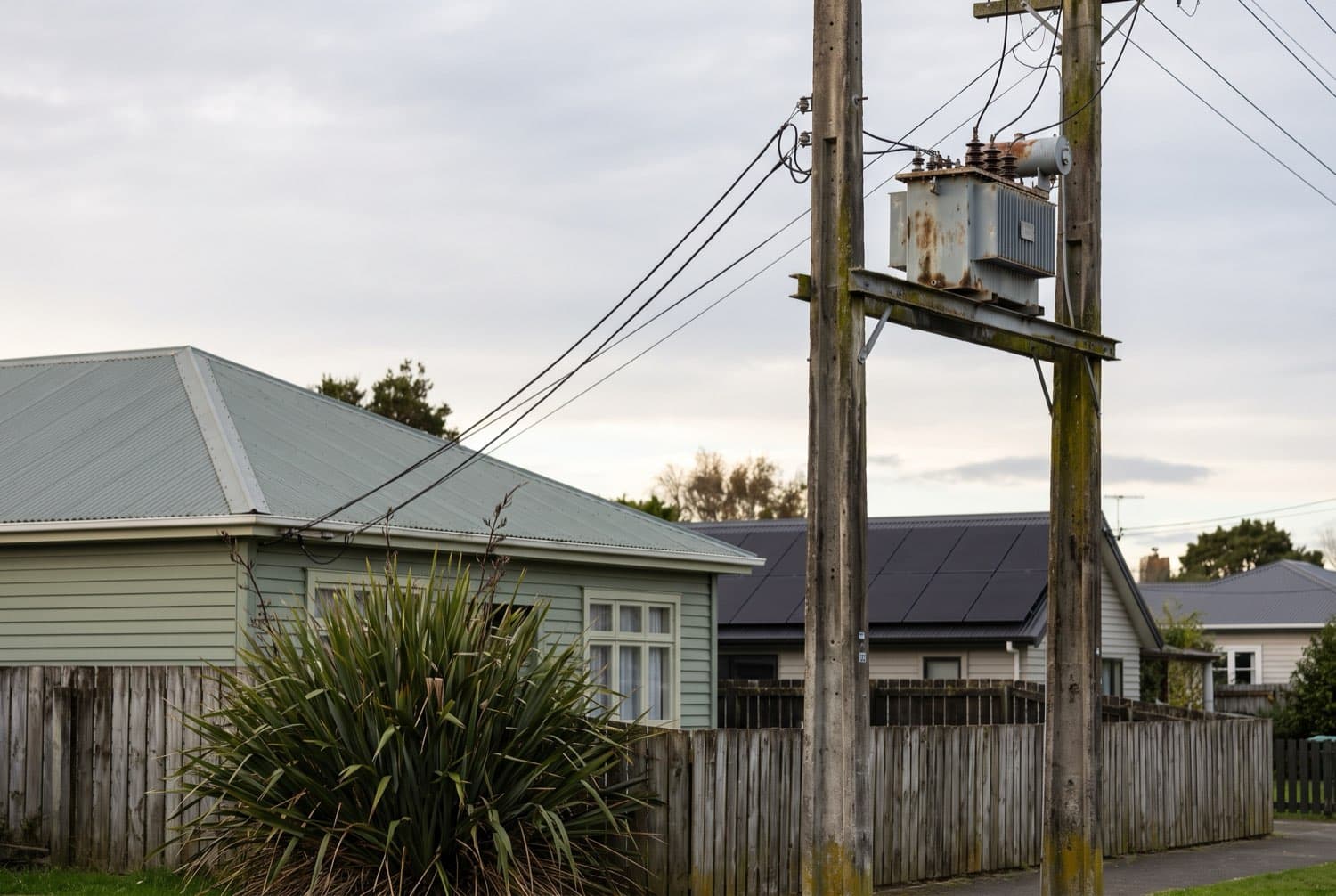
The line nobody puts on a sales slide: once that system is live, if your inverter's connection drops out (a home WiFi outage) it falls back to a fixed 2.5kW until it reconnects, a quarter of the dynamic limit and half the old fixed 5kW. Over a clear midday hour that's about 7.5 lost units, roughly $1.13 at Meridian's standard 15c rate. A dropped hour is nothing; a fortnight of dead WiFi is not. Put the inverter where the WiFi reaches, or hardwire it. And since CSIP is now a grid-access question in Auckland, here's which inverters have it.
Wellington: a price signal, not a limit
Wellington does something genuinely different: a price, not a flat number. From 11 May 2026, on its connection page: "Rather than set a fixed limit (10kW) we are ... using a price signal to DG owners to lower injection back to 5kW when parts of our network becomes congested." Export above the threshold and a congestion charge passes to your retailer. Why? Only about 3% of homes on its network have solar, and it reckons congestion won't show up until that hits 20%. Its congestion policy lays out the envelope, three ways to dodge the charge, and a heat map of where it might bite.
Two numbers are missing. The congestion rate isn't published: not on the connection page, not in the 2026 pricing index, not in the policy. And the charge lands on your power company, not you, and no retailer has said whether it'll pass it on. Nobody publishes the rate, so we've left it open here rather than invent a figure. The same network pays the other way too: from 1 April 2026 it brought in a regulated rebate for exports during the winter peak periods, smart meters only, and that rate isn't published either.
Christchurch, three phase, and going bigger than 10kW
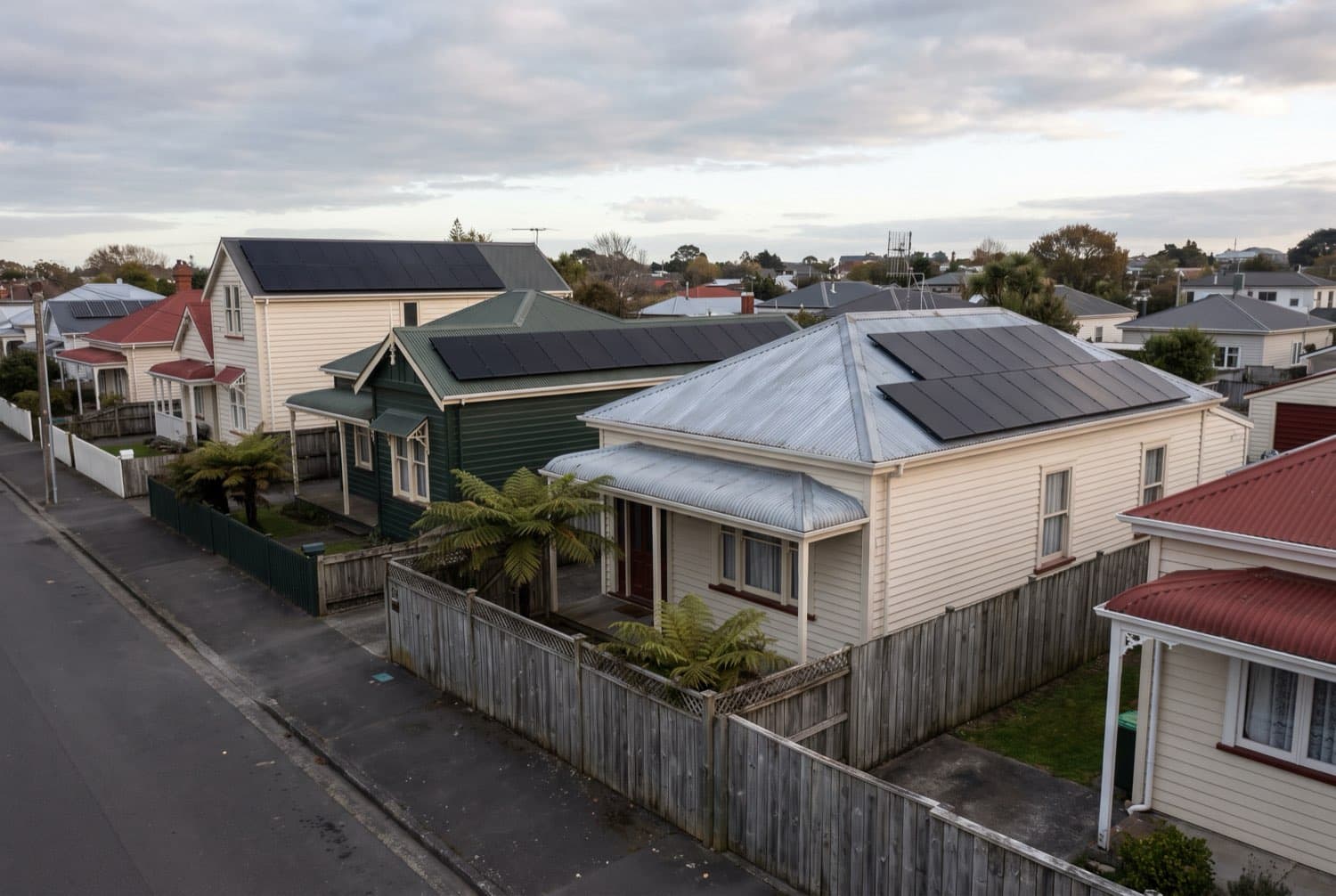
In Christchurch, Orion looks at your actual street. From 1 April 2026 new and existing owners can apply for a higher export limit, and where studies show room Orion intends to allow "export at or above 10kW per phase", crediting the Authority widening the allowed voltage range from ±6% to ±10%. Its under-15kW process wants a compliant AS/NZS 4777.2 inverter, import and export metering, an application with a fee (amount we couldn't verify), and your Certificate of Compliance and Record of Inspection filed within 10 working days.
Three-phase power usually exports more, but that's your lines company's call, not a national rule: neither "three phase" nor "30kW" appears anywhere in the amendment. WEL Networks is clearest: 0 to 10kW single phase, 0 to 30kW three phase, no fee for three phase up to 30kW, a $500 fee for single phase above 10kW, auto-approval "within 10 minutes" for compliant small systems. MainPower does 10kW single phase and looks at three phase case by case; Vector's dynamic offer is single phase only. Rule of thumb: three phase gets about 3× the single-phase allowance.
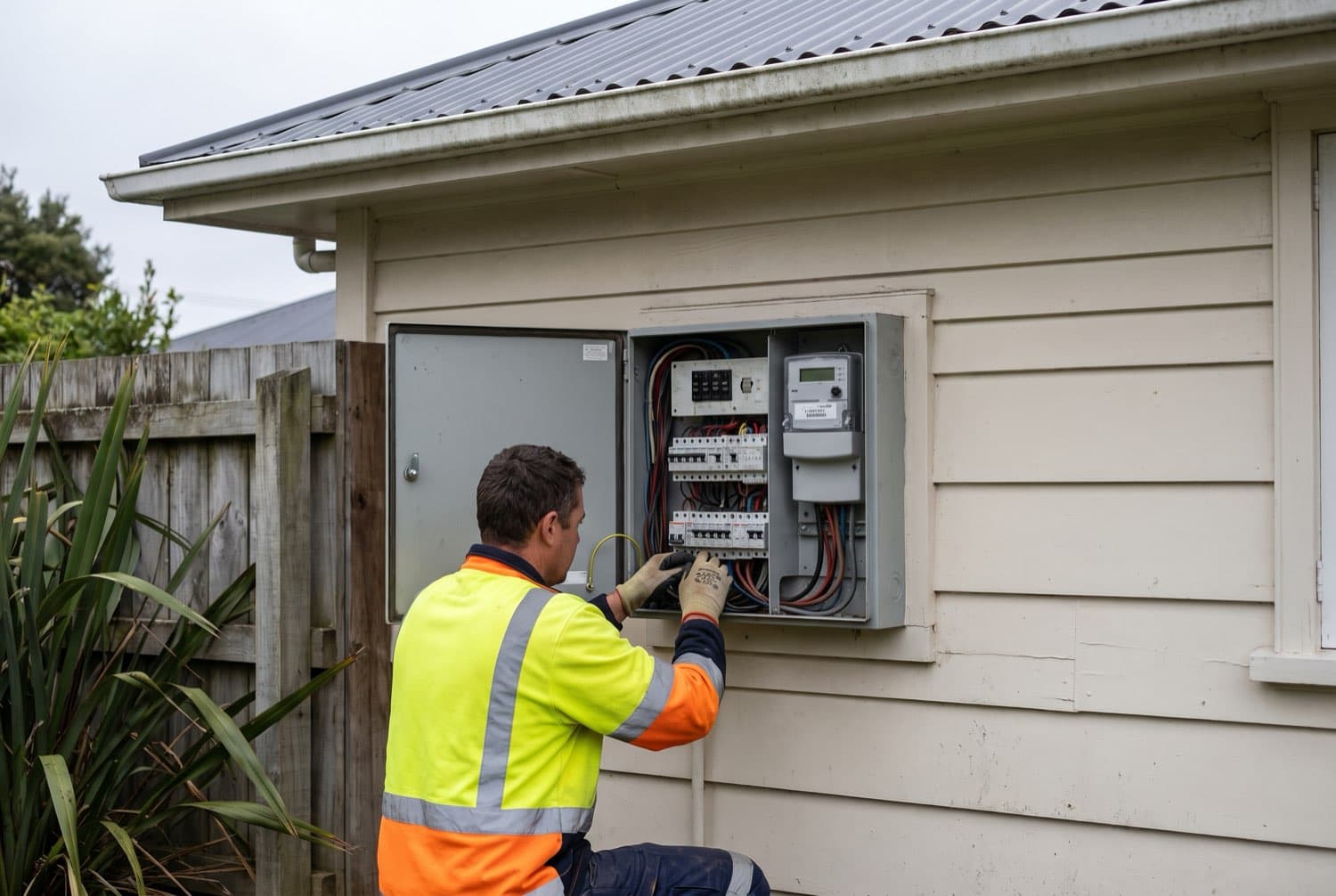
Going past 10kW on a single phase is a slower door: a different application, with the lines company responding within 30 business days of a complete application, up to another 20 by agreement. The old national fee cap has been struck out of the Code, so a "standard national fee" is made up; only each network's own published numbers are real.
A 10kW export cap does not cap a 10kW system
Here's the bit most of the coverage got wrong, and it's worth real money. The rule caps how much you export, not how big a system you build; it literally forbids your lines company from limiting your system's size. And an inverter can't push out more kW than its own AC rating anyway. So a 10kW export limit caps a 10kW inverter, and a 10kW inverter happily sits behind a 12kW array of panels. Those extra panels lift your yearly output by around 20% (EECA's figures, Auckland, north-facing roof, first year) for the cost of four or five more panels, and any hour you'd have overshot 10kW the inverter just trims the top off, a handful of the sunniest midday hours a year.
How much a kW of panels makes where you live is its own question. Here are the regional numbers.
What your extra panels are actually worth
So the rule lets you go bigger. Should you? Assumptions in the open: an Auckland roof facing north at a 30 degree tilt, first year, no shading, EECA's generation figures, a household on 8,000 units a year (the MBIE model home), buying power at 41.18c a unit and paid Meridian's 15c for exports. Meridian also pays 24c in its winter peak windows (7am to 10am and 5pm to 9pm, July to September), but almost no solar leaves the house then. These are gross energy numbers, not a payback figure.
The split between what you use and what you export is our assumption, not a measured figure.
The second 5kW earns you about $1,512 a year, two-thirds of it ($1,005) exported at 15c. So a unit from your first 5kW is worth about 25c, while a unit the second 5kW adds is worth about 19c, because more of it leaves the house. Still worth doing, just not double for double.
And the unit you use yourself is worth far more than the one you sell: about 2.7× in Auckland, 2.5× in Wellington, 2.6× in Christchurch, 2.8× nationally. You buy back at 41.18c in Auckland, 37.01c in Wellington and 38.53c in Christchurch, 42.0c on MBIE's national low-user model home (Quarterly Survey, 15 May 2026), and sell at Meridian's 15c. So a dynamic trim only ever costs you your cheapest units, when the network is drowning in midday solar and they're worth least. If that occasional trim buys a grid that can carry a whole street's worth of solar, it's a fair trade.
Exported units earn 8 to 17c. The ones you use yourself save 37 to 45c. Here's every retailer's rate.
The dates that still matter
The one to circle: until 11 November 2026, a lines company holding your limit below 10kW is marking its own homework. After that, it has to use the shared, agreed method.
What to actually do before you sign
None of this is hard. It's just the stuff to nail down before a deposit changes hands.
- Find your lines company on the scorecard, not your power retailer. It owns the poles, and it's the one that sets your export limit.
- Ask your installer which pathway they're lodging and what export limit is written on the application. If the quote doesn't say, nobody's thought about it.
- In Auckland, ask whether the inverter is CSIP capable and on the Clean Energy Council list, in writing. If it isn't, you're not getting the dynamic 10kW, and Vector hasn't published what you get instead.
- In Auckland, put the inverter where the WiFi reaches, or hardwire it. Once Vector's system is live, a dropped connection gets you 2.5kW.
- In Wellington, ask your retailer, in writing, what it'll do with the congestion charge. It can't answer today. Ask again before you switch on.
- Don't let a 10kW export limit talk you out of a 12kW array. The inverter is capped, not the panels.
- Get the export limit written into the quote. A payback worked out at 10kW on a network that'll give you 5kW is built on sand. If the quote doesn't name the limit, ask how to read it.
Every installer in our network is EWRB registered and a member of Master Electricians, and each one has to name the pathway and the export limit on your application. Get matched with vetted installers: free, and about two minutes.
Where we've corrected this page
This one tracks live network positions, and they move. The scorecard was re-verified 21 October 2026 and the prose re-checked 14 July 2026. Three numbers still aren't published anywhere, and we've said so in the text rather than guess: Vector's curtailment rate (its system isn't live), Wellington's congestion charge, and Orion's application fee. If you work for a network or a retailer named here and we have you wrong, or one of those rates gets published, tell us and we will fix it and re-date the page.
We would rather be corrected than be wrong.
Keep reading


Sources
- Export limits Code amendment, Electricity Authority
- Export Limits Amendment 2026, clause text, Electricity Authority
- New rules encourage more solar to networks, 7 April 2026, Electricity Authority
- Decision paper: Maximising benefits from local electricity generation, Electricity Authority
- Code Part 6, Schedule 6.1: process for obtaining approval, Electricity Authority
- Code Part 6, Schedule 6.2: regulated terms for distributed generation, Electricity Authority
- Part 6: connection of distributed generation, including Schedule 6.5 "Prescribed maximum fees", Electricity Authority
- Shift to 10kW export limits tracker, Electricity Authority (taken down by October 2026; the scorecard now cites each lines company's own page)
- Dynamic DG Export Connections FAQs, 11 May 2026, Vector
- Connect Power Generation, 10kW or Less, Vector
- Smaller systems with capacity of 10 kilowatts or less, Wellington Electricity
- Generating your own electricity, Wellington Electricity
- Congestion and Interruption Management Policy, ENP-107 rev 1, 7 May 2026, Wellington Electricity
- 2026 pricing disclosures, Wellington Electricity
- Export limits, Orion
- Generation under 15 kW, Orion
- Solar and distributed generation, WEL Networks
- Solar and distributed generation, MainPower
- Solar buy-back rates and plans, Meridian Energy
- Electricity cost and price monitoring, including the Quarterly Survey of Domestic Electricity Prices, MBIE
- Quarterly Survey of Domestic Electricity Prices to 15 May 2026 (PDF), MBIE
- Understanding the value of residential solar PV and storage in New Zealand, EECA
- Appendix Seven: Solar PV data and performance (PDF), EECA
All sources re-checked on 14 July 2026; scorecard positions re-verified 21 October 2026. If you work for a network or a retailer named here and we have you wrong, tell us and we will correct it the same week.
Key Points
- Since 11 May 2026 the grid's default solar export limit has been 10kW, and 26 of the 30 lines companies now give you a flat 10kW.
- Auckland's Vector gives you 10kW most of the time, but once its system goes live later in 2026, a home-internet dropout drops you to a fixed 2.5kW.
- Wellington swaps the flat limit for a price signal: export into a congested network and a charge lands on your power company, at a rate nobody has published.
- A 10kW export limit caps what you send out, not how big a system you build. A 10kW inverter happily carries a 12kW array and never hits the limit.
- The power you export is your cheap power, worth about 15c against the 41c you pay to buy it back, so a trimmed export costs you your least valuable units.


lights on
Related guides
View all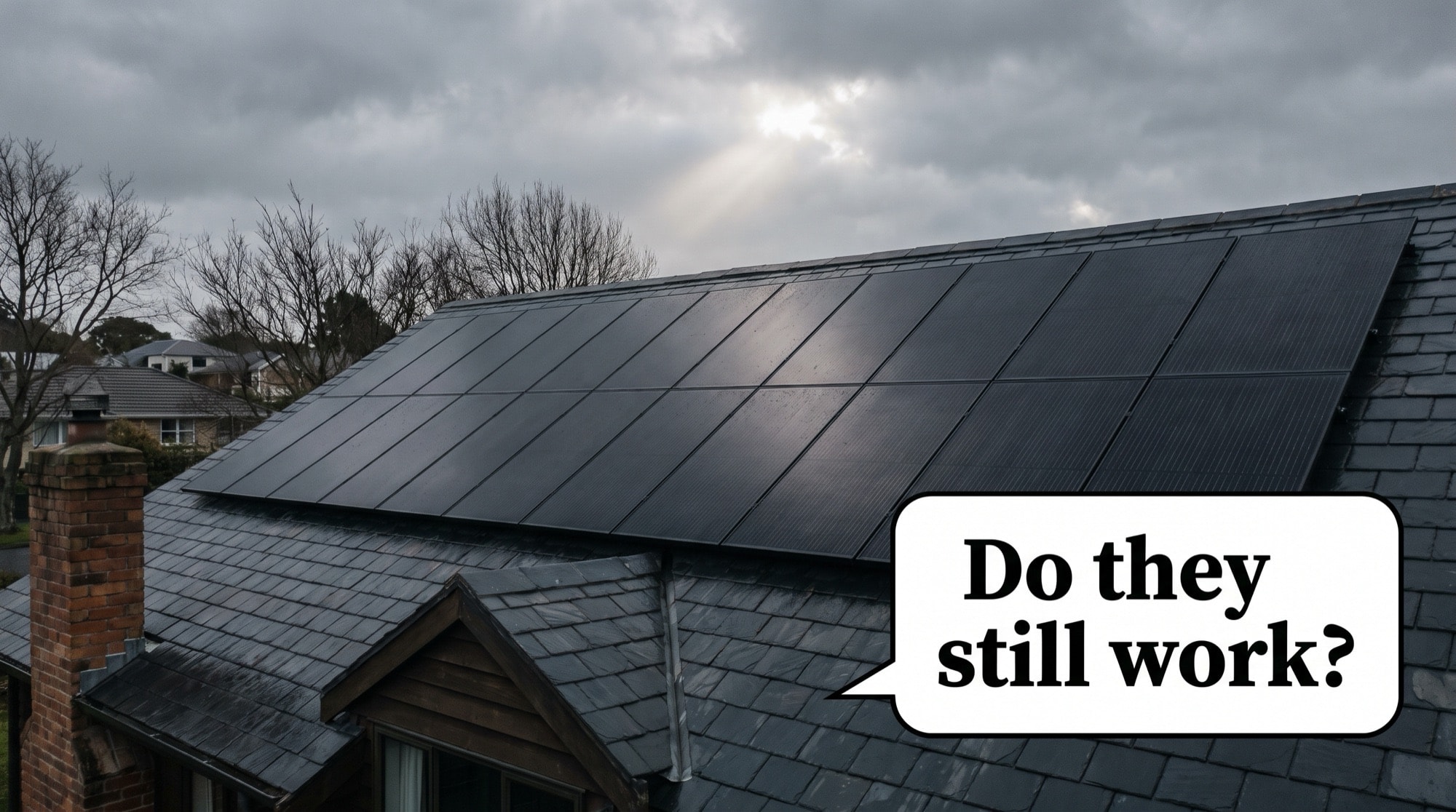
Do Solar Panels Work in Winter and on Cloudy Days in NZ?
Solar panels still generate power on cloudy days and through NZ winters. Here's exactly how much output changes and why it still works.
Read
Solar Panel Costs NZ: What You'll Actually Pay in 2026
Real pricing data for NZ solar in 2026. System costs by size, what affects price, and how to tell if a quote is fair.
Read
Best Solar Installers NZ (2026)
How to find a quality solar installer in NZ. What to look for, red flags to avoid, and when SEANZ membership matters for your bank loan.
Read
Solar Battery Storage NZ: Powerwall 3 Price and Is It Worth It?
Solar battery prices in NZ: Tesla Powerwall, BYD, Enphase compared. When batteries make sense and when you're better off without one.
Read
How to Get Solar Quotes in NZ (and Compare Them Properly)
How to get solar quotes in NZ: EECA's 2-3 quote rule, where to get them, what to have ready, comparing $/W like-for-like, and the red flags in the quoting process.
Read
10kW Solar System NZ: Price, Output and Is It Too Big? (2026)
10kW solar systems in NZ: $15,000-18,000 installed, 13,000-14,300 kWh a year, 22-24 panels, the 40m² engineering rule, export limits, and when 6.6kW beats it.
Read
Join the conversation
The best comments are honest ones: Real experience. Share yours, please stay civil and on topic. No self-promo links.
Your email is never shown or shared. To change or remove a comment later, .
No comments yet. What is your experience with this? Be the first to weigh in.