
Green Loans NZ: Every Bank's Solar Loan Compared (2026)
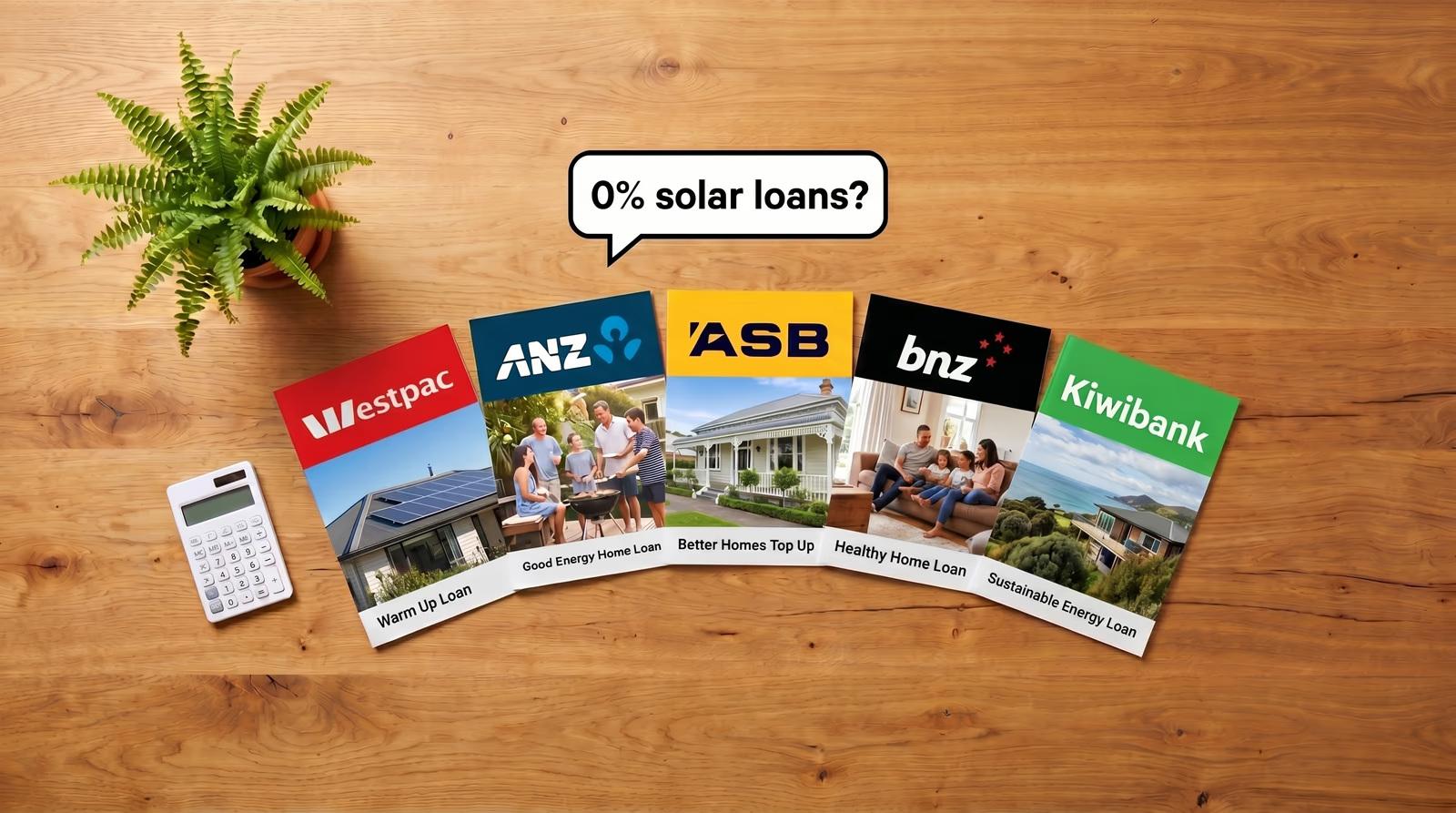

How NZ green loans work
There is no government subsidy for solar panels in New Zealand. Instead, NZ’s five major banks have created their own incentive: green loans with rates between 0% and 1% for homeowners installing solar.
The loans cover the whole system, not just the panels. Before you settle on an amount, see what home battery storage in NZ adds, which panels are worth paying for, and what your exports will earn under each retailer’s buy-back rate. If the system is for a rental or a business, the tax side is separate: solar and tax in NZ.
These loans are structured as mortgage top-ups, meaning they’re secured against your home. That lets banks offer far lower rates than personal loans or hire purchase.
The catch? Most require an existing mortgage with that bank, at least 20% equity, and a quote from a qualified installer. If you tick those boxes, you can finance a full solar system, and on a 0% or 1% loan your power savings can cover much of the repayment from the first month.
Four of NZ’s five major banks offer green loans at 0-1%. That’s effectively a bank-funded subsidy for solar.
Below, we compare every option: rates, terms, eligibility, and what it actually costs on a $15,000 system. Still deciding whether solar panels for the home are right for you? Our overview covers how a system works first.
All 6 green loans at a glance
This table covers all six green loan products from NZ’s major banks. Rates verified August 2026.
Westpac’s 0% for five years costs the least in interest, if you qualify. If you need to borrow more than $50,000, ANZ and ASB both go up to $80,000 at 1%. For working farms, ASB’s Smart Solar Loan is 0% for five years on up to $150,000, until 30 June 2027. See our solar for NZ farms guide for the full rural funding stack.
Bank-by-bank breakdown
Full details on each lender including eligibility requirements, worked examples, and direct links to apply.
Westpac green loan: Greater Choices Home Loan
Zero percent for five years. Not a teaser rate, the real deal.
What’s good:
- 5 years at 0%
- Up to $50,000
- No establishment fee
Worth knowing:
- Must be existing Westpac customer
- Need 20% equity
Eligibility:
- Existing Westpac mortgage
- Minimum 20% home equity
- At least $150,000 of standard Westpac Choices home lending
- Installer must be a qualified supplier or installer
$15,000 system over 5 years = exactly $250/month. Total paid: $15,000. Interest: $0.
ANZ green loan: ANZ Good Energy Home Loan
1% for 3 years with an $80,000 maximum. Ideal for premium or multi-structure installs.
What’s good:
- Higher maximum ($80k)
- 1% is still very low
Worth knowing:
- 1% vs Westpac's 0%
- Shorter term (3 years)
Eligibility:
- Existing ANZ mortgage
- Meets ANZ's home lending criteria
- Installer must be a SEANZ member company
- A quote plus an installation date
$15,000 system is about $15,232 total. Around $423/month for 3 years. $232 interest.
ASB green loan: Better Homes Top Up
Same 1% deal as ANZ but through ASB. Slightly stricter on quote expiry.
What’s good:
- Higher maximum ($80k)
- Fixed for 3 years
Worth knowing:
- 1% vs Westpac's 0%
- Stricter quote expiry (60 days)
Eligibility:
- Existing ASB mortgage
- Minimum 20% home equity
- Installer must be a qualified professional installer who does this work day to day
- Quote less than 60 days old
$15,000 system is about $15,232 total. Around $423/month for 3 years. $232 interest.
BNZ green loan: Better Future Home Loan Top-Up
Standard 1% green loan for 3 years, then re-fix or move to BNZ's floating rate.
What’s good:
- Higher maximum ($80k)
- Flexible terms
Worth knowing:
- 1% vs Westpac's 0%
- Shorter term (3 years)
Eligibility:
- Existing BNZ mortgage
- Minimum 20% home equity
- Installer must be a qualified business that supplies and installs as a normal part of its business
$15,000 system is about $15,232 total. Around $423/month for 3 years. $232 interest.
Kiwibank green loan: Sustainable Energy Loan
No discounted rate. Kiwibank instead pays a $2,000 cashback over 4 years on a loan at its standard variable rate.
What’s good:
- $2,000 cashback ($800 after year one, then $400 a year)
- Longer repayment terms
Worth knowing:
- Standard variable rate, not 0 to 1%
- Cashback drips in over 4 years
Eligibility:
- Existing Kiwibank mortgage
- Borrow more than $5,000 to get the cashback
- Installer must be a SEANZ member company that both supplies and installs
$15,000 system at Kiwibank's standard variable rate, with $2,000 back over 4 years: $800 after year one, then $400 a year for three years.
ASB Rural green loan: Smart Solar Loan
Zero percent on up to $150,000, for working farms only. The offer runs until 30 June 2027.
What’s good:
- 0% fixed for 5 years
- Highest maximum ($150k) for large installations
Worth knowing:
- Working farms only, not lifestyle blocks
- Offer ends 30 June 2027
Eligibility:
- A farm business whose main revenue is primary production
- Existing or new ASB Rural customer
- Solar on the farm, installed by a qualified professional
$50,000 farm system = exactly $50,000 repaid. Zero interest over 5 years.
How to Apply for Solar Finance in NZ
Five steps, terms as at August 2026.
- Get a written quote first. Every bank lends against a quote from an installer, so the quote comes before the application, not after.
- Check where your mortgage is. All five green loans need an existing home loan with that bank; there is no standalone product. If your mortgage is elsewhere, your options are a personal loan or moving the mortgage.
- Check the installer condition. ANZ and Kiwibank ask for a SEANZ member installer. The other three ask for a qualified installer.
- Apply as a home-loan top-up, online or through your banker, with the quote and the installer’s details. It runs through the home-loan side, so expect the bank’s normal top-up timeframe.
- Borrow for the short term, not the long one. ANZ, ASB and BNZ hold their 1% for an intro term and then revert to the standard rate; Westpac’s 0% is capped at $50,000; Kiwibank lends at its standard rate and pays a cashback instead. Pay the balance down inside the intro term or the cheap loan becomes an ordinary one.
Cash vs financing: which is better?
If you have the cash, paying upfront maximises your return. But financing with a green loan (especially Westpac’s 0%) still delivers strong returns. Your solar savings can cover much of each repayment from the first month, and all of it once the loan is paid off.
If you have the cash, paying upfront is technically cheapest. But at 0% interest, the financial difference is zero, and you keep your cash for emergencies.
Monthly payment example
Here’s what a typical $15,000 system looks like with Westpac’s 0% Greater Choices loan over five years.
For comparison, the same system on ANZ or ASB at 1% for three years costs $423/month with just $228 in total interest. Kiwibank works differently: the loan runs at its standard variable rate, offset by a $2,000 cashback paid over the first 4 years.
How we compared these options
We reviewed all major NZ banks and lenders offering loans suitable for solar installation as of August 2026. Here’s what we weighted.
Important information: The content on this page is general in nature and is not personalised financial advice under the Financial Markets Conduct Act 2013. It does not take into account your individual financial situation or goals. Interest rates and product details were verified in August 2026 but may change without notice. Always confirm current rates directly with lenders before applying. We recommend seeking advice from a qualified financial adviser before making financial decisions. Solar Scout does not receive compensation from any lenders listed on this page.
Sources and verification
Bank green loan programmes
Industry data
- WorkSafe NZ: Electrical Safety Requirements
- NZ banks have issued over $1 billion in green loans since 2022 (Newsroom, August 2025)
Last verified: August 2026. Loan terms and eligibility may change. Always confirm directly with banks before applying.
Frequently asked questions
Is there a government subsidy for solar panels in NZ?
No nationwide subsidy exists in New Zealand. However, Westpac, ANZ, ASB and BNZ offer green loans with subsidised rates (0-1%) specifically for solar panel finance as of August 2026, and Kiwibank pays a $2,000 cashback. This is effectively a bank-funded subsidy as they want to lend for green home improvements.
Can I pay monthly for solar panels in NZ?
Yes. Bank green loans are repaid monthly, over 3 to 5 years at the 0 to 1% banks and 7 to 10 years at Kiwibank. A $15,000 system costs about $250 to $425 a month on a 0 to 1% loan. Your power savings can cover much of that from the first month, and once the loan is paid off they're all yours.
What is the 20% equity rule for solar loans?
Most bank green loans are mortgage top-ups, which require at least 20% equity in your home. This means your mortgage balance must be less than 80% of your home's value. Kiwibank does not publish an equity minimum for its Sustainable Energy Loan (standard variable rate, $2,000 cashback, Kiwibank mortgage required), so ask them directly. Personal finance is another option, though rates are higher.
Which bank has the best solar loan in NZ?
It depends on who you already bank with. Westpac costs the least in interest: 0% for 5 years on up to $50,000, if you have 20% equity and at least $150,000 of other Westpac home lending. For larger systems ($50k-$80k), ANZ, ASB and BNZ offer 1% for 3 years. Kiwibank works differently: its loan runs at the standard variable rate with a $2,000 cashback (as of August 2026).
What kind of installer does a green loan need?
Every bank wants the quote from a qualified installer. ANZ and Kiwibank go further and ask for a SEANZ member company. Westpac, ASB and BNZ accept a qualified business that installs solar as part of its normal work. If you're with ANZ or Kiwibank, tell your installer before they quote.
Can I get solar panels with no deposit in NZ?
Green loans don't require a cash deposit as the loan covers the full system cost. But you do need home equity (typically 20%). Personal finance options like Q Card accept no deposit and no equity, but charge much higher interest rates (25%+ after promotional periods).
How long does it take to pay off solar panels in NZ?
On a 0 to 1% green loan, most homeowners pay off their system in 3 to 5 years. While the loan runs, your power savings cover much of each repayment. Once it's paid off, the savings are all yours for another 20+ years.
Does ASB have a green loan for solar panels?
Yes. ASB's Better Homes Top Up is 1% for 3 years on up to $80,000, as a top-up to an existing ASB home loan with 20% equity. ASB wants the quote to be under 60 days old, and the installer to be a qualified professional installer who does this work day to day.
What is the Kiwibank green loan for solar?
Kiwibank's Sustainable Energy Loan works differently from the other banks. The loan runs at Kiwibank's standard variable rate over 7-10 years, and Kiwibank pays $2,000 cashback over four years towards the system: $800 after year one, then $400 a year for three years. The installer must be a SEANZ member company that both supplies and installs, and Kiwibank publishes no borrowing cap.
Does Westpac still offer 0% for solar panels?
As at August 2026, yes. Westpac's Greater Choices Home Loan is 0% for up to 5 years on up to $50,000, and the loan must be repaid in full within those 5 years. You need an existing Westpac mortgage, 20% equity and at least $150,000 of standard Westpac Choices home lending. Westpac asks for a quote from a professional, then an invoice before funds are released.
What is the ANZ Good Energy Home Loan rate for solar?
1% fixed for 3 years on up to $80,000, as a top-up to an existing ANZ mortgage. ANZ asks for a quote plus an installation date, and the installer must be a SEANZ member company.
Does BNZ have a solar loan?
Yes. BNZ's Better Future Home Loan Top-Up is 1% for 3 years on up to $80,000 for an existing BNZ home loan. Send BNZ a quote for supply and installation from a qualified business that supplies and installs as a normal part of its business.
What happens after the green loan fixed period ends?
Westpac's 0% loan must be repaid in full within its 5 years. At ANZ, ASB and BNZ, the 1% period ends after 3 years and the loan moves to the bank's standard floating rate, or you can re-fix. We recommend paying off the loan within the fixed period. If that's not possible, you can refinance at that point.
What to do next
Ready to see what solar could save your home? Our free quiz takes two minutes and lets you compare quotes from up to 3 vetted local installers. Scout my savings →
Related guides
View all
How to Pay for Solar in NZ: Cash, Loans and Payment Plans (2026)
Cash vs green loans vs personal loans for solar in NZ. Real monthly payments, total interest costs, opportunity cost analysis, and the gotchas banks don't mention.
Read
Solar Panel Grants and Incentives NZ (2026)
What financial help is available for solar in NZ? Green loans, EECA programmes, and what NZ doesn't have compared to Australia and the UK.
Read
Can I Claim Solar Panels on Tax in NZ? (2026)
How solar interacts with NZ tax, by audience. Owner-occupier, landlord, business, lifestyle block, Air BnB, and buy-back income. General info, not tax advice.
Read
Solar Panel Costs NZ: What You'll Actually Pay in 2026 (From $14,000)
Real pricing data for NZ solar in 2026. System costs by size, what affects price, and how to tell if a quote is fair.
Read
Are Solar Panels Worth It in New Zealand? Pros, Cons and Real Payback
An honest look at whether solar makes financial sense for NZ homeowners. Payback periods, savings data, and the scenarios where it doesn't stack up.
Read
Solar Panels for Rental Property NZ: The Landlord's Guide
Should you put solar on your NZ rental? The honest answer: depreciation tax shield, buy-back, property uplift, body corp realities, and the legal trap most landlords miss.
Read
Join the conversation
The best comments are honest ones: Real experience. Share yours, please stay civil and on topic. No self-promo links.
Your email is never shown or shared. To change or remove a comment later, .
No comments yet. What is your experience with this? Be the first to weigh in.