
BYD Battery-Box NZ: Price, Models and Is It Worth It? (2026)
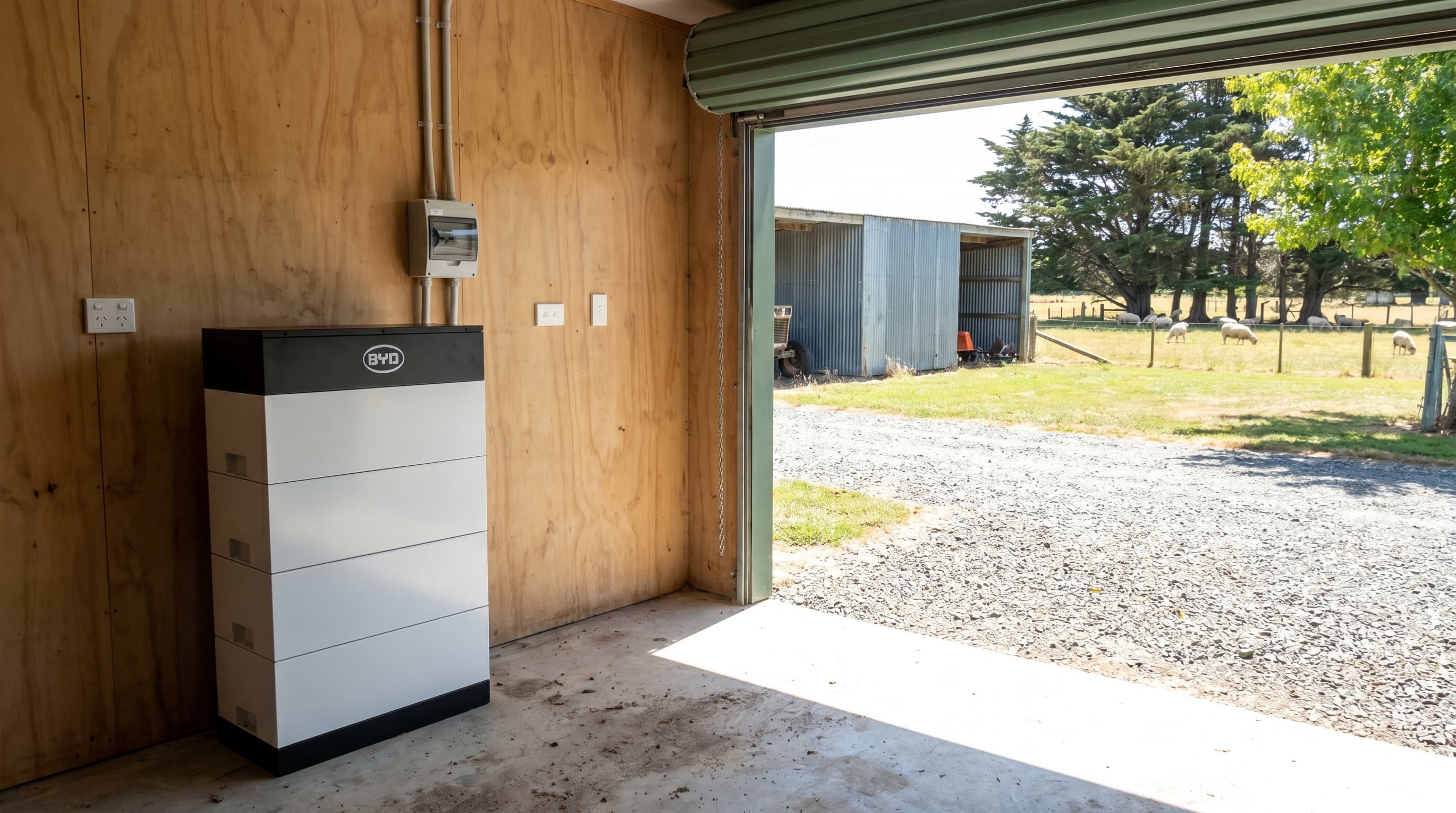

BYD is one of the world's largest battery makers, and the Battery-Box is its home solar battery range. In New Zealand the models installers quote are the Battery-Box Premium HVS and HVM towers, often beside a Fronius GEN24 Plus or Sungrow hybrid inverter. If one is on your quote, this is what you are getting.
We do not sell batteries. What follows is read off BYD's own documents: the models sold here, what they cost, which inverters they pair with, how backup works, and the warranty fine print.
Who Makes It and Who Stands Behind It Here
BYD is based in Shenzhen, China. It publishes New Zealand warranty documents for the Battery-Box HVS and HVM, the LVS, the LVL and the LV Flex, so the paperwork does name this country.
What it does not name is a New Zealand distributor. The service partner on BYD's New Zealand warranty is Alps Power Pty Ltd in Peakhurst, New South Wales. Trade stock comes through electrical wholesalers such as Ideal Electrical and J.A. Russell, and at least one installer describes itself as an official Battery-Box supplier. That matters the day a module fails: the manufacturer's named service desk is in Sydney, and your installer sits between you and it.
So ask your installer, in writing, who handles a BYD claim in New Zealand and how long the last one took from fault to fix.
The paperwork is Australian-run. That is not a reason to avoid the battery. It is a reason to know, before you sign, who picks up the phone here.
The BYD Models Sold in NZ: HVS and HVM
Two towers are what a grid-tied New Zealand home gets quoted. Both are a base, a control unit on top and battery modules stacked between, so capacity is set by how many modules you buy. Neither has an inverter inside: they are DC batteries that plug into a hybrid inverter.
There is also a 48 V family, the LVS and the larger LVL, for off-grid homes and builds around a Victron or SMA system. They are not what a grid-tied house with a Fronius or Sungrow hybrid gets quoted.
One note on the newer gear. BYD launched a Blade-cell HVB tower and the HVS+ and HVM+ overseas in 2025, and the HVB and HVM+ are on the Australian CEC list, but BYD's Australia and New Zealand document set, as of October 2026, still covers only the Premium HVS and HVM. If a quote says “Blade” or “HVB”, ask for the New Zealand warranty document that names it. The original HVS and HVM modules stay in production for retrofits and expansions. You can put the HVS and HVM specs next to every other battery sold here in our battery comparison tool.
Want to compare
quotes?
Get matched with vetted local installers and see real quotes for your home. It’s free, with no obligation.
Compare up to 3 quotesWhat a BYD Battery Costs in NZ
Our battery comparison registry puts the HVM 8.3 tower, with 8.3 kWh usable, at about $9,500 installed, last checked 30 June 2026. Home batteries as a category run $8,000 to $24,000 installed in 2026, and BYD sits at the low end because the inverter is a separate line on the quote.
Per kilowatt hour, the New Zealand figures we found run from about $800 to $1,450 per usable kWh installed: My Solar Quotes' July 2026 review puts BYD at $800 to $1,000, and a May 2026 source put a 10 kWh tower at $11,000 to $14,500 without saying whether that was installed. Nobody we found publishes a full HVS tower installed; stack five modules on a control unit at the retail list below and the hardware alone is about $15,600, so installer trade pricing has to sit well under retail for those per-kWh figures to hold.
As a sanity check, one New Zealand retailer's October 2026 supply-only list had an HVS 2.56 kWh module at about $2,840, an HVM 2.76 kWh module at about $2,875, and the control unit and base at about $1,445, GST not stated. That is one retailer's list, not the market: labour, the inverter, switchboard work and margin go on top.
We could not find a New Zealand installer that publishes a BYD package price, so get three quotes for the same tower and inverter. Against a Tesla Powerwall 3 at $19,000 to $24,000 installed, BYD looks cheaper, and often is, but the Powerwall price includes its own solar inverter, while a BYD tower needs a hybrid inverter you may already be buying for the panels. Installing solar at the same time, BYD usually costs less for similar storage; adding a battery to an existing string inverter, the hybrid is an extra cost and the gap narrows (the SMA Sunny Boy Storage on the list is the battery-only inverter that does this job).
Which Inverters It Works With
BYD's compatible-inverter list, V2.22 dated 10 October 2026, names these inverters, among others, for the Premium HVS and HVM. Each row carries a minimum firmware version; the module counts shown are the list's own limits for the two Fronius GEN24 Plus models.
A common New Zealand pairing is a Fronius GEN24 Plus. The single-phase Primo tops out at HVS 7.7 kWh or HVM 19.3 kWh; the biggest towers, HVS 10.2 kWh and above and the HVM 22.1 kWh, need the three-phase Symo. And the smallest HVM, the 8.3 kWh three-module tower, is not on the Fronius list at all; on a GEN24 Plus an HVM starts at four modules, 11.0 kWh. Sungrow's SH-RS and SH-RT hybrids are the other pairing you will see here.
Two things to hold your installer to: the minimum firmware on each row is real, and an inverter that is not on the list voids the battery warranty. Our inverter comparison tool puts these hybrids side by side, and our string versus microinverter guide explains why a DC battery does not pair with microinverters directly.
What Backup Covers
A BYD tower has no inverter, so blackout backup is the hybrid inverter's job, and the answer changes with the inverter on the quote.
On a Fronius GEN24 Plus there are two levels. “PV Point” is one 3 kW power point (3 kVA) that comes alive about 15 seconds after the grid drops: fridge, modem and phone chargers, not the house. “Full Backup” feeds the circuits you choose, needs extra switchover hardware, and takes about 10 seconds. A Sungrow SH-RT has backup built in and switches in under 20 milliseconds.
The circuits chosen matter more than the switchover time. Ask for them listed individually on the quote, and keep ovens, hot water and full-power heat pumps off the backup side. A 7.7 kWh HVS tower running a 3 kW load is empty in about two and a half hours; running lights, a fridge and the internet it can last the night.
What to Check Before You Sign
- The warranty document that names New Zealand. BYD publishes one for the HVS and HVM: 60% of usable capacity at ten years, or a throughput limit of about 3 MWh per kWh usable, whichever comes first, which at one full cycle a day is roughly eight years. The Australian document for installs from November 2024 promises 70%. The New Zealand document is the one that applies here; ask for it in writing and keep it.
- When the clock starts. The warranty runs from six months after the production date, or from 30 days after delivery if you can prove it. A module added later has its own clock.
- Which control unit you are getting. Plus-generation modules do not fit older HVS and HVM towers, so later expansion depends on the battery control unit (BCU) installed today. Ask for it by name on the quote.
- The module limits for your inverter. A single-phase Fronius Primo GEN24 Plus caps the tower at HVS 7.7 kWh or HVM 19.3 kWh. Any system takes at most three identical towers, and HVS is never mixed with HVM.
- Where it will stand. The datasheet says charging slows below 5 C, so a Central Otago garage wall needs thought. IP55 means outdoors is allowed, but out of rain and direct sun, and within -10 to 50 C.
- The clauses that void cover. A non-listed inverter, a system not installed within a month of delivery, a module left unused for six months, a claim lodged more than 30 days after the fault, or refusing BYD internet access to the system. A battery kept offline for privacy may not be covered.
- What else the documents say. BYD can bill you for an inspection that finds no fault, so log the symptoms and dates before you call. Day to day you watch the battery in the inverter's app; BYD's own Be Connect app is a commissioning tool. We found no recall or safety notice for the Battery-Box between 2024 and 2026.
We are not going to tell you BYD is the best battery, or rank the companies that install it. Neither claim would survive contact with your actual house. A battery is the right one when its usable kilowatt hours match your evening use, its backup covers the circuits you care about, and its warranty is documented for New Zealand.
Compare quotes for your own roof and your own evening usage, not brands in the abstract. A BYD quote sitting next to two others tells you more than any review, including this one.
Common Questions
Is BYD a good solar battery?
On the documents it is a well-specified, conventional LFP battery: cobalt-free cells, IP55, 2.56 or 2.76 kWh modules stacked to the size you need, a ten year warranty and a long compatible-inverter list, at the low end of the New Zealand battery price range. The qualifications are the warranty, 60% at ten years here against 70% in Australia, and a service chain that runs through an Australian partner. Press your installer on who handles a claim here.
BYD Battery-Box vs Tesla Powerwall 3: which is better for NZ?
Different shapes. A Powerwall 3 is one 13.5 kWh unit with its own solar inverter built in, at $19,000 to $24,000 installed. A BYD tower is a DC battery with no inverter, 5.1 to 22.1 kWh in one stack, and needs a hybrid inverter from the compatible list. Buying panels at the same time, BYD plus a hybrid usually costs less for the same storage; if you want one box from one brand, the Powerwall is simpler. Price both for your house.
How much does a BYD battery cost installed in NZ?
Our registry puts the HVM 8.3 tower at about $9,500 installed. The New Zealand figures we found run from about $800 to $1,450 per usable kilowatt hour installed. One retailer's October 2026 supply-only list had the HVS module at about $2,840, the HVM module at about $2,875 and the control unit and base at about $1,445, GST not stated. We could not find an installer that publishes a package price, so get three quotes.
What warranty does a BYD Battery-Box have in NZ?
Ten years under BYD's New Zealand document, holding at least 60% of usable capacity or a throughput limit of about 3 MWh per kWh usable, whichever comes first; at one full cycle a day the throughput limit arrives at roughly eight years. The Australian document for installs from November 2024 promises 70%, but the New Zealand document is the one that applies here; ask for it in writing. The clock starts six months after production or 30 days after proven delivery, and the named service partner is Alps Power in New South Wales.
Which inverter do I need for a BYD battery?
A hybrid inverter on BYD's compatible list, currently V2.22 dated 10 October 2026. In New Zealand that usually means a Fronius Primo GEN24 Plus on single phase, which takes HVS towers of two or three modules and HVM towers of four to seven, or a Symo GEN24 Plus on three phase for the biggest towers. Sungrow SH-RS and SH-RT, GoodWe, SMA Sunny Boy Storage, Solis, Deye SUN-SG01HP3 and Kostal are also listed. A non-listed inverter voids the battery warranty.
Can I add more BYD modules later?
Usually, within limits. An HVS tower takes two to five modules and an HVM tower three to eight, your inverter sets its own cap, and any system takes at most three identical towers, never HVS mixed with HVM. Two catches: Plus-generation modules do not fit older towers, so the control unit installed today decides what you can add later, and a module added later carries its own warranty clock.
What is the difference between BYD HVS and HVM?
Module size and tower range. An HVS tower stacks 2.56 kWh modules, two to five of them, for 5.1 to 12.8 kWh usable; an HVM tower stacks 2.76 kWh modules, three to eight, for 8.3 to 22.1 kWh usable. The two are never mixed in one system, and both carry the same ten year warranty. Your inverter decides which you can run: the single-phase Fronius Primo GEN24 Plus takes the small HVS towers and HVM only from four modules up.
Next steps for your solar journey
Sources and verification
Every specification, warranty term and inverter pairing on this page is read from BYD's own documents or the inverter maker's; the prices come from the two New Zealand pages below and from the battery comparison registry, which states its own basis.
BYD documents
Inverter makers
Related guides
View all
Solar Battery Storage NZ: Powerwall 3 Price and Is It Worth It?
Solar battery prices in NZ: Tesla Powerwall, BYD, Enphase compared. When batteries make sense and when you're better off without one.
Read
Best Tesla Powerwall Alternatives NZ: BYD and Enphase Compared (2026)
The best Tesla Powerwall 3 alternatives in NZ. BYD, Sungrow, and Enphase compared on price, $/kWh, inverter compatibility, and warranty. The honest decision matrix.
Read
Tesla Powerwall 3 NZ: Price, Specs and Honest Review (2026)
Independent Tesla Powerwall 3 review for NZ: ~$15,600 supply-only and $19,000-24,000 installed, 13.5kWh storage, 11.5kW output, the single-phase catch, and when an alternative fits better.
Read
Sigenergy SigenStor Review NZ: Price vs Powerwall 3 (2026)
Sigenergy SigenStor review for NZ: stackable 5 to 9 kWh modules, 98.3% efficiency, ~$9,124 supply-only pricing, the Powerwall 3 comparison, and the 2025 safety recall.
Read
AlphaESS NZ Review: SMILE S8 and T20 Specs, Warranty and Backup
AlphaESS review for NZ: the 8 kW S8 and 20 kW T20 hybrid systems, 9.3 kWh usable modules, backup that actually works, and what to check before you sign.
Read
Best Solar Panels NZ: Brands, Tiers and What to Look For (2026)
Compare the best solar panels available in NZ. Tier 1 brands, specs, warranties, NZ pricing, and what installers actually use. TOPCon vs PERC vs HJT explained.
Read
Join the conversation
The best comments are honest ones: Real experience. Share yours, please stay civil and on topic. No self-promo links.
Your email is never shown or shared. To change or remove a comment later, .
No comments yet. What is your experience with this? Be the first to weigh in.