
Home EV Chargers in NZ: Cost, Installation and Which to Buy

Key Takeaways
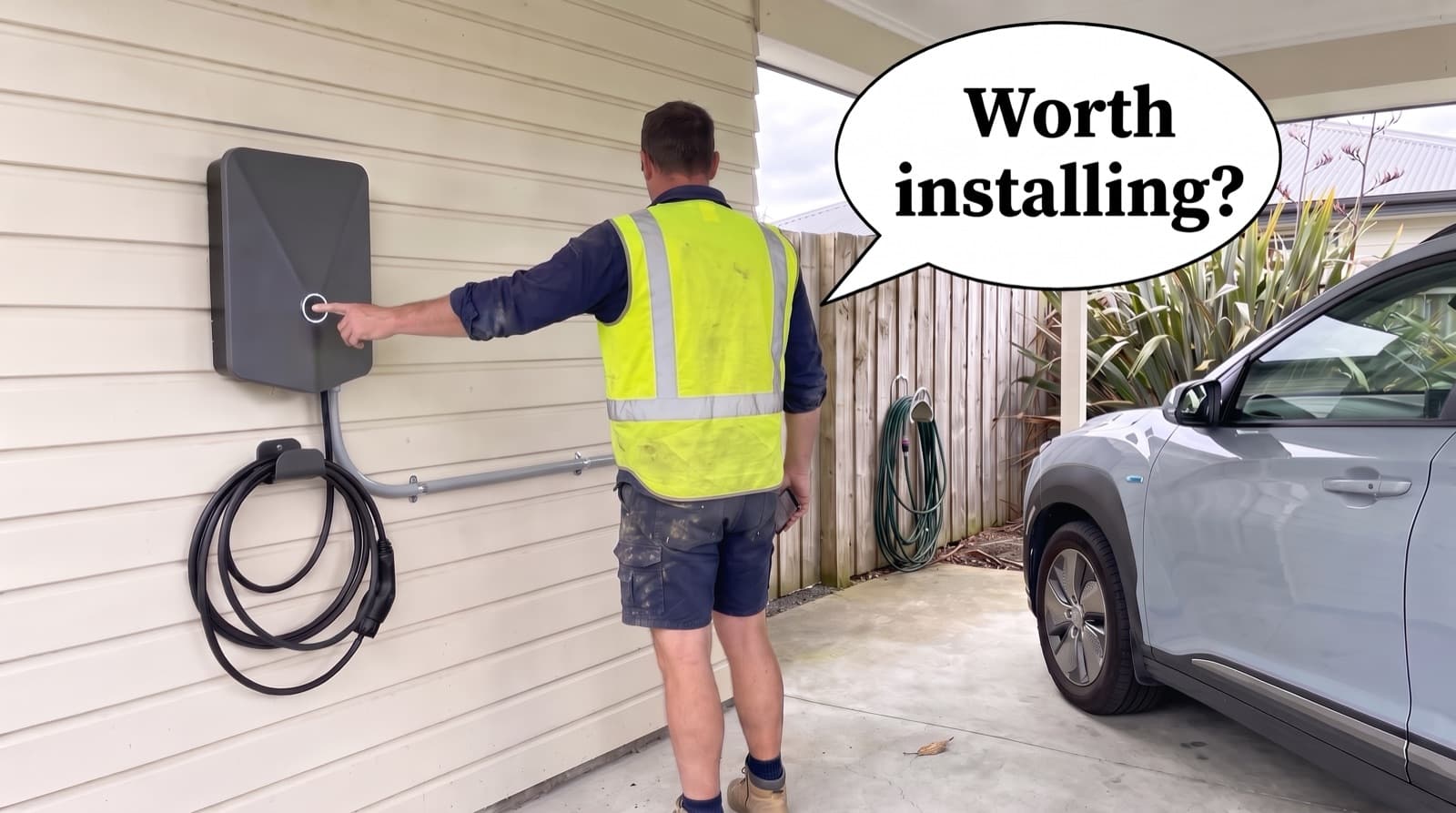
- Evnex publishes fixed installed prices of $1,835 to $2,385 for its 7.4 kW home chargers, and Tesla puts a straightforward installation at $750 to $1,500 on top of its $850 Wall Connector. A switchboard upgrade adds about $800 to $4,000.
- A wall charger must be installed by a licensed electrician, on its own circuit with a Type B RCD or an approved equivalent, and you should receive a Certificate of Compliance within 20 days.
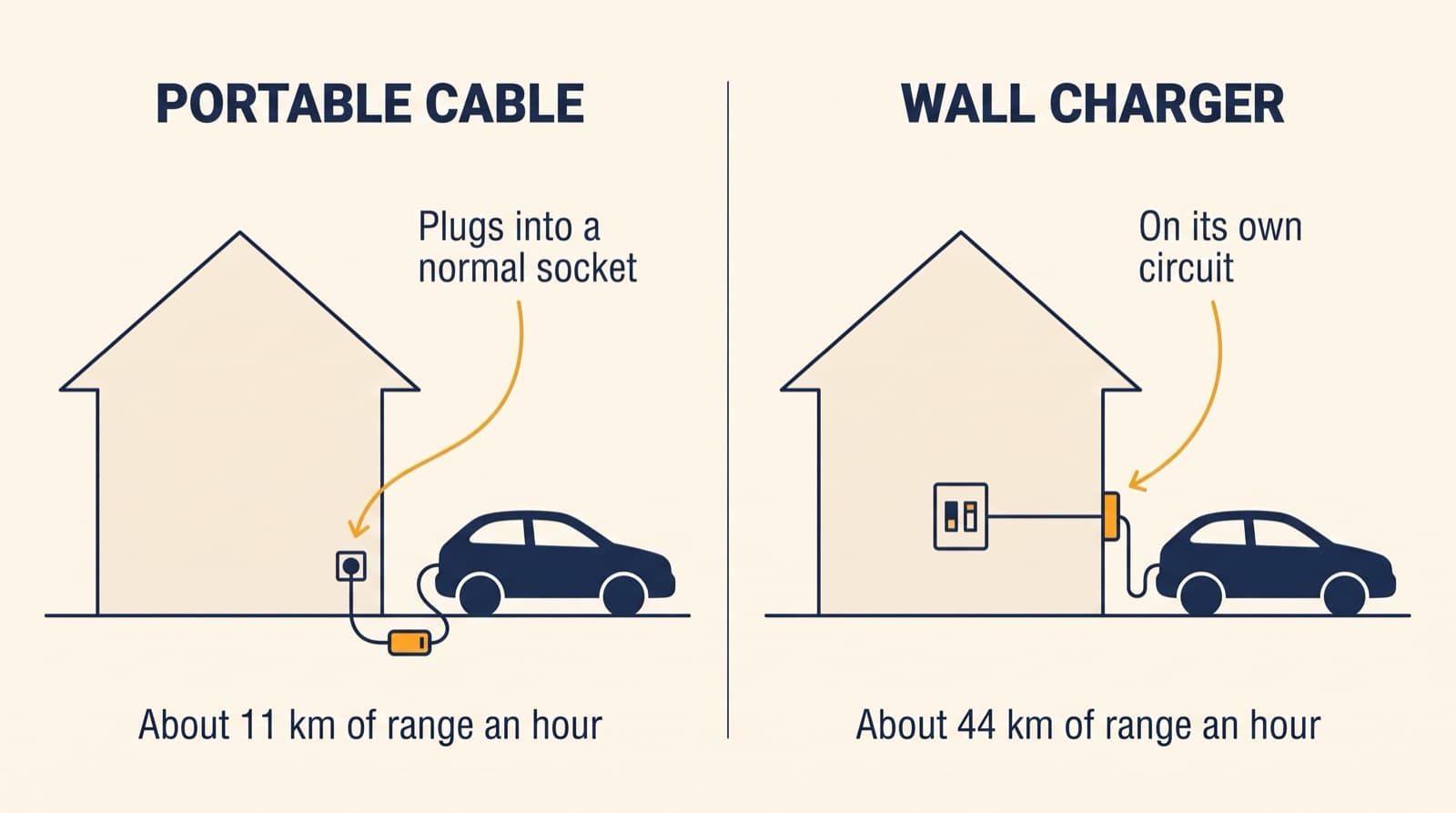
- A portable charger on a normal 10 amp socket is limited to 8 amps, about 11 km of range an hour, against about 44 km an hour from a 7.4 kW wall charger (Standards NZ).
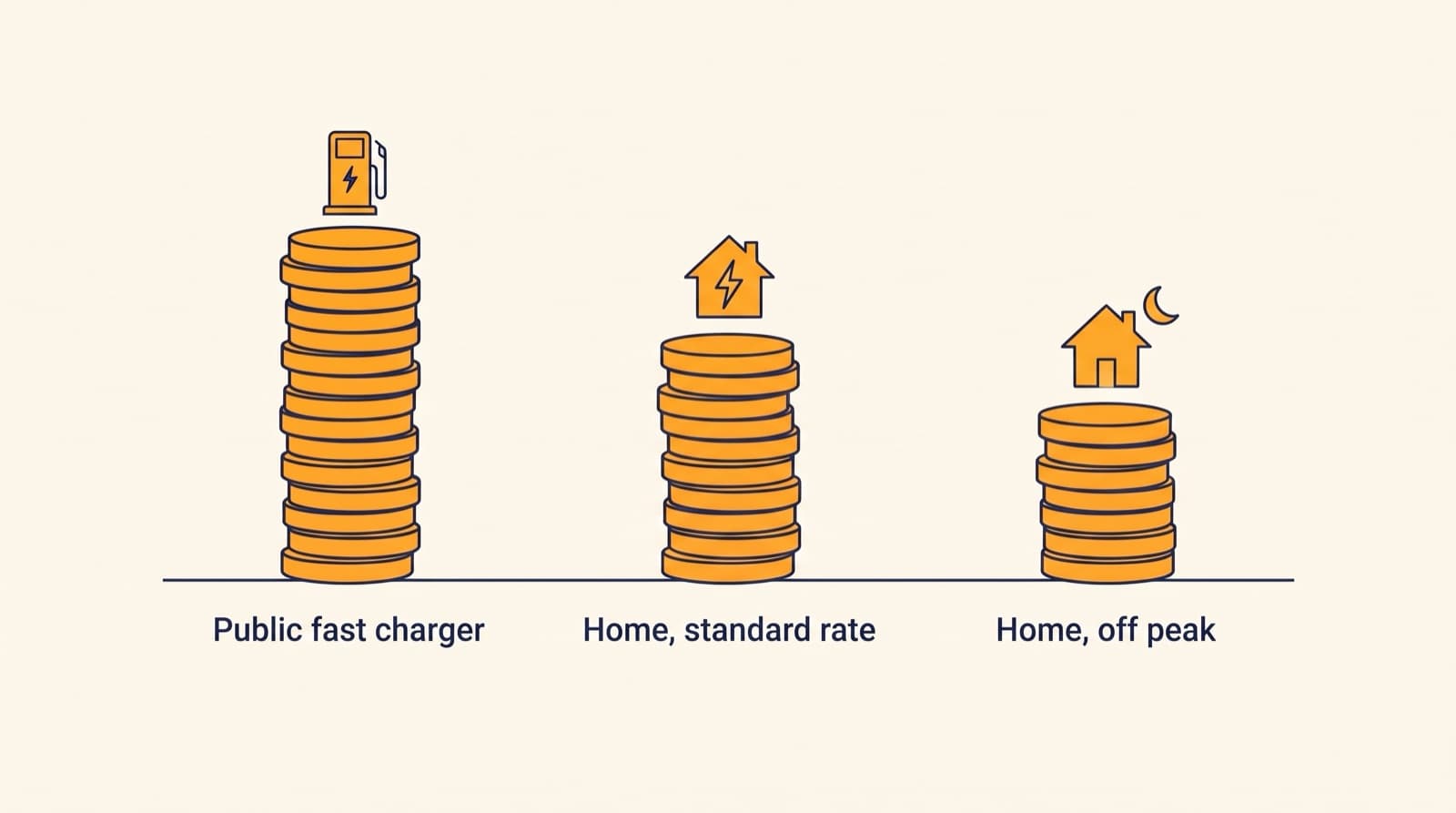
- Charging at home off-peak costs about $11 per 100 km including road user charges, against $19 at a public fast charger, on EECA's figures.
- There is no government subsidy for home EV chargers in 2026, but ANZ, ASB, BNZ and Westpac green loans list EV chargers as eligible.
Most EV owners in New Zealand charge at home. In EECA's 2025 charging research, people who charge at home do about 80% of their charging there, and 47% of them use a dedicated wall charger rather than, or as well as, the portable cable that came with the car.
This guide covers what a wall charger costs to buy and install, who is allowed to fit one, what your lines company needs to know, and how to choose between them. We don't sell chargers or install them. Every price below is dated and sourced, because the published figures disagree more than you would expect.
Do You Need a Wall Charger?
Not necessarily. Almost every EV can charge from a normal socket with a portable cable, and for short daily driving that can be enough. The limit is speed. WorkSafe's EV charging guidelines cap a portable charger on a standard 10 amp plug at 8 amps, or 10 amps only where the plug senses the temperature of its pins. That is about 1.8 kW, which Standards NZ puts at roughly 11 km of range for every hour the car is plugged in.
A single-phase wall charger runs at up to 7.4 kW (32 amps): about 44 km of range an hour on the same figures, or around 10 hours from flat to full. EECA's rule of thumb is that a smart wall charger is at least three times faster than a three-pin plug.
There is a middle option. An electrician can fit a 15 amp socket or a 16 amp caravan socket, either of which lets a portable charger run at 12 amps. Since January 2026, WorkSafe's guidance also allows a 32 amp socket for a 32 amp portable charger, but only after a maximum-demand check of the house, and it recommends load management alongside it.
Whatever you use, plug it straight into the wall. WorkSafe lists extension leads, adaptors, multi-boxes and cable reels among the unsafe ways to charge an EV.
How Fast: 7, 11 or 22 kW
Source: Standards NZ, SNZ PAS 6011:2023, Table 1. Those speeds only happen if the car can take them. Every EV has an onboard charger that sets its own ceiling for AC charging: around 3.6 kW on older EVs and up to 11 kW on newer ones. A 22 kW charger connected to a car with an 11 kW onboard charger charges at 11 kW, so check your car's AC charging rate before paying for more than it can use.
The faster chargers also need three-phase power, and the standard home supply on most networks is single phase. Adding phases is a job for your lines company and is quoted individually. What each network asks before a charger goes in is under installing one, below.
What a Home Charger Costs
There are two costs: the charger, and fitting it. The chargers in the table below list from $849 to $2,454 before installation.
Hardware only, as listed on 1 October 2026. Prices move, so check before you buy. Retailer prices come from NZ shops we do not name. Several shops also sell their own-brand 7 kW chargers, from $549 to $949. “On EECA's list” means EECA's approved smart charger list as its files stood on 18 August 2026. Listing is voluntary, so a charger that is not on it has not failed anything.
Fitting it depends mostly on your switchboard and how far the charger is from it. Two makers publish installed prices for a standard job. Evnex's 7.4 kW chargers cost $1,835 to $2,385 fully installed, and Tesla puts a straightforward installation at $750 to $1,500 on top of its $850 Wall Connector. EECA's figures put the charger higher than today's list prices: $1,000 to $1,500 for the unit, plus $500 to $1,000 to install it. Every published figure we could source, side by side:
The sources agree on what moves the price: the distance from the switchboard to the charger, whether the switchboard has room and capacity, how the cable gets there (through a roof space, or trenched across a section), and whether you need load management or a bigger supply. Price guides published by NZ electricians put a switchboard upgrade alone at about $800 to $4,000.
Ask for a fixed price after the electrician has seen your switchboard and where the car parks. A photo of the switchboard with its door open, and one of where the charger would go, helps them price it.
Thinking about solar too?
Compare up to 3 solar quotes from vetted local installers. It’s free, with no obligation.
Compare up to 3 quotesSmart Chargers and EECA's List
A smart charger connects to the internet, so it can be scheduled, controlled from an app, and told by a power company or network when to slow down. In EECA's 2025 research, 53% of people with a wall charger said theirs was smart.
EECA keeps a voluntary list of approved smart chargers. To qualify, a charger must run the open charging protocol OCPP (version 1.6 or later), keep charging if its connection drops, show the owner how much energy it uses, and by default wait a random delay of up to 10 minutes before it starts. Being on the list is voluntary and the maker has to apply, so a charger that is not on it has not failed a test. Tesla's and Evnex's home chargers are not on it.
Smart chargers are about to become a requirement. On 5 May 2026 the government decided that new EV chargers above 2.4 kW sold in New Zealand will have to meet minimum smart functions and carry a label, and EECA consulted on the technical rules until 4 September 2026. It is not law yet: it needs a change to the Energy Efficiency and Conservation Act, and no start date has been set. The rule is about the chargers that are sold, not about you, and MBIE says it would not force anyone to install a smart charger.
The government's reason is peak demand. It says unmanaged charging could increase a household's peak demand by up to 40%, and that smart charging could save households up to $220 a year by 2050.
Choosing a Charger
There is no single best charger, only one that fits your car, your house and whether you have solar. Work through it in this order:
- Your car's onboard charger. If the car takes 7 kW, a 22 kW charger buys you nothing today.
- Your supply. A single-phase home suits a 7.4 kW charger. Three phase opens up 11 and 22 kW, if the car can use them.
- Solar. If you have panels or plan to, choose a charger that can follow your surplus. Most need a CT clamp or a meter to see what the house is exporting, and some only do it with the same maker's battery.
- Your switchboard. If it is near its limit, choose a charger with overload protection, which slows charging while the house is busy.
- Fixed cable or socket. A fixed cable is simpler day to day. A socket means using your own cable, which lets one charger suit cars with different plugs.
- Warranty and support. The chargers in our table carry 3 to 4 year warranties where the maker publishes one. Ask who handles a fault in New Zealand.
- The Supplier Declaration of Conformity. EV chargers are a declared medium-risk product, so they can't be sold here without one. Ask the seller for it: they have to give it to you within 10 days.
Installing One
Fitting a wall charger is prescribed electrical work, so it must be done by an electrician who is registered and holds a current practising licence. You can check a licence with the Electrical Workers Registration Board. WorkSafe's advice to homeowners is plain: a wall-mounted charger must be installed by a registered electrician.
WorkSafe's guidelines ask for the charger on its own circuit from the switchboard, wired in rather than plugged in, with a lockable isolating switch. Outdoors it needs a weatherproof rating of at least IPX4, and in a garage it should be kept out of any area where petrol vapour can collect. Standards NZ suggests mounting it near where the car's charging port ends up, with its controls between 0.75 and 1.2 metres off the ground.
The circuit also needs protection that can detect the kind of fault an EV charger can produce. Since WorkSafe's January 2026 addendum, that means one of three things: a Type B RCD on the circuit, a Type A RCD paired with a DC fault detector (an RDC-DD), or a charger with a Type B RCD built in. The common Type A RCD on its own is not enough.
The electrician should check that your incoming supply can carry the extra load. The Electrical Workers Registration Board tells installers to check this especially above 15 amps, and to upgrade the mains or use smart charging control where the supply falls short.
When the work is finished you should receive a Certificate of Compliance within 20 days, and an Electrical Safety Certificate once the charger is connected. Keep both, because insurers and buyers can ask for them. An inspection by a second electrician is only needed for high-risk work, such as work on the mains.
Can you do it yourself? Not the charger. The law's homeowner exemption lets an owner-occupier do limited wiring that a licensed person then tests, certifies and connects, but WorkSafe says a wall charger must be installed by a registered electrician, and tenants and landlords can't do electrical work themselves at all.
On consents: no building consent rule names home EV chargers, and the Electrical Safety Certificate is what records that the electrical work meets the Building Code. If the job includes building work, such as a new carport, ask your council. Under planning rules, a private charger has been a permitted activity since 7 May 2026, so it needs no resource consent. One more date: from 13 November 2026, new chargers must meet the EV charging standards now written into the Electricity (Safety) Regulations. Chargers already installed are not affected.
Tell your lines company
Standards NZ's guidance tells installers to check what the local lines company wants, and the networks differ. These eight publish something specific:
If your network is not listed, ask your electrician to check with it before the job is booked.
Pair it with solar
Compare up to 3 solar quotes from vetted local installers. It’s free, with no obligation.
Compare up to 3 quotesWhat It Costs to Run
Charging at home is the cheapest way to run an EV. On EECA's figures, which include road user charges, it costs about $11 per 100 km charging at home off-peak, $14 at home on a standard rate, and $19 at a public fast charger.
Road user charges are part of that: $76 per 1,000 km for a battery EV and $38 for a plug-in petrol hybrid, which EVs have paid since 1 April 2024 (NZTA).
The saving comes from charging overnight. The Electricity Authority now requires the four large retailers to offer time-of-use plans, and it says about 70% of EV owners already charge overnight. Ask your retailer when its cheaper rate starts, set the charger or the car to begin after it, and compare plans on Powerswitch.
Charging From Your Own Solar
If you have solar panels, a charger that follows your surplus can fill the car with power you would otherwise export. On a single-phase home it needs about 1.4 kW of spare solar before it starts, because a car won't charge below 6 amps. Chargers that switch between one and three phases can start from about 1.38 kW.
How much solar that takes, and what it saves per kilometre, is in our guide to charging an EV from your own solar panels.
Renters, Apartments and Body Corporates
If you rent, a wall charger is a fixture, so you need your landlord's written consent, and Tenancy Services says a landlord can't unreasonably withhold it. Agree before the work starts who owns the charger when you leave: a fixture left behind becomes the landlord's unless you have agreed otherwise.
In a unit-title building, the body corporate can meter a car park and charge the owner for the EV's power, at the price the body corporate pays, under the Unit Titles Act. Buildings on one shared connection come under Standards NZ's commercial guidance, SNZ PAS 6010.
Powering the House From the Car
Two-way charging, where the car sends power back to the house (V2H) or the grid (V2G), is in trials in New Zealand, not yet in ordinary homes. Any two-way charger has to meet the same standard as a solar inverter, AS/NZS 4777, and lines companies treat it as generation that needs their approval first.
EECA says only two chargers available here meet New Zealand's requirements, both DC units, and one works only with the same maker's home battery system. Most car makers support two-way charging here only in approved trials, and EECA is running one in Queenstown with 30 to 40 chargers during 2026. If a charger is sold to you as V2H-ready, ask for the car maker's approval in writing.
Is There a Subsidy?
No. There is no government subsidy for home chargers in 2026. EECA's funding page for homes lists only Warmer Kiwi Homes, and the Energy Minister has said EV uptake is growing “without unnecessary subsidies from taxpayers”. We found no council, lines company or retailer rebate either.
What does exist is cheaper borrowing. ANZ, ASB, BNZ and Westpac green loans all list EV chargers as eligible; Kiwibank's sustainable energy loan does not. Rates and terms are in our green loan guide. Some chargers also come with the car: in EECA's research, 20% of dedicated home chargers came free with the vehicle.
Common Questions
How much does it cost to install an EV charger at home in NZ?
Evnex publishes fixed installed prices of $1,835 to $2,385 for its 7.4 kW home chargers, and Tesla puts a straightforward installation at $750 to $1,500 on top of its $850 Wall Connector. The price rises with the distance from the switchboard, the cable route and the state of the switchboard itself: price guides published by NZ electricians put a switchboard upgrade alone at about $800 to $4,000. EECA's figures are $1,000 to $1,500 for a charger plus $500 to $1,000 to install. Ask for a fixed price after an electrician has seen your switchboard.
What is the 80% rule, and should I charge to 100% every night?
The 80% rule is advice to stop charging at about 80%. EECA gives it for public fast chargers, because the last 20% of a battery takes longer to charge. For everyday charging at home, the right limit depends on your car's battery, and car makers do not all give the same advice, so use the limit your car's manual or app recommends. Most EVs and many smart chargers let you set one.
Can any electrician install an EV charger?
Any electrician who is registered and holds a current practising licence can install a home wall charger, because it is prescribed electrical work. You can check a licence with the Electrical Workers Registration Board. The electrician should put the charger on its own circuit with the right RCD, check your supply can carry the load, and give you a Certificate of Compliance within 20 days.
What is the best home EV charger in NZ?
There is no single best charger. The right one depends on your car, your supply and whether you have solar. Check your car's onboard charger first, because a 22 kW unit charges no faster than the car accepts. Then decide whether you want to charge from surplus solar, which usually needs a CT clamp or meter, and whether your switchboard needs overload protection. Compare warranties and New Zealand support, check EECA's approved smart charger list, and ask the seller for the Supplier Declaration of Conformity.
Is a 7 kW charger worth it over a 3 kW one?
A 7.4 kW charger adds about 44 km of range an hour, against about 22 km for a 3.7 kW circuit, on Standards NZ's figures: twice as much over the same night. If your daily driving is short, the slower circuit or even the portable cable may cover it. EECA recommends wiring a new charger circuit to carry 32 amps anyway, because it future-proofs the installation.
Can I install an EV charger myself?
Not a wall charger. WorkSafe says a wall-mounted charger must be installed by a registered electrician. The homeowner exemption in the Electricity Act lets an owner-occupier do limited wiring that a licensed person then tests, certifies and connects, but it does not cover connecting the work, and tenants and landlords cannot use it. What you can do yourself is plug a portable charger into a suitable socket.
Can I charge my EV from a normal wall socket?
Yes, with a portable cable, but slowly. WorkSafe's guidelines limit a portable charger on a normal 10 amp plug to 8 amps, about 1.8 kW or roughly 11 km of range an hour on Standards NZ's figures. Plug it straight into the wall, never through an extension lead, adaptor or multi-box. An electrician can fit a 15 amp socket or a 16 amp caravan socket, which lets a portable charger run at 12 amps.
Can I get a free EV charger or a subsidy in NZ?
There is no government subsidy for home EV chargers in 2026. EECA's funding page for homes lists only Warmer Kiwi Homes, and we found no council, lines company or retailer rebate. ANZ, ASB, BNZ and Westpac green loans list EV chargers as eligible, and Kiwibank's does not. Some chargers come with the car: in EECA's 2025 research, 20% of dedicated home chargers came free with the vehicle.
How long does a home EV charger last?
EECA gives a technology lifespan of 10 to 15 years for a smart home charger. Warranties are shorter: the chargers in our table carry 3 to 4 year warranties where the maker publishes one.
How much does it cost to charge an EV at home in NZ?
About $11 per 100 km off-peak, or $14 on a standard rate, including road user charges, on EECA's figures. A public fast charger works out at about $19 per 100 km. The road user charge alone is $76 per 1,000 km for a battery EV and $38 for a plug-in petrol hybrid. Charging overnight on a time-of-use plan is what gets you to the lower figure.
Next steps for your solar journey
Related guides
View all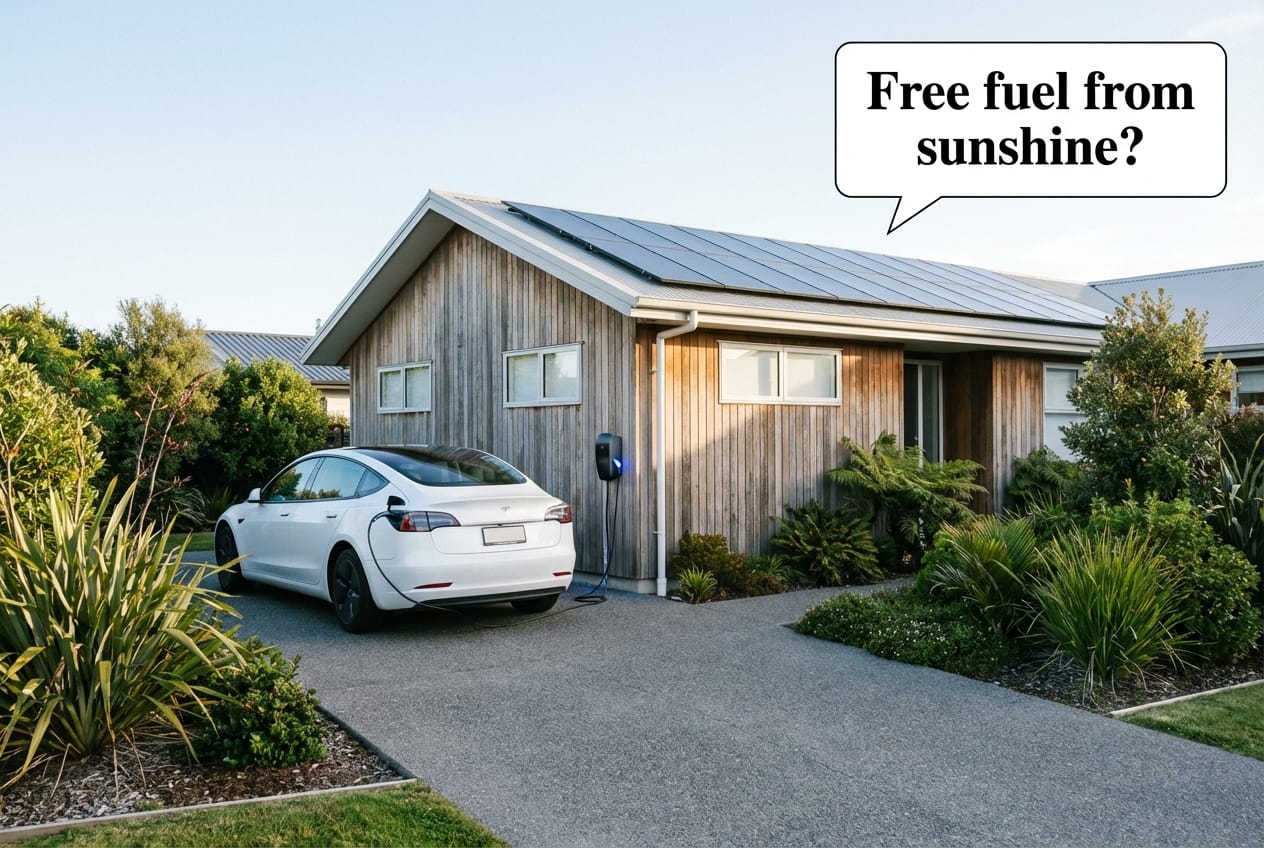
Solar Panels and EV Charging in NZ: The Complete Setup
How to charge your EV with solar in NZ. Smart charger options, how much solar you need, and the real cost per kilometre.
Read
Solar Battery Storage NZ: Powerwall 3 Price and Is It Worth It?
Solar battery prices in NZ: Tesla Powerwall, BYD, Enphase compared. When batteries make sense and when you're better off without one.
Read
Sigenergy SigenStor Review NZ: Price vs Powerwall 3 (2026)
Sigenergy SigenStor review for NZ: stackable 5 to 9 kWh modules, 98.3% efficiency, ~$9,124 supply-only pricing, the Powerwall 3 comparison, and the 2025 safety recall.
Read
Best Solar Buy-Back Rates NZ: 13 Retailers Compared (2026)
Compare solar buy-back rates across 13 NZ power companies. Octopus, Meridian, Mercury, Genesis, Contact, Power Edge and more.
Read
Solar Panel Costs NZ: What You'll Actually Pay in 2026
Real pricing data for NZ solar in 2026. System costs by size, what affects price, and how to tell if a quote is fair.
Read
How Many Solar Panels Do I Need in NZ?
Work out how many solar panels your NZ home needs. Based on your power usage, roof space, and whether you're adding a battery or EV charger.
Read
Join the conversation
The best comments are honest ones: Real experience. Share yours, please stay civil and on topic. No self-promo links.
Your email is never shown or shared. To change or remove a comment later, .
No comments yet. What is your experience with this? Be the first to weigh in.