
Hot Water Heat Pumps NZ:
Cost, Savings and How to Choose

Key Takeaways
- EECA puts a hot water heat pump at around $7,000 including purchase and installation. In EECA's 2025 trial of 84 homes, all-in-one systems averaged $7,500 plus GST installed and split systems $10,800 plus GST.
- Swapping an electric cylinder for a heat pump saves a household of three $285 to $436 a year depending on the city, on EECA's own model at February 2026 prices.
- EECA's installer guide says replacing a working water heater with a heat pump is unlikely to pay for itself. The time to switch is when your cylinder is near the end of its life, and around 46% of homeowners with an electric cylinder say it is more than 10 years old.
- The saving grows with the household: in Auckland it is $138 a year for one person and $675 for six. Households of one or two, or that use very little hot water, are unlikely to save enough to justify the cost.
- Heat pump water heaters are not regulated for energy efficiency in NZ: there is no mandatory testing, label or minimum standard. Compare how cold each model runs to and how loud it is for your site, not the COP on the box.
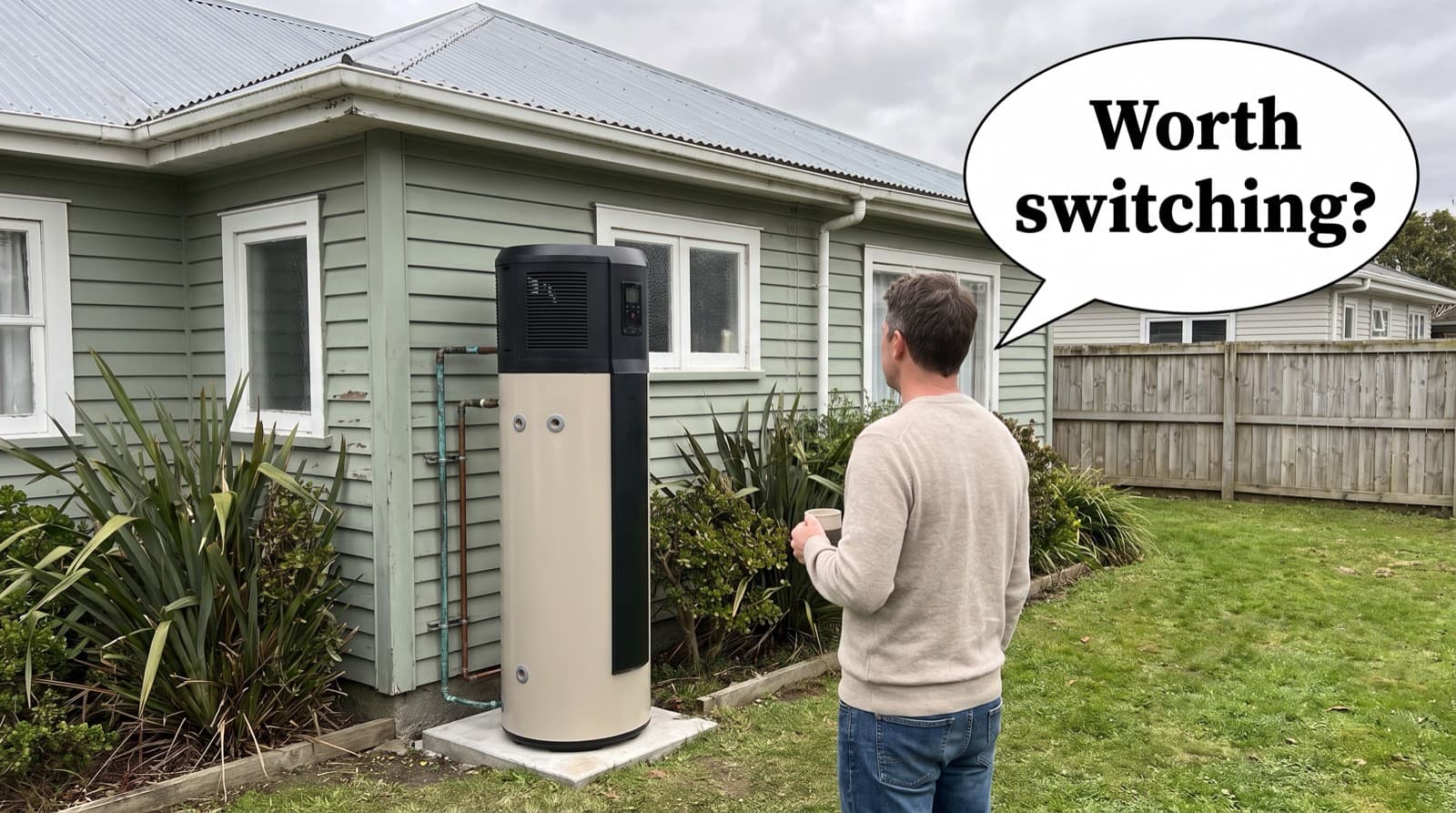
A hot water heat pump heats your water the way a fridge keeps food cold, in reverse: it pulls warmth out of the outside air and moves it into the tank. EECA says a hot water heat pump uses around 60 to 75% less electricity than a conventional electric system.
What the brochures leave off: it costs more than a normal cylinder to buy, it saves the most in homes that use the most hot water, and EECA's own installer guide says pulling out a cylinder that still works rarely pays. This guide covers what they cost in NZ, what they save city by city, all 44 models from 17 makers on sale here, and plainly when one is not worth it. We do not sell hot water heat pumps.
The Short Answer
For most households that are replacing a dying cylinder, leaving gas, or using a lot of hot water, yes. EECA puts a hot water heat pump at around $7,000 including purchase and installation. A straightforward all-in-one swap is about $6,000 to $9,000 in installers' published prices, and it saves a typical family several hundred dollars a year.
It rarely pays for one or two people who use little hot water, or as a swap for a cylinder that still works. And because nothing regulates their efficiency in NZ, the claims on the box need reading carefully. The rest of this guide shows the numbers behind each of those points.
What It Is, and What It Isn't
A hot water heat pump is a hot water cylinder with a small heat pump attached, either built onto the top of the tank (all-in-one) or in a separate outdoor unit piped to it (split). A fan draws outside air across a coil, the heat pump concentrates that warmth, and it heats the water. An electric element usually sits in the tank as a backup.
It is not the heat pump on your lounge wall, which heats rooms and has nothing to do with your hot water. It is also not solar hot water: that heats water with roof panels, and our solar hot water guide covers it.
They are still rare. EECA estimates hot water heat pumps make up only about 1% of NZ water heaters. Of the 2,015 homeowners who asked SolarScout for solar quotes between February and September 2026, 5% already heat their water with one.
How It Works, and What COP Means
A heat pump's efficiency is its COP, the coefficient of performance: the units of heat it delivers for each unit of electricity. An element is 1: one unit of power in, one unit of heat out. EECA says an acceptable COP is at least 3, and better products reach 4 or more.
The catch is where that number comes from. Makers mostly quote COP at 19°C air. Auckland averages 15.2°C across a year and Central Otago 9.6°C. A heat pump works harder in cold air, so the figure on the box is higher than most NZ homes will see across a year. EECA's own model, recalibrated on its field trial in June 2026, assumes about 3.2 in Central Otago to 3.9 in Wellington.
The COP on the box is a lab figure at 19°C. What you get depends on your winters, your hot water use and the install.
What It Costs in NZ
EECA puts a hot water heat pump at around $7,000 including purchase and installation. The fuller picture comes from three sources that do not depend on each other: EECA's own trial, installers' published prices, and what homeowners report paying.
The unit is often less than half the bill. Installation covers the plumbing, an electrician's connection, removing the old cylinder, and anything the site needs. Installs in EECA's coldest climate zone cost about $1,500 more, and EECA walked away from two quotes of $15,000 to $20,000.
What pushes the price up
- A split system rather than an all-in-one
- A cold climate, which needs a bigger system
- Moving an indoor cylinder outside, or re-routing pipes on a two-storey house
- A new electrical circuit or switchboard work
- Going from low to mains pressure, which can need new taps and shower mixers
- No drain near the unit for the condensate
- Disconnecting gas, which some homeowners report paying extra for
EECA publishes a 13-point checklist for homeowners, including getting two itemised written quotes.
Thinking about solar too?
Compare up to 3 solar quotes from vetted local installers. It’s free, with no obligation.
Compare up to 3 quotesRunning Costs and Savings by City
- Piped gas cylinder: $716 a year
- Electric cylinder: $533 a year
- Bottled gas: $532 a year
- Piped gas instant: $278 a year
- Hot water heat pump: $186 a year
We ran EECA's own savings model, the one behind its public calculator, for 21 cities, four current systems and households of one to six people. For three people with average use:
Yearly saving on running costs from switching to a hot water heat pump, for three people with average hot water use. Calculated by SolarScout with EECA's open-source Home Efficiency Calculator (the model behind EECA's own savings calculator), at its February 2026 power and gas prices, run 1 October 2026. Fixed daily charges are not included: a home that disconnects gas entirely also stops paying the gas connection charge. The South Island has no natural gas network, so its table has no piped gas columns.
One column stands out. An efficient piped gas instantaneous heater is cheap to run, so on running costs alone a heat pump saves those homes only $92 to $166 a year. Their bigger saving is the daily gas connection charge, and that only goes if the heat pump lets you disconnect gas completely, with no gas hob or heater left.
Is It Worth It?
It depends mostly on how much hot water your home uses, and on whether you are replacing something that has already failed.
Auckland, average hot water use, running costs only. EECA's open-source model at its February 2026 prices, run 1 October 2026.
- Worth it: your cylinder is near the end of its life, you have three or more people, or you are leaving gas or bottled LPG.
- Probably not: your cylinder works fine, or it is one or two of you using little hot water. EECA found most systems oversized for households using less than 100 litres of hot water a day, which cuts their performance.
- Check first: if your current cylinder heats on a cheap controlled or night rate, the saving is smaller, because a heat pump works best in daytime warmth.
All-in-One or Split
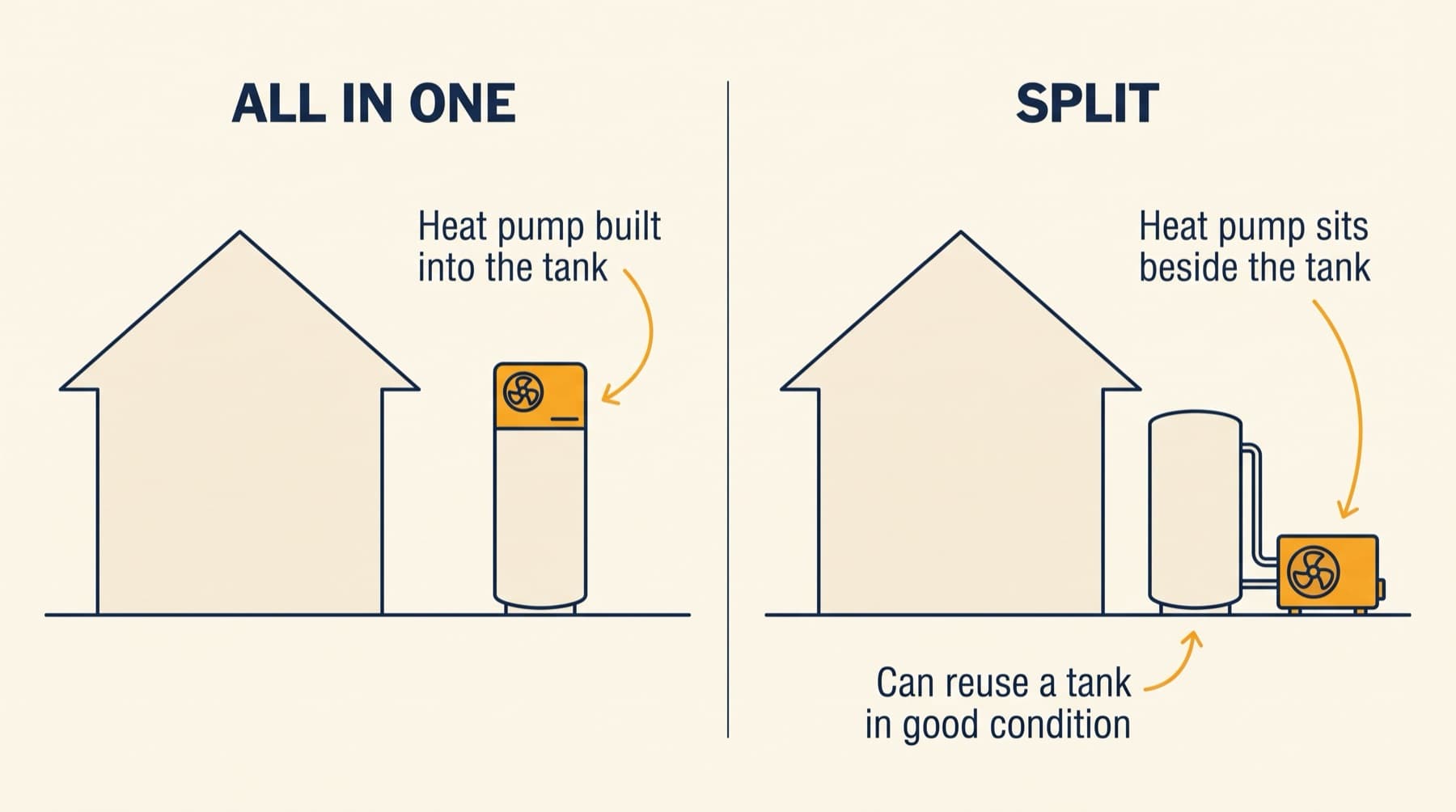
An all-in-one unit has the heat pump built into the top of the tank and goes outside, usually on a small concrete pad. A split system puts the heat pump in its own outdoor box, piped to a tank that can sit inside or out, and some can connect to a cylinder you already have.
EECA has so far seen no significant difference in performance between all-in-one and split systems. Split systems cost more: in the same trial they averaged $10,800 plus GST installed against $7,500 for all-in-one units. A split makes most sense when your cylinder is in good condition, or when there is no room outside for a tall tank.
Every Model on Sale in NZ
These are the 44 models we could confirm on sale in New Zealand, from 17 makers, with each maker's own figures. We do not rank them: the makers test in different conditions, and the right one depends on your house.
Each maker's own figures from its NZ spec page or datasheet, checked 1 October 2026. Makers test at different air and water temperatures, so a higher COP here is not proof of a better heat pump. Where a maker's own pages disagree, we show both. Heat pump water heaters have no mandatory efficiency testing in NZ.
How to Choose One for Your House
Size it for your hot water, not your house
EECA sizes by how much hot water a home uses a day. Its guide for installers gives these rough figures, and notes that a tank can supply more in a day than it holds:
A heat pump reheats more slowly than an element, so size up rather than down, especially in a cold climate or if you are replacing gas.
Check it runs in your winters
EECA gives installers a design low temperature for each region. It is a typical winter low, not an extreme one, because a heat pump can do its heating in the warmer hours of the day. Pick a model rated to run below yours without leaning on its backup element. In a sunless or damp valley, allow 1 or 2 degrees lower.
Put it where the noise won't matter
They generally run at around 40 to 55 dB, about a library to moderate rain. EECA's guide says, ideally, not within 2 metres of a bedroom or 3 metres of a neighbour's window. Councils set noise limits at the boundary, and they are lower at night.
Look past the COP
- Refrigerant: Early trial results put R134a units lowest and CO2 and R32 units best, with R290, the most common, in the middle. R134a is being phased out in NZ.
- Warranty: check the years on the heat pump itself, not just the tank, and what counts as keeping it valid. Most makers require a service every 12 months to keep the warranty.
- Controls: a timer lets it run in the warmest part of the day, or on your own solar.
The Downsides, Plainly
- Upfront cost. EECA puts a new electric cylinder at around $4,000 installed, against around $7,000 for a hot water heat pump.
- Noise. A fan and a compressor run outside, sometimes at night.
- Cold weather. Efficiency drops as the air gets colder, and below its rated minimum the backup element does the work.
- Slower to reheat. A big evening of showers can take hours to recover from, so undersizing hurts.
- More to maintain. Moving parts, an annual service, and cheaper compressors can fail in 5 to 7 years.
- Installer skill varies. EECA's trial found set-up steps missed and some poor installs.
- The water may feel less hot. Hot water at showers, baths and basins in a house is capped at 50°C under the Building Code's acceptable solution, since 2 November 2024.
Switching From Gas or LPG
How much you save depends on the kind of gas heater you have. A piped gas cylinder is the dearest way to heat water in EECA's model, so replacing one saves the most: $530 to $686 a year for three people. Bottled gas saves $319 to $490. A piped gas instantaneous heater is cheap to run, so it saves only $92 to $166.
Installers in EECA's trial found gas instantaneous heaters especially easy to replace, because the power and plumbing were already in place outside the house, though the wiring sometimes needed upgrading. The real prize is the gas connection itself, which the running costs above leave out. Take gas out completely and the daily charge goes too. Keep a gas hob or heater and you keep paying the gas daily charge.
Among the homeowners who ask us for solar quotes, gas hot water is common, especially in Wellington:
2,015 NZ homeowners who asked SolarScout for solar quotes between February and September 2026, regions with 60 or more answers. These are people shopping for solar, not a census. "Gas" covers piped gas and bottled LPG.
Installation, Consent and Who Does It
Replacing a water heater with a heat pump, or moving it from inside to outside, needs no building consent when an authorised plumber does it. A brand new or additional system does need consent. Adding a split heat pump to an existing cylinder is a grey area: MBIE's own pages disagree, so check with your council first.
Consent or not, the work has to meet the Building Code. That means seismic straps on the tank, a tempering valve so the hot water at your taps is not too hot, and a tank that stores at 60°C or more to keep legionella out.
- A registered plumber for the plumbing. Replacing a cylinder is restricted work.
- A registered electrician to wire it in and issue a certificate of compliance.
- A gasfitter if gas is being capped off.
Never put a heat pump water heater on ripple control unless its maker says it can take it: some compressors are damaged by the power cuts.
Hot Water Heat Pumps and Solar
A heat pump and rooftop solar work well together: set its timer to run through the middle of the day and it heats your water on your own power, when the air is warmest too. A solar hot water diverter is the wrong tool here, because it drives an element, not a compressor. Our buy-back rates guide explains why using your own solar beats exporting it.
If your panels are still to come, the order matters less than the timing: replace the cylinder when it is due, and set the heat pump to run in the day.
Pair it with solar
Compare up to 3 solar quotes from vetted local installers. It’s free, with no obligation.
Compare up to 3 quotesGrants, Rebates and Loans
There is no national subsidy for hot water heat pumps in NZ. Warmer Kiwi Homes funds insulation and wall heat pumps, not water heating, and the council rates schemes that once covered them are closed to new applicants.
What you can get is a cheap home loan top-up. Several banks name hot water heat pumps on their own pages:
Each bank's own product page, read 1 October 2026. Every one is a top-up to a home loan with that bank, and banks change these offers without notice: check the page before you apply.
For the wider picture, see our green loans comparison.
Common Questions
How much does a hot water heat pump cost in NZ?
EECA puts a hot water heat pump at around $7,000 including purchase and installation. In EECA's 2025 trial of 84 homes, all-in-one systems averaged $7,500 plus GST installed and split systems $10,800 plus GST. Installers' published prices for a straightforward all-in-one swap run about $6,000 to $9,000 including GST. Moving the cylinder or a complex job can reach $13,000.
Are hot water heat pumps worth it?
Usually yes when your cylinder is near the end of its life, you have three or more people, or you are leaving gas or bottled LPG. On EECA's own model, a household of three switching from an electric cylinder saves $285 to $436 a year depending on the city. EECA's installer guide says replacing a working water heater with a heat pump is unlikely to pay for itself.
What are the downsides of a hot water heat pump?
EECA puts a new electric cylinder at around $4,000 installed, against around $7,000 for a hot water heat pump. They also make some noise outside, they lose efficiency in cold weather, they reheat more slowly than an element, and they need servicing. EECA's trial also found installer skill varied. None of these rules one out, but each is worth planning for.
Which hot water heat pump is best in NZ?
There is no single best one. Match the tank to your daily hot water use, choose a model rated to run below your region's winter lows, check the noise figure against where it will sit, prefer a low-impact refrigerant, and compare the warranty on the heat pump itself. The table above lists every model on sale here with each maker's own figures.
How long do hot water heat pumps last?
EECA gives a lifespan of around 15 years, and its installer guide says cheaper compressors can fail at around 5 to 7 years. Most makers require a service every 12 months to keep the warranty.
Is a heat pump cheaper to run than gas hot water?
EECA says hot water heat pumps can be around 60% cheaper to run than an electric cylinder or piped gas, and 75% cheaper than LPG. The exception is an efficient piped gas instantaneous heater: on running costs alone a heat pump saves those homes $92 to $166 a year on EECA's model, so the real saving is the gas connection charge if you disconnect entirely.
Do hot water heat pumps work in cold places like Central Otago?
Yes, if you choose one rated for your winters. Many models run down to -7°C and some to -10°C or -15°C, while EECA's design low for Central Otago is -5 to -4°C. Efficiency still drops in the cold, so size up and expect the backup element to help on the coldest mornings.
Are hot water heat pumps noisy?
They generally run at around 40 to 55 dB, about a library to moderate rain. EECA's guide says, ideally, not within 2 metres of a bedroom or 3 metres of a neighbour's window. Councils also set night-time noise limits at the boundary.
Can you run out of hot water with a heat pump?
You can if it is undersized, because a heat pump reheats more slowly than an element. Size the tank to your daily use (EECA suggests about 150 litres a day for a three-bedroom home), and size up in a cold climate or when replacing gas.
Can I keep my existing hot water cylinder?
Sometimes. A split heat pump can connect to a cylinder in good condition, which avoids buying a new tank. Adding a split heat pump to an existing cylinder is a grey area: MBIE's own pages disagree, so check with your council first.
Do I need building consent for a hot water heat pump?
Replacing a water heater with a heat pump, or moving it from inside to outside, needs no building consent when an authorised plumber does it. A new or additional system needs consent. Adding a split heat pump to an existing cylinder is a grey area: MBIE's own pages disagree, so check with your council first.
Are there grants for hot water heat pumps in NZ?
There is no national subsidy for hot water heat pumps in NZ. Several banks offer a 0 to 1% home loan top-up that names hot water heat pumps; the table above lists them with the date we checked.
Do hot water heat pumps work with solar panels?
Yes. Use the heat pump's timer to run it through the middle of the day, so it heats water on your own solar. A hot water diverter does not work with one, because a diverter drives an element, not a compressor.
How long does a hot water heat pump take to heat up?
Longer than an element: a full tank can take several hours to recover after heavy use. That is why sizing matters more than with a normal cylinder.
Next steps
Related guides
View all
Solar Hot Water NZ: What It Costs and Whether It's Worth It
Solar hot water in NZ: thermal systems run $7,000-9,000 installed and cover 50-75% of your hot water. Why most homes now do it with PV and a diverter or a heat pump cylinder instead.
Read
Best Solar Buy-Back Rates NZ: 13 Retailers Compared (2026)
Compare solar buy-back rates across 13 NZ power companies. Octopus, Meridian, Mercury, Genesis, Contact, Power Edge and more.
Read
Solar Panels and EV Charging in NZ: The Complete Setup
How to charge your EV with solar in NZ. Smart charger options, how much solar you need, and the real cost per kilometre.
Read
How to Pay for Solar in NZ: Cash, Loans and Payment Plans (2026)
Cash vs green loans vs personal loans for solar in NZ. Real monthly payments, total interest costs, opportunity cost analysis, and the gotchas banks don't mention.
Read
How Many Solar Panels Do I Need in NZ?
Work out how many solar panels your NZ home needs. Based on your power usage, roof space, and whether you're adding a battery or EV charger.
Read
Is My House Suitable for Solar Panels in NZ? (2026 Guide)
Check if your NZ home is right for solar. Roof direction, pitch, shade, and structural factors explained for Kiwi houses.
Read
Join the conversation
The best comments are honest ones: Real experience. Share yours, please stay civil and on topic. No self-promo links.
Your email is never shown or shared. To change or remove a comment later, .
No comments yet. What is your experience with this? Be the first to weigh in.